100% Pure Ghee
Made Only From Gir Cow Milk
100% Pure Ghee
Made Only From Gir Cow Milk Every Batch
Independently Lab-Tested for Purity
Every Batch
Independently Lab-Tested for Purity Free
Shipping Available Across India
Free
Shipping Available Across India Crafted Using the
Traditional Bilona Method
Crafted Using the
Traditional Bilona Method
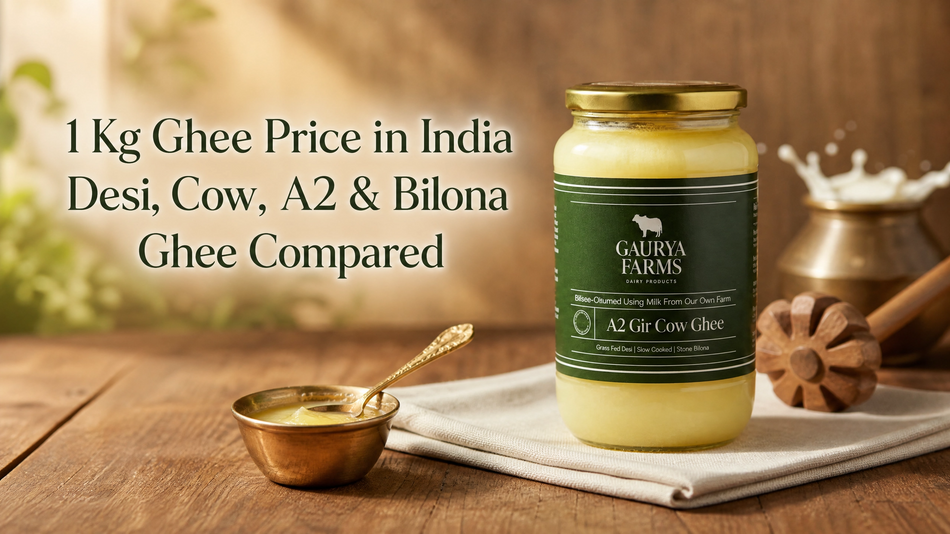
Quick Answer
The price of ghee in India varies widely because ghee covers products made from different milk sources, production methods and production scales. Mainstream ghee can sit at the lower end of the market, while premium cow, A2-positioned and traditional Bilona ghee can cost considerably more.
The useful question is not simply which ghee is cheapest? A better question is: what am I getting for the price?
Current retail listings checked in July 2026 show many mainstream 1-litre ghee products around ₹600-₹900, while premium products can be substantially higher. These are market snapshots, not fixed national price bands.
Live Gaurya Price
₹2,499
1000 ml A2 Bilona Gir Cow Ghee, verified on 14 August 2026
Milk Needed
25-30 L
Gaurya Farms production figure for 1 kg of its Bilona ghee
Process Route
Milk → Curd → Butter → Ghee
Traditional Bilona-style production journey
What Is the Price of 1 Kg Ghee in India?
There is no single market price for 1 kg of ghee. A mainstream dairy ghee, cow ghee, A2-positioned cow ghee and traditional Bilona ghee can have very different prices because they may use different raw materials, processes and production scales.
For a useful comparison, look at the net quantity, production method, milk source and evidence of quality, not just the number printed on the front of the jar.
1 Litre vs 1 Kg Ghee: Are They the Same?
No. Litre measures volume and kilogram measures weight. They should not be treated as interchangeable when comparing prices. For a fair comparison, compare the same unit, such as price per 100 g or price per litre, and check the net quantity printed on the pack.
Why Does Ghee Cost So Differently?
The price of ghee is shaped by what happens before it reaches the jar. FSSAI defines ghee as a milk-fat product derived from milk or products obtained from milk, with water and milk solids-not-fat largely removed during processing. Its current standard lists minimum milk fat of 99.5% and maximum moisture of 0.5% for ghee.
Traditional Bilona production follows a longer route. At Gaurya Farms, the process is described as milk → curd → cultured butter (makhan) → ghee. That means more stages, more handling and a different production yield than a faster industrial route.
How Much Milk Is Needed to Make 1 Kg of Ghee?
Gaurya Farms states that approximately 25-30 litres of Gir cow milk are needed to produce 1 kg of its Bilona ghee. This is a Gaurya Farms production figure, not a universal rule for every ghee manufacturer.
Actual yield can vary with milk composition, especially fat content, as well as season and processing conditions. The important point is that a large quantity of milk is concentrated into a much smaller quantity of ghee.
Why Is Bilona Ghee More Expensive?
- More milk is required: Gaurya Farms states that roughly 25-30 litres of Gir cow milk are needed for 1 kg of its Bilona ghee.
- There are more production stages: milk is converted to curd, curd is churned to obtain cultured butter, and butter is then cooked into ghee.
- The process requires more time and handling than many high-volume production systems.
- Small-batch production does not have the same economics as very large industrial processing.
- Testing, batch records, packaging and traceability can also contribute to the cost of a premium product.
Regular Ghee vs Traditional Bilona Ghee
What Should You Check Before Buying 1 Kg Ghee?
Buyer checklist
- Source: Is it cow or buffalo ghee, and does the brand explain where the milk comes from?
- Production method: If it is called Bilona, does the brand clearly explain milk, curd, butter and ghee stages?
- Ingredients: Is the ingredient information clear and simple?
- Testing: Can you inspect lab reports, report dates, batch details or reference information?
- Quantity: Are you comparing 1 kg with 1 kg, or litre with litre?
What Does FSSAI Say About Ghee?
FSSAI's current food standards define ghee as a milk-fat product derived from milk or products obtained from milk. The current compendium lists a minimum of 99.5% milk fat and a maximum moisture level of 0.5% for ghee, along with other quality parameters.
This is useful context, but it answers a different question from was this made by the Bilona method? FSSAI standards concern food quality and safety; Bilona describes a production method.
Is More Expensive Ghee Always Better?
No. Price alone cannot prove quality. A higher price can reflect milk source, production method, smaller scale, testing, packaging, distribution and brand economics.
A better comparison asks what the brand can actually show you: Is the source clear? Is the process explained? Are ingredients stated? Is batch information available? Can you inspect relevant testing evidence?
What About the Health Benefits of Ghee?
Ghee has a long-standing place in Indian cooking and traditional food culture. It adds a rich dairy aroma and deep flavour to dishes, and it is commonly used for tadka, sweets, rice, roti and other foods.
Ghee is also a concentrated source of fat. The 2024 Dietary Guidelines for Indians identify ghee and butter among sources of saturated fat and advise keeping saturated-fat intake within recommended limits. WHO likewise recommends limiting saturated fat as part of a healthy diet.
So it is better to think of ghee as a cooking fat that can fit into a balanced diet, rather than as a food that provides unlimited health benefits. Portion size and the rest of the diet matter.
What Does Gaurya Farms 1 Litre Ghee Cost?
Gaurya Farms price snapshot
1000 ml A2 Bilona Gir Cow Ghee: ₹2,499
At the time this article was verified on 14 August 2026, Gaurya Farms listed its 1,000 ml A2 Bilona Gir Cow Ghee at ₹2,499, with a displayed MRP of ₹4,500. The store also listed 250 ml, 500 ml and 5-litre variants. Prices and offers can change, so readers should check the live product page before purchasing.
Gaurya Farms describes the product as being made from milk of indigenous Gir cows using the traditional Bilona method: milk is set into curd, the curd is churned to obtain cultured butter (makhan), and the butter is gently slow-cooked into ghee.
The product page states that approximately 25-30 litres of Gir cow milk are needed to produce 1 kg of Bilona ghee.
Gaurya Farms' lab-report page states that batches are independently tested by Avon Food Lab, described there as NABL certified. The page currently displays a March 2026 report and states that the product conforms to FSSAI standards.
Why Does Gaurya Farms Ghee Cost More Than Mainstream Ghee?
The answer is mainly the production model. Gaurya Farms says the product begins with Gir cow milk and follows the milk-to-curd-to-cultured-butter-to-ghee route. The brand also states that approximately 25-30 litres of milk are needed for 1 kg of its Bilona ghee and that batches are independently tested.
That does not mean every lower-priced ghee is poor quality. It means products should be compared on the things that actually differ: source, process, quantity, testing and traceability.
Ghee Price Comparison: What Should You Pay?
- For everyday cooking at the lowest cost: a mainstream dairy ghee may be sufficient.
- If you specifically want cow ghee: look for clear sourcing and ingredient information.
- If you want an A2-positioned product: check what the claim refers to and what the brand documents about the milk source.
- If you want traditional Bilona ghee: look for a clearly described curd-to-butter-to-ghee process.
- If you want farm-origin Gir Cow Bilona Ghee: look for farm information, sourcing, production details, testing and batch transparency.
Final Takeaway
The price of ghee in India varies because products sold under the same broad category can have very different sources, production methods and economics.
If you compare a mainstream ghee with a premium Gir Cow Bilona Ghee, do not look only at the price on the jar. Look at how the milk is sourced, how the ghee is made, how much product you are actually getting, what testing is available and how transparent the brand is.
For Gaurya Farms, the stated process begins with milk from indigenous Gir cows, continues through curd and cultured butter, and ends with slow-cooked ghee. The brand states that approximately 25-30 litres of milk are required for 1 kg of its Bilona ghee and that batches are independently tested. Those are the facts buyers can use when deciding whether the product's price makes sense to them.