100% Pure Ghee Made Only From Gir Cow Milk
 Every Batch Independently Lab-Tested for Purity
 Free Shipping Available Across India
 Crafted Using the Traditional Bilona Method
For many Indian families, ghee is not just an ingredient. It is part of daily food, festivals, childhood memories, and traditional cooking. A spoon of ghee on hot dal, khichdi, roti, bajra roti, or halwa can change the whole meal.
But today, buying ghee has become confusing. Every brand says “pure”, “natural”, “desi”, “A2”, “bilona”, or “traditional”. A first-time buyer naturally asks: what is actually different? Is A2 Gir Cow Ghee better than regular ghee? What are the real A2 ghee benefits? And how can you identify authentic ghee?
This article explains the topic honestly. No exaggerated health promises. No miracle claims. Just a clear explanation of what A2 ghee is, what Gir Cow Ghee means, how traditional Bilona Ghee is made, and why many conscious Indian households prefer it.
At Gaurya Farms in Chittorgarh, Rajasthan, ghee is made from indigenous Gir cow milk using the traditional Bilona process. The focus is on ethical cow care, small-batch preparation, purity testing, and transparent lab reports. That is the right way to understand premium ghee: not only by claims, but by source, process, testing, and trust.
What Is A2 Ghee?
A2 ghee is commonly used to describe ghee made from the milk of cows that naturally produce A2 beta-casein protein in their milk.
However, it is important to understand one thing clearly: A2 refers to a milk protein. Ghee is mostly milk fat after moisture and milk solids are removed. So, when talking about A2 ghee benefits, the most responsible explanation is not that ghee itself is a protein-rich food. The real value comes from the source of milk, the quality of cow care, the preparation method, and the purity of the final ghee.
In simple words, A2 ghee usually means:
- Ghee made from A2 cow milk
- Often associated with indigenous Indian cow breeds
- Commonly positioned as premium ghee
- Usually preferred by buyers looking for traditional and traceable dairy products
For a customer, the practical question should be:
“Is this ghee made from a trustworthy milk source, using a clean process, and tested for purity?”
That is more useful than only looking at the word A2 on the label.
What Is Gir Cow Ghee?
Gir Cow Ghee is ghee made from the milk of Gir cows, an indigenous Indian cow breed. Gir cows are traditionally valued in India and are known for their distinctive appearance, strong build, and cultural importance.
Many customers prefer Gir Cow Ghee because it connects the product to:
- Indigenous Indian cow heritage
- Traditional dairy practices
- A more traceable farm story
- Premium ghee production
- Cultural trust around desi cow milk
At Gaurya Farms, the Gir cows are ethically cared for, and the brand’s ghee is made using the traditional Bilona method. This matters because the quality of ghee begins much before cooking. It starts with the cow, the feed, the care routine, hygiene, milk handling, and the honesty of the production process.
From a Rajasthan farming perspective, this is especially important. In places like Chittorgarh, traditional dairy practices are closely connected with land, animals, family food habits, and respect for cows. A good ghee brand should not hide behind only packaging. It should be able to show its farm, its cows, its method, and its testing.
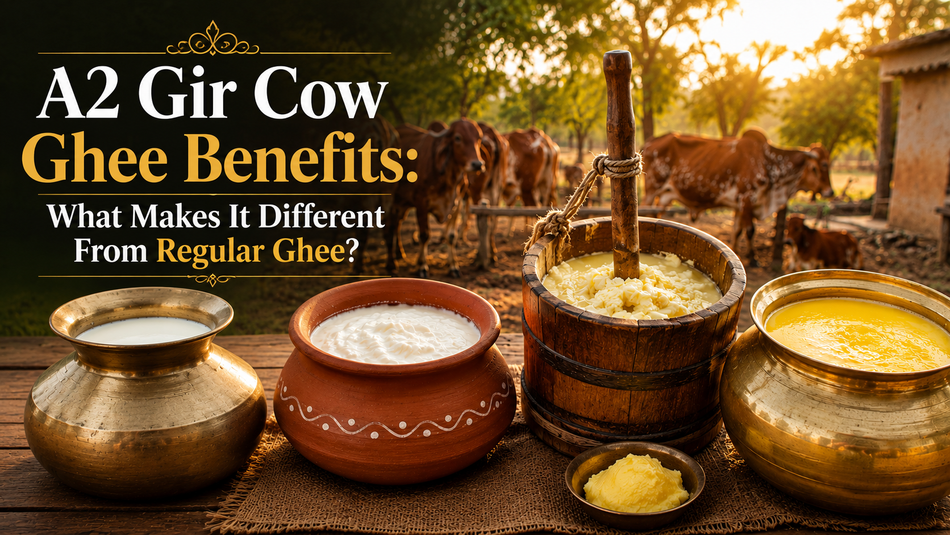
How Traditional Bilona Ghee Is Made
Traditional Bilona Ghee is made through a slow and careful process. It is different from faster commercial methods where ghee may be made directly from cream.
The traditional Bilona method follows this journey:
1. Milk Is Collected
Fresh milk is collected from cows. In the case of Gaurya Farms, the ghee is made from indigenous Gir cow milk.
The quality of milk depends on several things:
- Cow breed
- Feed and water
- Cow care
- Hygiene during milking
- Freshness of milk
- Handling and storage
This is why farm transparency matters. A brand that shows its source gives customers more confidence.
2. Milk Is Set Into Curd
The milk is boiled and then cooled. A culture is added to set it into curd.
This step is important because Bilona Ghee is not made directly from cream. It begins with curd, which gives the final product its traditional identity.
3. Curd Is Churned Into Butter
The curd is churned using the bilona process to separate cultured butter, also called makhan.
This is the heart of the traditional Bilona method. It takes time, effort, and patience. It is not a shortcut process.
4. Butter Is Slow-Cooked Into Ghee
The cultured butter is heated slowly. As it cooks, moisture evaporates and the ghee separates from the milk solids.
This slow-cooking stage develops the rich aroma, golden color, and traditional taste that many buyers associate with Bilona Ghee.
5. Ghee Is Filtered and Packed
Once ready, the ghee is filtered and packed carefully. Good brands also test their batches for purity and safety.
At Gaurya Farms, every batch is lab tested, and lab reports are made available for transparency.
A2 Gir Cow Ghee Benefits
When we talk about A2 Gir Cow Ghee benefits, we should focus on practical, factual, and trustworthy benefits. Ghee is still a fat-rich food, so it should be consumed in moderation as part of a balanced diet.
Here are the real reasons many people prefer A2 Gir Cow Ghee.
1. Traditional Preparation Method
The traditional Bilona process is one of the biggest reasons people choose this type of ghee.
Instead of using only cream, Bilona Ghee follows the milk-to-curd-to-butter-to-ghee method. This process is closer to how many Indian households traditionally made ghee.
For buyers who value traditional food practices, this matters.
2. Made From Cultured Butter
Bilona Ghee is made from cultured butter, not directly from cream.
This gives the product a different identity from mass-produced ghee. Many customers associate cultured butter ghee with better aroma, deeper flavor, and a more traditional feel.
3. Rich Aroma and Taste
One of the most noticeable Gir Cow Ghee benefits is taste.
Good Bilona Ghee usually has:
- A rich aroma
- A golden appearance
- A smooth texture
- A deeper traditional flavor
- A pleasant aftertaste in cooked food
This is why many customers use it not only as a cooking fat but also as a finishing ingredient on dal, rice, rotis, khichdi, and sweets.
4. Suitable for Everyday Indian Cooking
Ghee has a high smoke point compared with many common cooking fats, so it works well for Indian cooking methods such as tadka, sautéing, roasting, and making sweets.
It can be used in:
- Dal tadka
- Khichdi
- Rice
- Roti and paratha
- Halwa
- Laddoo
- Panjiri
- Pulao
- Traditional festive recipes
The key is moderation. A small amount can add good aroma and taste.
5. Contains Naturally Occurring Fat-Soluble Vitamins
Ghee, being a dairy fat, can contain naturally occurring fat-soluble vitamins such as vitamin A and vitamin E. The exact amount can vary depending on milk source, feed, and processing.
This should not be exaggerated into a medical claim. Ghee should not be presented as a cure or treatment. It is better understood as a traditional cooking fat that can be part of a balanced diet.
6. Produced From Indigenous Gir Cow Milk
For many buyers, the source matters as much as the final product.
Gir cow milk gives the ghee a strong story of indigenous cow heritage and traditional dairy culture. When the farm source is transparent, customers can feel more confident about what they are buying.
7. Small-Batch Preparation
Small-batch preparation usually allows better control over process, aroma, cooking time, and quality checks.
In mass production, speed and scale often become the priority. In small-batch Bilona Ghee, the focus is more on care, process, and consistency.
8. Transparency Through Lab Testing
One of the most practical benefits is not taste or tradition. It is trust.
When a brand provides lab reports, customers can check whether the ghee has been tested for purity and safety. In a market where adulteration is a common concern, this is a serious advantage.
A2 Gir Cow Ghee vs Regular Ghee
| Factor | A2 Gir Cow Bilona Ghee | Regular Ghee |
|---|---|---|
| Milk Source | Made from indigenous Gir cow milk | May come from mixed or unspecified milk sources |
| Preparation Method | Traditional milk → curd → butter → ghee process | Often cream-based or industrial process |
| Churning | Curd is churned to obtain cultured butter | Churning may not be part of the process |
| Batch Size | Often small-batch | Often large-scale |
| Taste | Rich, traditional aroma and deeper flavor | Taste varies by brand and process |
| Price | Usually higher | Usually lower |
| Transparency | Better when farm source and lab reports are available | May or may not provide source/testing proof |
| Best For | Buyers seeking traditional, traceable, premium ghee | Buyers seeking basic everyday ghee |
| Trust Factor | Depends on farm proof, cow care, and testing | Depends on brand reputation and quality control |
The biggest difference is not only “A2”. The real difference is source + process + transparency.
A premium ghee should answer these questions clearly:
- Which cows is the milk from?
- How is the ghee made?
- Is it made from curd or cream?
- Is every batch tested?
- Are lab reports available?
- Are there real customer reviews?
- Is the brand transparent about price and process?
Why Bilona Ghee Costs More
Many customers ask: why is Bilona Ghee so expensive?
It is a fair question. Premium ghee should not hide behind vague words. The price should be explained honestly.
Bilona Ghee costs more because:
- It requires more milk.
- The milk is first converted into curd.
- The curd must be churned to obtain butter.
- The butter is slow-cooked carefully.
- The process takes more time and labor.
- Small-batch preparation is harder to scale.
- Good cow care and hygiene add cost.
- Lab testing adds cost.
- Packaging, handling, and shipping also affect final price.
Mass-produced ghee can be cheaper because the process is faster and more scalable. Traditional Bilona Ghee is slower and more labor-intensive.
This does not mean every expensive ghee is automatically good. Customers should still check proof before buying.
How to Identify Pure A2 Gir Cow Ghee
Buying pure Gir Cow Ghee online can be confusing. Many brands use similar words. Here are practical buyer tips.
1. Check the Milk Source
The brand should clearly explain the source of milk. If it claims Gir Cow Ghee, it should talk about Gir cows, farm practices, and sourcing.
2. Check the Preparation Method
Look for clear explanation of the Bilona process.
A trustworthy brand should explain:
- Milk to curd
- Curd to butter
- Butter to ghee
- Slow cooking
- Filtering and packing
If a brand only says “traditional” but does not explain the process, be careful.
3. Check Lab Reports
This is one of the most important checks.
Look for:
- Batch testing
- Purity report
- Fat content
- Adulteration checks
- Safety parameters
- Report date
Gaurya Farms provides lab reports for transparency, which is a strong trust signal.
4. Check Ingredients
Pure ghee should not need a long ingredient list. It should be simple and clear.
5. Check Reviews
Look for verified reviews, especially reviews that mention taste, aroma, packaging, and repeat purchase.
Photo and video reviews are even better.
6. Check Price Logic
Very cheap “premium” Bilona Ghee can be suspicious. If the product claims traditional Bilona process, Gir cow milk, small batch, and lab testing, the price should reflect the effort.
7. Check Packaging and Storage Guidance
Good brands explain how to store ghee.
Storage tips:
- Keep the jar tightly closed.
- Store in a cool, dry place.
- Avoid direct sunlight.
- Use a clean, dry spoon.
- Do not allow water to enter the jar.
8. Avoid Buying Only by Buzzwords
Do not buy only because the label says:
- A2
- Desi
- Pure
- Natural
- Organic
- Traditional
- Bilona
These words are useful only when supported by proof.
Common Buying Mistakes
Many first-time buyers make these mistakes:
- Buying only because of the word A2
- Not checking whether it is Bilona or cream-based
- Ignoring lab reports
- Comparing only price per jar, not process and source
- Not checking pack size and usage needs
- Believing exaggerated health claims
- Assuming all expensive ghee is pure
- Not checking storage instructions
- Ignoring customer reviews
- Buying from unknown sellers without traceability
A better buying approach is simple:
Check source, process, testing, reviews, and storage guidance before purchasing.
Common Myths About A2 Ghee
Myth 1: A2 Ghee Cures Health Problems
No food product should be claimed to cure, treat, or prevent diseases unless legally and scientifically approved for such claims.
A2 Gir Cow Ghee can be part of traditional cooking, but it should not be marketed as medicine.
Myth 2: All A2 Ghee Is Automatically Pure
Not true.
A2 describes the milk source, but purity depends on production, handling, testing, and honesty. Always check lab reports and brand transparency.
Myth 3: Bilona Ghee and Regular Ghee Are the Same
They are both ghee, but the process differs. Bilona Ghee is made from curd and cultured butter, while many regular ghee products are made from cream.
Myth 4: More Expensive Always Means Better
Not always.
A higher price should come with proof: farm source, traditional method, lab reports, good packaging, and real reviews.
Myth 5: Ghee Can Be Eaten Without Limit
Ghee is calorie-dense and fat-rich. It should be eaten in moderation based on personal diet and lifestyle.
Myth 6: If Ghee Smells Strong, It Must Be Pure
Aroma can be a sign of good preparation, but it is not proof of purity. Lab testing and sourcing matter more.
Myth 7: A2 Claims Alone Are Enough
No. A serious buyer should look beyond the word A2 and evaluate the complete product.
Final Thoughts
A2 Gir Cow Ghee is different from regular ghee when the difference is real and proven through source, process, and transparency.
The most trustworthy premium ghee is not the one with the loudest claims. It is the one that clearly shows:
- Where the milk comes from
- How the cows are cared for
- How the ghee is made
- Whether the Bilona process is followed
- Whether batches are tested
- Whether lab reports are available
- Whether customers can trust the brand
For Gaurya Farms, the strongest story is simple and honest: indigenous Gir cow milk, traditional Bilona preparation, small-batch care, ethical cow care, and lab-tested transparency from Chittorgarh, Rajasthan.
That is what makes A2 Gir Cow Ghee meaningful for a modern Indian buyer: not hype, but heritage with proof.
Frequently Asked Questions
What is A2 ghee?
A2 ghee generally refers to ghee made from the milk of cows that naturally produce A2 beta-casein protein in their milk. In practical buying terms, customers should focus on source, process, purity testing, and transparency.
What is Gir Cow Ghee?
Gir Cow Ghee is ghee made from the milk of indigenous Gir cows. It is valued for its traditional Indian cow breed connection, farm story, and premium positioning.
What are A2 Gir Cow Ghee benefits?
A2 Gir Cow Ghee benefits include traditional preparation, rich aroma, suitability for Indian cooking, small-batch handling, and a traceable milk source when made by a transparent farm-based brand.
Is A2 ghee healthier than regular ghee?
It is better to avoid broad medical claims. A2 Gir Cow Ghee may be preferred for its source, traditional process, taste, and transparency, but it should still be consumed in moderation.
How is A2 ghee different from regular ghee?
A2 ghee is linked to the milk source, while regular ghee may come from mixed or unspecified sources. Traditional A2 Bilona Ghee also differs by process when made from curd and cultured butter.