100% Pure Ghee Made Only From Gir Cow Milk
 Every Batch Independently Lab-Tested for Purity
 Free Shipping Available Across India
 Crafted Using the Traditional Bilona Method
Quick Answer
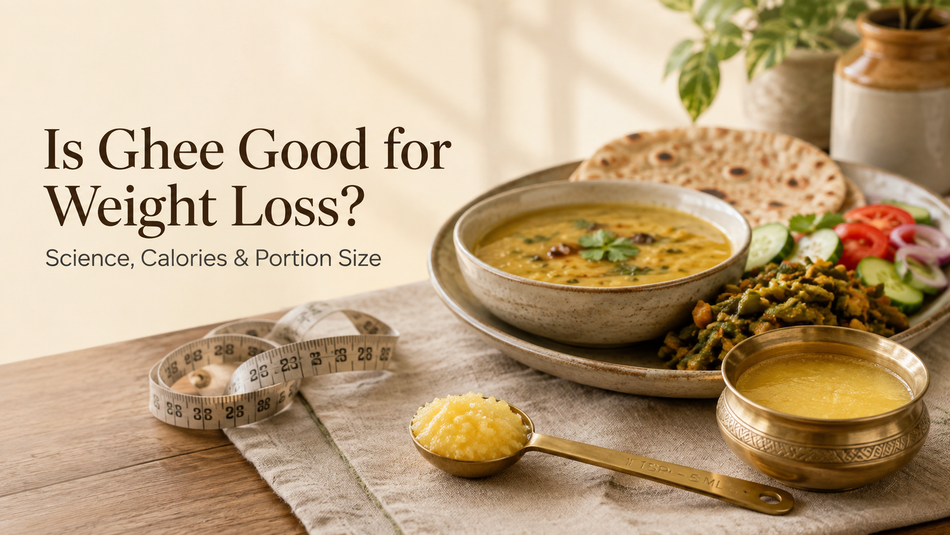
Ghee is not a weight-loss food by itself. It does not melt belly fat, burn calories automatically or guarantee faster fat loss.
But that does not mean you must avoid ghee when trying to lose weight.
Ghee is a concentrated source of fat. It is calorie-dense, so portion size matters. If you add ghee on top of an already high-calorie diet, it can make weight loss harder. If you use a measured amount within your daily calorie needs, ghee can fit into a balanced weight-loss diet.
The most honest answer is this:
Ghee can be part of a weight-loss diet, but it is not a magic weight-loss ingredient.
Weight loss depends mainly on your overall eating pattern, calorie intake, physical activity, sleep, stress, medical conditions and consistency over time.
Calories
About 876 per 100 g
According to USDA FoodData Central.
Best Use
Measured portions
A teaspoon can fit more easily than a tablespoon.
Bottom Line
Not magic
It can fit a diet, but it does not burn fat by itself.
Why Are People Asking If Ghee Helps With Weight Loss?
For many Indian households, ghee is not a trend. It is normal food.
A spoon on dal, roti, khichdi, rice, bajra roti or halwa has been part of everyday eating for generations. Then modern diet culture started treating all fat as something to fear. Now the pendulum has swung again, and people are asking a more practical question:
If ghee is fat, can I still eat it while trying to lose weight?
That question is worth answering carefully.
Some online articles claim that ghee "burns fat", "boosts metabolism" or "melts belly fat". These claims sound attractive, but they are not established facts. The better question is not whether ghee causes weight loss. The better question is whether ghee can fit into a diet that supports weight loss.
What Is Ghee?
Ghee is clarified butterfat. It is made by heating butter or makkhan until water evaporates and milk solids separate from the fat. The remaining golden fat is strained and stored as ghee.
Because most milk solids are removed during clarification, ghee contains very little carbohydrate or protein. Nutritionally, it is mostly fat.
That is why ghee has a strong flavour even in small amounts. It also explains why a small spoon can add a meaningful number of calories to a meal.
Established Fact: Ghee Is Calorie-Dense
This is the most important point for anyone trying to lose weight.
According to USDA FoodData Central, ghee contains about 876 calories per 100 grams and is almost entirely fat. A common serving estimate is:
These numbers do not make ghee "bad". They simply mean it should be measured if weight loss is your goal.
For example, one extra tablespoon of ghee every day can add roughly 120 calories. Over time, that matters if the rest of the diet is not adjusted.
Established Fact: Weight Loss Depends on Overall Calorie Balance
Weight loss happens when the body uses more energy than it receives from food and drinks over time. The CDC explains that reducing calories from food, combined with using calories through physical activity, creates the calorie deficit needed for weight loss.
This is why no single food can guarantee weight loss.
Not ghee. Not green tea. Not oats. Not lemon water.
A food can support a healthy pattern, improve meal satisfaction or replace a less suitable choice. But body weight still responds to the overall pattern.
So if someone asks, "Does ghee make you fat?", the accurate answer is:
Ghee alone does not make you fat. Regularly eating more calories than your body uses can lead to weight gain, and ghee can contribute to that because it is calorie-dense.
Does Ghee Burn Fat?
There is no strong human evidence showing that eating ghee directly burns body fat.
This is where many articles become misleading. They may mention fatty acids, CLA, butyrate or keto diets, and then jump to a claim that ghee causes fat loss. That jump is not justified.
Here is the clearer way to understand it:
If you enjoy ghee, you do not need to fear it. But it should not be sold as a fat-burning shortcut.
Can Ghee Help You Feel Full?
Possibly, depending on the meal.
Fat slows digestion and can make food feel more satisfying. A little ghee on dal, khichdi, millet roti or vegetables may make the meal more enjoyable and help some people feel satisfied.
But this does not mean more ghee is better.
Satiety comes from the whole meal, not only from ghee. Protein, fibre, water-rich vegetables, whole grains, legumes and mindful portion size matter a lot. A teaspoon of ghee on a balanced meal is very different from adding several spoons of ghee to a low-fibre, high-calorie meal.
What Does Research Say About Ghee and Weight Loss?
Research on ghee is growing, but the direct evidence for weight loss is limited.
A 2024 review published in the Journal of Ayurveda and Integrative Medicine examined ghee from both Ayurveda and modern science perspectives. The review notes that modern scientific literature on ghee's functional benefits is still limited, and much current research has focused on cardiovascular health, wound healing and skin health rather than weight loss.
This matters because it prevents overclaiming.
The review can support a balanced statement such as:
Ghee has cultural, culinary and traditional significance, and researchers are studying its fatty acids and possible functional roles. However, current evidence does not prove that eating ghee directly causes weight loss.
That is the right level of confidence.
Ghee, Saturated Fat and Heart Health
Ghee is high in saturated fat because it is a dairy fat. This does not mean every person must avoid it completely, but it does mean regular intake should be considered within the whole diet.
The Dietary Guidelines for Americans recommend limiting saturated fat to less than 10% of daily calories. The American Heart Association gives a stricter target, recommending a dietary pattern with less than 6% of calories from saturated fat, especially for heart health.
If you already consume a lot of saturated fat from butter, cheese, cream, fried foods, sweets, bakery foods or fatty meats, adding more ghee may not be ideal.
People with high LDL cholesterol, heart disease, diabetes, obesity, liver concerns or other medical conditions should ask a qualified doctor or registered dietitian for personalised guidance.
How Much Ghee Should You Eat Daily for Weight Loss?
There is no universal spoon-count that works for everyone.
You may see advice like "eat 2 teaspoons daily" or "take ghee every morning for weight loss." That is too general. A person's ideal intake depends on total calories, activity level, health status, cooking oil use, cholesterol levels and the rest of the diet.
A practical approach is:
For many adults, 1 teaspoon of ghee in a meal may be easier to fit into a weight-loss diet than 1 tablespoon, especially if the rest of the meal already contains oil, nuts, seeds, dairy or fried foods.
Ghee vs Oil for Weight Loss
This is another common question: Is ghee better than oil for weight loss?
The answer is not as simple as "ghee is better" or "oil is better."
Both ghee and cooking oils are calorie-dense fats. Most oils provide about 9 calories per gram, similar to ghee. Replacing one spoon of oil with one spoon of ghee does not automatically reduce calories.
If your goal is weight loss, the most important question is not only which fat you use. It is how much total fat you use across the day.
A helpful habit is to measure cooking fat with a spoon instead of free-pouring it.
Is Ghee Coffee Good for Weight Loss?
Ghee coffee, sometimes compared with bulletproof coffee, is popular among people following keto or low-carb diets.
It usually means coffee blended with ghee, sometimes with MCT oil or butter. Because ghee has very little carbohydrate, it can fit into a ketogenic diet.
But here is the catch:
Ghee coffee adds calories.
If you add 1 tablespoon of ghee to coffee, you may add around 120 calories before eating any food. If that drink replaces a higher-calorie breakfast and helps you stay within your daily intake, it may fit your plan. If it is added on top of your regular breakfast, it can make weight loss harder.
Also, ghee coffee is not suitable for everyone. Some people feel nauseous or uncomfortable after drinking fat-heavy coffee. People with cholesterol concerns, gallbladder issues, diabetes, acid reflux or medical conditions should be cautious and seek professional advice.
Is Ghee Good for Keto Diet?
Ghee can fit into a keto diet because it is almost entirely fat and has negligible carbohydrates.
But keto is not magic either.
People may lose weight on keto when the diet helps them reduce total calorie intake, control hunger or simplify food choices. But it is still possible to overeat calories on keto, especially from high-fat foods like ghee, butter, cream, cheese, nuts and oils.
So the answer is:
Yes, ghee can be used in a keto diet. No, ghee does not guarantee keto weight loss.
Is Desi Cow Ghee Better for Weight Loss?
There is no strong evidence that desi cow ghee causes more weight loss than other edible fats when calories are the same.
Cow ghee may differ from buffalo ghee or commercial ghee in colour, flavour, aroma, fatty-acid profile and production method. Traditionally made ghee may also be preferred by people who care about taste, sourcing and process.
But from a weight-loss perspective, the main factor remains portion size and total diet.
It would be misleading to say:
"A2 cow ghee burns fat."
A more accurate statement is:
"If you prefer traditional cow ghee, you can include a measured amount in a balanced diet, but it should not be treated as a weight-loss medicine."
Can You Eat Gaurya Farms Ghee While Trying to Lose Weight?
Yes, if it fits your diet and health needs.
Gaurya Farms offers Gir Cow Bilona Ghee made with a traditional Bilona-style process. Based on Gaurya Farms' own published product and farm information, the ghee is made from milk from its own Gir cows, follows the milk-to-curd-to-butter-to-ghee route, is independently lab-tested, and contains no added colours, artificial flavours or preservatives.
Those details are relevant for people who care about sourcing, traditional preparation and the taste of cow ghee.
But it should not be promoted as a weight-loss cure.
The responsible way to use ghee during weight loss is simple:
- Use a measured portion.
- Add it to balanced meals, not random extra calories.
- Avoid pairing it frequently with high-sugar sweets and fried snacks.
- Consider your total intake of oil, butter, cream, cheese and other fats.
- Speak to a doctor or dietitian if you have a medical condition.
Traditional food can be part of a modern health goal. It just needs portion awareness.
How to Include Ghee in a Balanced Weight-Loss Diet
Here are practical ways to use ghee without turning it into a calorie overload:
The best use of ghee during weight loss is not to eat it alone. It is to use a small amount where it improves the meal enough that you can stay consistent with your diet.
Common Myths About Ghee and Weight Loss
Myth 1: Ghee melts belly fat
No food can target belly fat directly. Fat loss happens across the body through sustained calorie balance, activity and lifestyle changes.
Myth 2: Eating ghee every morning guarantees weight loss
There is no strong evidence for this. Morning ghee still contains calories.
Myth 3: Ghee is always better than oil
Not always. Oils differ widely. Some are richer in unsaturated fats, while ghee is richer in saturated fat. The best choice depends on your health needs, cooking use and total diet.
Myth 4: If ghee is traditional, unlimited intake is fine
Traditional does not mean unlimited. Many traditional diets also included physical labour, seasonal foods, home cooking, lentils, grains, vegetables and smaller processed-food intake.
Myth 5: Ghee is bad for everyone trying to lose weight
Also not true. A small amount can fit into a balanced diet for many people.
Who Should Be More Careful With Ghee?
Be cautious with ghee intake if you:
- Have high LDL cholesterol
- Have heart disease or strong family history of heart disease
- Have diabetes or metabolic syndrome
- Are managing obesity with a medical diet
- Have gallbladder disease or difficulty digesting fat
- Have been advised to limit saturated fat
- Are adding ghee coffee on top of regular meals
This does not mean ghee is forbidden. It means personal context matters.
Final Takeaway
So, is ghee good for weight loss?
The most evidence-led answer is:
Ghee does not directly cause weight loss, but it can fit into a weight-loss diet when used in small, measured amounts.
If you enjoy ghee, you do not need to remove it from your life out of fear. But do not expect it to burn fat for you.
Use it like a powerful flavour ingredient: a little can make simple food satisfying. Too much can quietly add calories.
For Gaurya Farms, the honest message is stronger than a miracle claim:
Choose good-quality ghee for taste, tradition and mindful cooking. For weight loss, focus on portion size, balanced meals and the overall pattern of your day.