100% Pure Ghee Made Only From Gir Cow Milk
 Every Batch Independently Lab-Tested for Purity
 Free Shipping Available Across India
 Crafted Using the Traditional Bilona Method
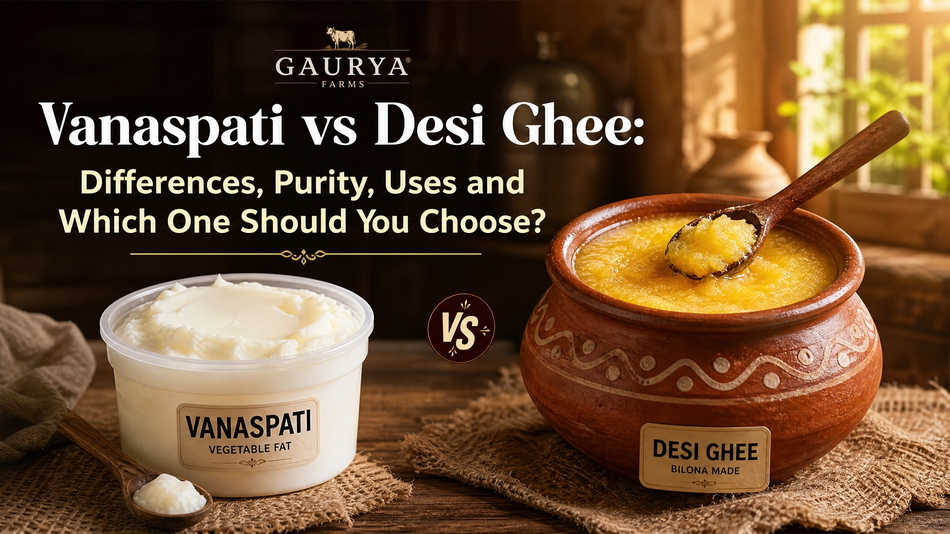
Direct answer: Vanaspati and desi ghee may look similar in a dabba, but they are not the same product. Vanaspati is made from refined vegetable oils that are processed to become semi-solid, while desi ghee is milk fat prepared from butter or cream. Ghee has a dairy aroma and traditional food value; vanaspati is usually chosen for lower cost, bulk cooking and some commercial sweets.
What Is Vanaspati?
Vanaspati is a semi-solid vegetable fat. In India, many people casually call it “vanaspati ghee”, but technically it is not ghee because it does not come from milk.
As per Indian food standards, vanaspati is made from refined edible vegetable oils that are processed through hydrogenation or related methods to give a solid or grainy texture. It is used in bakeries, sweets, snacks and large-scale cooking because it is cheaper than dairy ghee and has a longer, more predictable shelf life.
Common vanaspati ghee ingredients may include refined vegetable oils such as palm oil, soybean oil, cottonseed oil or other permitted edible oils, depending on the manufacturer and label.
How Is Vanaspati Made?
Vanaspati begins as vegetable oil. The oil is refined, processed and converted into a semi-solid fat. Traditionally, this was done by hydrogenation, where hydrogen is added to vegetable oil in the presence of a catalyst.
This process changes the texture of liquid oil and makes it behave more like a solid cooking fat. That is why vanaspati can resemble ghee in appearance, especially when packed in tins or used in sweets.
A key nutrition concern with older hydrogenated fats was industrial trans fat. India has moved to stricter limits on trans fats in oils and fats, so consumers should still read labels and choose products that clearly disclose ingredients and nutrition information.
What Is Desi Ghee?
Desi ghee is clarified milk fat. It is made by heating butter or cream until the water evaporates and milk solids separate, leaving behind aromatic golden fat.
Traditional ghee has a distinct dairy aroma, nutty flavour and natural grainy texture. Its colour, aroma and texture can vary depending on milk source, season, feed, cooking temperature and production method.
Desi ghee is not vegetable fat. Pure ghee should come from milk fat, not vanaspati, refined oils or animal body fat.
How Traditional Ghee Is Made
There are different ways to make ghee. In many commercial systems, cream is separated from milk, converted into butter and then clarified into ghee.
Traditional Bilona ghee follows a slower route:
Milk → Curd → Hand-churned Butter → Slow-cooked Ghee
At Gaurya Farms in Chittorgarh, Rajasthan, Gir cow Bilona ghee is prepared using this older dairy method. The point is not that every traditional method is automatically “miraculous”, but that the production journey is different from vanaspati and even from many industrial ghee processes.
Bilona ghee starts with milk, is cultured into curd, churned to separate butter, and then slow-cooked into ghee. This creates a different flavour profile, aroma and production cost.
Why Vanaspati and Ghee Look Similar but Are Different
They look similar because both are fats that can become semi-solid at room temperature. Both can be yellowish, grainy and used in Indian cooking.
They are different because their source is different.
Vanaspati comes from vegetable oil.
Desi ghee comes from milk fat.
That one difference changes everything: taste, aroma, cost, nutrition profile, cultural use and how purity should be judged.
Vanaspati vs Desi Ghee: Detailed Comparison
| Factor | Vanaspati | Desi Ghee |
|---|---|---|
| Source | Refined edible vegetable oils | Milk fat from cow, buffalo or mixed milk |
| Manufacturing process | Refined oils are processed, often through hydrogenation or interesterification, to become semi-solid | Butter or cream is heated to remove moisture and separate milk solids |
| Traditional method | Not a traditional dairy process | Can be made through cream-based or Bilona method |
| Taste and aroma | Neutral or artificial buttery note, depending on brand | Dairy-rich, nutty, aromatic |
| Texture | Smooth or grainy, designed for consistency | Grainy or semi-solid; varies naturally with temperature and milk source |
| Cooking uses | Commercial sweets, bakery items, deep frying, snacks | Tadka, dal, roti, sweets, traditional cooking, finishing dishes |
| Price difference | Usually cheaper | Usually costlier because it requires milk and more dairy processing |
| Consumer considerations | Read label for oils used, trans fat, additives and intended use | Check source, batch details, aroma, texture, lab reports and brand transparency |
| Is it ghee? | No, it is vegetable fat | Yes, if made only from milk fat |
| Best suited for | Budget-sensitive bulk cooking and some commercial applications | Flavour-led cooking, traditional sweets and households that prefer dairy fat |
Why Traditional Ghee Costs More Than Vanaspati
Many users ask: why is vanaspati cheaper than ghee?
The simple answer is that ghee starts with milk, and milk is expensive to produce.
To make real ghee, you need a large quantity of milk to obtain enough cream or butter. In the Bilona method, the process is even more involved because milk is first turned into curd, then churned into butter, then slow-cooked into ghee.
The cost includes:
- Milk production and animal care
- Feed, labour and farm operations
- Curd setting and churning
- Slow cooking in smaller batches
- Lower yield compared to refined vegetable fat
- Skilled handling to preserve flavour and avoid burning
Vanaspati is cheaper because vegetable oils can be processed at scale. The raw material cost, production speed and batch size are very different from small-batch dairy ghee.
Ghee Adulteration With Vanaspati
Adulteration means mixing a cheaper substance into a product and selling it as if it were pure. In ghee, vanaspati may be used as an adulterant because it can imitate ghee’s semi-solid texture at a lower cost.
Why does this happen?
Because pure ghee is expensive to make, and vanaspati is cheaper. If someone mixes vanaspati into ghee and sells it at a ghee price, the profit margin increases unfairly.
This is why consumers should be cautious with unusually cheap “pure ghee” claims. A very low price does not automatically prove adulteration, but it should make you ask better questions: What is the milk source? Is there a batch number? Is there an FSSAI licence? Are lab reports available? Does the brand explain its process clearly?
How to Identify Pure Ghee
You can make some home observations, but you cannot prove purity at home with complete confidence.
Useful home observations:
- Pure ghee usually has a natural dairy aroma, not a flat oily smell.
- It may become grainy or semi-solid depending on temperature.
- It melts easily when warmed.
- Good ghee has a clean aftertaste and should not feel waxy or greasy in an unusual way.
- Very strong artificial fragrance can be a warning sign.
These checks are helpful, but they are not final proof. Some adulterated products can smell and look convincing.
Laboratory testing is more reliable. Food labs can check parameters such as milk fat quality, fatty acid profile, Reichert-Meissl value, Butyro-refractometer reading and specific adulterants. FSSAI manuals also mention tests such as the Baudouin test for detecting vanaspati in milk fat products.
For consumers, the best approach is practical:
- Buy from a traceable source.
- Check label, batch number and licence details.
- Prefer brands that disclose the process.
- Ask for lab reports if purity is a major concern.
- Avoid products that are suspiciously cheap compared to real milk economics.
Health and Nutrition: A Balanced View
Vanaspati is not “poison”, and ghee is not a miracle food. Both are fats. Both add calories. Both should be used with portion control.
The main nutrition difference is the fat source and processing. Vanaspati is made from vegetable oils that are processed into semi-solid fat. Older hydrogenated fats were a major source of industrial trans fats, which global health bodies recommend reducing or eliminating. India has also tightened limits on trans fats in oils and fats.
Ghee is dairy fat. It is rich in saturated fat and energy. It also carries traditional food value in Indian households, but that does not mean unlimited ghee is healthy for everyone.
Your choice should depend on:
- Quantity used
- Overall diet
- Frequency of fried foods and sweets
- Health conditions
- Budget
- Taste preference
- Whether the product is genuine and properly labelled
If someone has heart disease, high LDL cholesterol or a medical dietary restriction, they should take personalised advice from a qualified doctor or dietitian.
Which Is Better for Indian Sweets?
For traditional sweets, desi ghee is usually better for flavour.
Laddoo, halwa, panjiri, churma, besan sweets and many festive recipes depend on ghee’s aroma. Ghee gives a nutty depth that vanaspati usually cannot match.
Vanaspati is still used in some commercial sweets because it is cheaper, gives a consistent texture and can help reduce production cost. That does not make every vanaspati sweet unsafe, but it does make label transparency important.
If a sweet is sold as “made with ghee”, it should actually be made with ghee. If it is made with vanaspati or vegetable fat, the seller should be clear.
Which Is Better for Daily Cooking?
For flavour-led home cooking, many families prefer desi ghee in small quantities. A spoon of ghee on dal, roti, khichdi or millet dishes can add aroma and satisfaction.
For high-volume frying or budget cooking, some people use cooking oils or vanaspati. The better choice depends on the recipe and the household’s dietary needs.
For daily cooking, a sensible approach is:
- Use fats in moderation.
- Use ghee where flavour matters.
- Use suitable cooking oils for regular sautéing or frying.
- Avoid repeatedly reheating any fat.
- Read labels carefully.
Can Vanaspati Replace Ghee?
Vanaspati can replace ghee in some recipes from a texture and cost point of view, but it does not truly replace ghee in taste, source or identity.
It may work in:
- Bakery shortening
- Bulk frying
- Some commercial sweets
- Budget recipes where aroma is not the main feature
It is not an equal replacement for:
- Traditional sweets where ghee aroma is central
- Ayurvedic or ritual uses where dairy ghee is specifically required
- Recipes where ghee is used as a finishing fat
- Households choosing ghee for its dairy origin and traditional preparation
Dalda vs Ghee: Are They the Same?
No. Dalda became a widely recognised name associated with vanaspati in India, so many people use it as a general term. But vanaspati and ghee are not the same.
If a product is made from vegetable oil, it is not desi ghee. Always check the label instead of relying on colour, packaging or common names.
Ghee vs Cooking Oil
Ghee and cooking oil both belong to the fat category, but they behave differently.
Cooking oils such as mustard, groundnut, sesame, sunflower or rice bran oil are liquid vegetable oils. Ghee is clarified milk fat. Vanaspati is processed vegetable fat made semi-solid.
A practical kitchen can use different fats for different purposes:
- Mustard oil for regional cooking and pickles
- Groundnut or sesame oil for certain Indian recipes
- Ghee for tadka, sweets and finishing
- Neutral oils for recipes where aroma should stay light
No single fat needs to do everything.
Key Takeaway
Vanaspati is processed vegetable fat. Desi ghee is milk fat. They may look similar, but they differ in source, process, flavour, cost and traditional use.
Choose ghee when you want dairy aroma, traditional preparation and better flavour in Indian food. Choose any fat, including oil or vanaspati, only after checking the label, usage and quantity. For purity, trust traceability and lab testing more than appearance alone.