100% Pure Ghee Made Only From Gir Cow Milk
 Every Batch Independently Lab-Tested for Purity
 Free Shipping Available Across India
 Crafted Using the Traditional Bilona Method
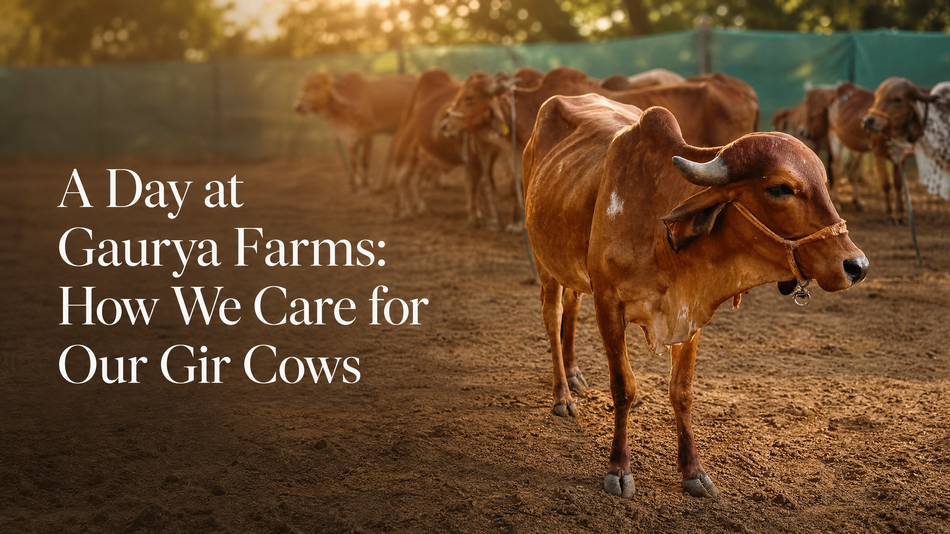
At Gaurya Farms in Chittorgarh, Rajasthan, our work with Gir cows begins early in the morning, before the day's milk becomes the first step in our Bilona ghee-making process.
For us, caring for the cows and making ghee are not two separate things. The milk we use for our ghee comes from our own farm, and we do not purchase milk, cream, butter or ghee from outside.
That makes the daily routine at the farm an important part of what we do.
Here is what a typical day involves, from the early-morning health check to milking, milk handling and the beginning of the Bilona process.
The Day Begins Before Milking
Our cows receive a health check in the early morning before milking.
A veterinarian is appointed at the farm, so veterinary support is available when required. If a cow becomes sick, the appointed veterinarian handles her care.
This early check is part of our routine because we want to know the condition of the cows before starting the day's milking.
We have not tried to turn this into a complicated checklist. The basic principle is simple: check the cows first, then begin the milking routine.
Cleanliness Comes Before Milking
Before every milking, the cow's udder and the milking vessels are cleaned.
Milking at Gaurya Farms is done by hand.
This is an important part of our milk-handling routine because the milk collected at this stage will eventually become the starting material for our Bilona ghee.
The milk is not mixed together without keeping track of its source. Milk from different breeds is kept in separate containers breed-wise.
That separation gives us better control over where the milk comes from before it moves into the next stage.
Calves Drink Milk Before the Remaining Milk Is Collected
One detail of our milking routine is especially important to us: calves drink milk before the remaining milk is collected.
We don't want the story of our milk to begin only with a container or a production process. It begins with the cows and their calves.
After the required milk is collected, the fresh milk is stored in a refrigerator.
This is the milk that becomes the starting point for our ghee-making process.
Our Milk Comes From Our Own Farm
All the milk used for a2 cow ghee is produced at our own farm.
We do not purchase milk, cream, butter or finished ghee from outside.
That gives us control over the starting point of the process.
The journey is:
Gir Cow Milk → Curd → Butter → Ghee
The milk collected at the farm does not go directly into a commercial cream-separation process. We first convert it into curd, then churn the curd to obtain butter, and finally slowly heat the butter to make ghee.
From Fresh Milk to Curd
The first stage after collecting the milk is preparing the curd.
The milk is first boiled and then allowed to cool. After cooling, lactic acid fermentation is used to convert the milk into curd.
The farm has not provided a fixed fermentation time or the exact starter used, so we are not adding those details here.
That may sound like a small distinction, but it matters when documenting a real process. We would rather leave a detail unconfirmed than give readers a number that does not represent what actually happens at our farm.
Churning the Curd Into Butter
Once the curd is ready, it moves into the churning stage.
At Gaurya Farms, we use a Bilona machine for this step.
The churning process takes approximately one hour.
The purpose is to separate the butter from the buttermilk. The same Bilona machine is used for the butter-separation stage.
This is one of the defining steps in our production journey because the ghee does not begin with commercially purchased butter. The butter is made from the milk produced at our own farm.
Slow Heating the Butter
After the butter is separated, it is transferred to a stainless-steel container.
The butter is then cooked using a clean LPG flame for approximately one hour.
This is the stage where butter is transformed into ghee.
We have not provided a fixed temperature or a specific visual test for determining exactly when the ghee is ready, so we have deliberately not added one here.
The important point is the actual process we follow: the butter is slowly heated rather than replacing this stage with a different commercial production method.
What Happens to the Ghee After Cooking?
The farm's current information does not specify the exact filtration and filling procedure, so we are not going to describe a method that has not been confirmed.
What we can confirm is that Gaurya Farms maintains batch and production records, and every batch is tested for purity or quality.
The tests themselves have not yet been specified by the farm, so we do not claim particular laboratory tests here.
Quality Is Part of the Process
Every batch of Gaurya Farms ghee is tested for purity or quality.
We also maintain batch numbers, milk records and production records.
For us, this is important because transparency should not stop at telling customers where the milk comes from. There should also be a record of what happens to that milk during production.
We are continuing to build this information into our process so that customers can understand more about the product they receive.
What About the Cows That Are No Longer Giving Milk?
Not every cow on a farm is necessarily a currently milking cow.
At Gaurya Farms, old or non-milking cows receive the same care as the other cows.
This is part of how we view the farm. The value of a cow is not limited to whether she is currently producing milk.
Ghee Is Part of Our Own Kitchen Too
Gaurya Farms ghee is not something we produce only for customers.
Our family uses it in daily household cooking as well as festive recipes.
Pure desi ghee also has a special place in our family traditions, including festive recipes, baby food and postpartum laddoos prepared for new mothers.
These uses are part of our food traditions and family practices. They should not be confused with medical claims or guarantees about health.
For us, ghee is first a food that has been part of our kitchen and traditions for generations.
From Our Cows to Our Ghee
When you look at a jar of ghee, it can be easy to think only about the finished product.
At Gaurya Farms, there is a much longer journey behind it.
It begins with milk from our own Gir cows.
Then:
Milk → Curd → Butter → Ghee
The milk is boiled and cooled before fermentation. The curd is churned for approximately an hour. The butter is separated and then slowly heated for approximately another hour in a stainless-steel container over a clean LPG flame.
The process is not simply about the final jar.
It is about maintaining control over the journey that comes before it.
What We Want You to Know About Our Farm
We don't want to describe our cows using claims that we cannot document.
Instead, we want to show you what we actually do.
Our cows are checked in the early morning before milking. Their udders and milking vessels are cleaned before every milking. Milking is done by hand. Calves drink milk before the remaining milk is collected. Milk is kept separately by breed and refrigerated after collection.
The milk used for our ghee comes from our own farm.
We do not purchase milk, cream, butter or ghee from outside.
From there, the milk follows our Bilona process through curd, butter and finally ghee.
That is the part of our story we can document and stand behind.
A Farm Is More Than the Final Product
Gaurya Farms is a dairy farm before it is a ghee brand.
The daily routine starts with the cows, continues through careful milk handling and eventually reaches the kitchen where the finished ghee is used.
We are still documenting more details of our farm practices, and we believe it is better to share confirmed information gradually than to fill the gaps with impressive-sounding claims.
For us, transparency means telling you not only what we make, but also where it begins.
And for Gaurya Farms, that beginning is here--with our Gir cows and the milk they provide.