100% Pure Ghee Made Only From Gir Cow Milk
 Every Batch Independently Lab-Tested for Purity
 Free Shipping Available Across India
 Crafted Using the Traditional Bilona Method
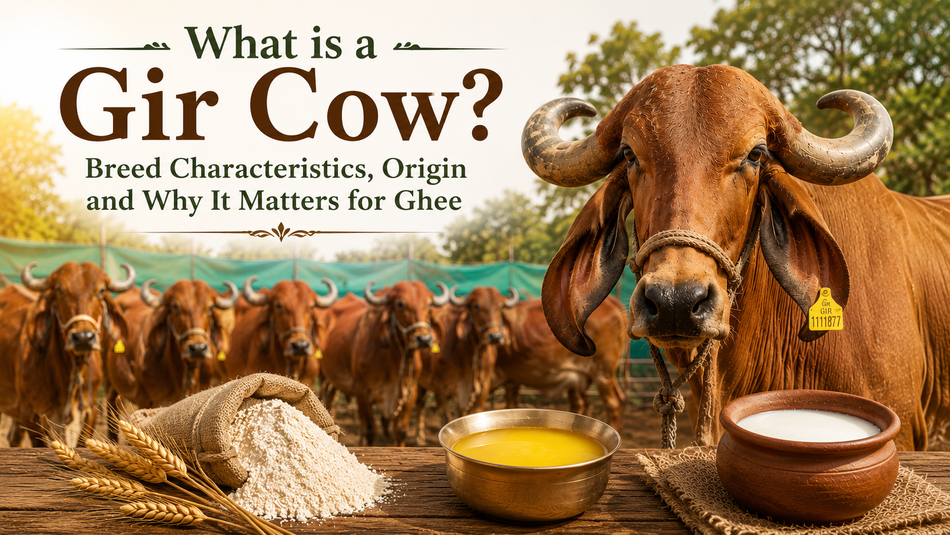
In India, people do not see cows only as milk-producing animals. In many families, cows are connected with food, farming, tradition, and respect. That is why the question “what is Gir cow?” has become common among people who are trying to understand A2 milk, Bilona Ghee, and premium ghee.
A Gir cow is one of India’s well-known indigenous cow breeds. It is valued for its milk-producing ability, heat tolerance, hardy nature, and importance in traditional dairy farming. For brands that make premium ghee, especially Bilona Ghee, the cow breed matters because the quality of ghee starts much before the ghee-making process. It starts with the animal, its care, feed, environment, milking practices, and milk quality.
At Gaurya Farms in Chittorgarh, Rajasthan, Gir cows are central to the brand’s ghee story. The farm produces Bilona A2 Gir Cow Ghee using the traditional Bilona process, with a focus on ethical cow care, small-batch preparation, and lab-tested transparency.
This article explains what a Gir cow is, where the breed comes from, what makes it special, how it connects with A2 milk, and why it matters for traditional Bilona Ghee.
Origin of Gir Cows
The Gir cow breed originated in Gujarat, especially around the Gir forest and the Kathiawar region. The breed is also associated with areas such as Junagadh, Bhavnagar, Amreli, and Rajkot.
The name “Gir” comes from the Gir region of Gujarat. In different regions, the breed has also been known by names such as Sorthi, Surti, Kathiawari, Desan, Gujarati, and Bhodali.
Gir cows are part of India’s traditional cattle wealth. They belong to the zebu type of cattle, which are known for a hump, loose skin, heat tolerance, and adaptability to Indian conditions.
For Indian dairy farming, the Gir cow is important because it combines tradition with practical usefulness. It is known for:
- Good milk-producing ability among indigenous breeds
- Adaptability to hot climates
- Strong body structure
- Calm temperament when properly handled
- Cultural and agricultural significance
The breed has also gained global attention. Gir genetics have been used in other countries, including Brazil, for dairy breeding programs. This shows how valuable Indian cattle genetics can be when properly conserved and managed.
Gir Cow Breed Characteristics
A Gir cow is easy to identify if you know what to look for. It has a distinct appearance compared with many other Indian cow breeds.
Appearance
Gir cows usually have:
- A broad and prominent forehead
- Long, pendulous ears
- A convex or domed face profile
- Curved horns that often turn backward
- Loose skin
- A well-developed hump
- A strong body frame
- Coat colors ranging from red, white, speckled red, yellowish-red, or patches
Their long ears are one of the most recognizable features. The forehead and face shape also make the Gir breed stand out.
Temperament
Gir cows are generally known to be calm and manageable when handled properly. Like all animals, their behavior depends on environment, handling, routine, and trust with caretakers.
On a farm, this matters a lot. A stressed animal is not easy to manage. Ethical care, regular routine, clean space, and gentle handling all contribute to better animal welfare.
Milk Yield
Gir cows are valued as a dairy breed among indigenous Indian cattle. Milk yield can vary widely depending on genetics, feed, health, lactation stage, management, and climate.
According to the Food and Agriculture Organization's documented breed data, Gir cattle average around 1,930 litres of milk in a 300-day lactation period, with a total lactation yield of roughly 2,063 litres over an average 326-day lactation. The National Dairy Development Board (NDDB) similarly describes Gir as a promising dairy breed known for milk-producing ability, fertility, heat tolerance, and easy maintenance.
A responsible brand should avoid making fixed claims like “every Gir cow gives X litres daily.” Real farming is not so mechanical. Milk yield differs from cow to cow and season to season.
Heat Tolerance and Hardiness
Gir cows are adapted to Indian climatic conditions. Their zebu characteristics help them manage heat better than many exotic breeds.
This is one reason traditional Indian cow breeds remain important in Indian farming. They are not only milk sources; they are part of a farming system suited to local climate and conditions.
Disease Resistance and Longevity
Gir cattle are often described as hardy and adaptable. NDDB material describes the breed as known for disease resistance, longevity, heat tolerance, good fertility, and easy maintenance.
However, this does not mean Gir cows never fall sick. They still need proper feed, hygiene, vaccination, veterinary care, clean water, shade, and regular observation. Good farming is not about leaving animals alone because they are hardy. It is about caring for them well because they are valuable.
Why Gir Cows Matter for A2 Milk and Ghee
To understand why Gir cows matter for premium ghee, we first need to understand A2 milk.
What Is A2 Milk?
Milk contains proteins, including casein. One type of casein is beta-casein. A2 milk refers to milk that contains the A2 type of beta-casein protein.
Many indigenous Indian cow breeds, including Gir, are commonly associated with A2 milk. This is one reason people searching for A2 milk, A2 ghee, and Gir cow milk often become interested in Gir cows.
But there is one important point: ghee is mostly milk fat. During ghee making, most water and milk solids are removed. So, when talking about A2 Gir Cow Ghee, the strongest and most accurate explanation is not that ghee is a protein-rich food. It is better to say that the ghee is made from the milk of Gir cows, traditionally associated with A2 milk, and prepared through a careful process.
That is a more honest and trustworthy explanation. Read more in our guide on A2 Gir Cow Ghee Benefits: What Makes It Different.
Why Gir Cow Milk Matters for Ghee
The quality of ghee depends on the quality of milk and the method used to make it.
Gir cow milk is valued in premium ghee production because:
- It comes from an indigenous Indian breed.
- It is associated with traditional dairy practices.
- It can have good fat content, which matters for ghee making.
- It supports the identity of premium A2 Gir Cow Ghee.
- It connects the product to native cow heritage.
For a farm-based ghee brand, the breed is not just a label. It is part of the full product story.
Connection With Bilona Ghee
Bilona Ghee is made using the traditional milk-to-curd-to-butter-to-ghee method.
The process usually looks like this:
- Milk is collected.
- Milk is set into curd.
- Curd is churned to obtain cultured butter.
- Butter is slow-cooked into ghee.
- Ghee is filtered and packed.
When this process uses Gir cow milk, the final product is often called A2 Gir Cow Bilona Ghee. You can read the full process breakdown in What Is Bilona Ghee? Traditional Bilona Method Explained, and see how it compares with other methods in Bilona Ghee vs Regular Ghee.
This is where Gaurya Farms’ story becomes relevant. The farm’s ghee is not only about the breed. It is about Gir cow milk, ethical cow care, traditional Bilona preparation, small-batch handling, and lab-tested purity.
Gir Cow Milk vs Other Cow Breeds
Every cow breed has its own strengths. Gir is not the only valuable Indian breed. India has many traditional cow breeds such as Sahiwal, Red Sindhi, Tharparkar, Kankrej, Rathi, Ongole, and others.
The comparison below is meant to help a first-time buyer understand the broad differences, not to insult other breeds.
| Factor | Gir Cow | Other Indigenous Cow Breeds | Exotic/Crossbred Dairy Cows |
|---|---|---|---|
| Origin | Gujarat, India | Different regions of India | Outside India or crossbred systems |
| Climate Adaptability | Strong heat tolerance | Usually suited to local Indian regions | May need more intensive management |
| Milk Type Association | Commonly associated with A2 milk | Many Indian breeds are also associated with A2 milk | Depends on breed/genetics |
| Milk Yield | Good among indigenous dairy breeds | Varies by breed and management | Often higher in intensive systems |
| Ghee Suitability | Valued for premium Gir Cow Ghee and Bilona Ghee | Also suitable depending on breed and process | Used widely in commercial dairy |
| Traditional Value | Strong cultural and breed recognition | Strong regional importance | Less connected to Indian traditional cow heritage |
| Farm Story Value | High for A2 Gir Cow Ghee brands | High for regional dairy brands | More production-focused |
The key point is this: good ghee does not come from breed name alone. It comes from the complete system: animal care, milk quality, handling, ghee-making process, storage, and testing.
Caring for Gir Cows on a Farm
A premium ghee brand must talk about cow care honestly. It is easy to say “ethical care,” but customers should understand what it means in practice.
Ethical Milking Practices
Ethical milking means the cow is treated with respect and not handled roughly.
Good practices include:
- Clean milking environment
- Gentle handling
- Regular milking routine
- Clean utensils and equipment
- Proper udder hygiene
- Calf-conscious care practices where relevant
- Avoiding stress during milking
- Monitoring animal health
At a farm level, calm routines matter. Animals respond to people, environment, noise, and handling. A farm that values cow care should have trained people who understand this.
Feed and Diet
A cow’s milk quality is influenced by what she eats and how she is cared for.
A balanced diet may include:
- Green fodder
- Dry fodder
- Clean drinking water
- Mineral support as advised by veterinarians
- Seasonal feed adjustments
- Proper feeding schedule
Good feed is not only about milk quantity. It supports health, comfort, and long-term productivity.
Shelter and Comfort
Gir cows are hardy, but they still need proper shelter.
Good farm care includes:
- Shade during heat
- Clean resting area
- Ventilation
- Dry flooring
- Protection from extreme weather
- Access to clean water
- Space for comfortable movement
This is especially important in hot regions like Rajasthan, where heat management becomes part of daily farm care.
Veterinary Care
Even hardy animals need regular health monitoring.
A responsible farm should pay attention to:
- Vaccination
- Deworming
- Hoof care
- Reproductive health
- Mastitis prevention
- Regular veterinary checks
- Early detection of illness
Healthy cows are the foundation of trustworthy dairy products.
Small-Batch Ghee Production
When milk from carefully managed Gir cows is used for small-batch Bilona Ghee, the process becomes more controlled.
Small-batch production helps with:
- Better monitoring
- Better aroma control
- More careful slow cooking
- Easier quality checks
- Better traceability
- More consistent customer experience
This is one reason small-batch premium ghee costs more than mass-produced ghee.
Common Myths About Gir Cows
There is a lot of misinformation online about Gir cows, A2 milk, and ghee. A trustworthy brand should educate people without exaggeration.
Myth 1: Every Gir Cow Gives Very High Milk Every Day
Not true. Milk yield depends on genetics, lactation stage, feed, health, age, climate, and care. Some cows give more, some give less. Responsible farming does not make unrealistic claims.
Myth 2: Gir Cow Milk or Ghee Cures Diseases
No. Milk and ghee should not be marketed as cures or treatments. Gir cow milk and Bilona Ghee may be valued for tradition, taste, source, and preparation method. But they should not be promoted with medical claims.
Myth 3: All A2 Ghee Is Automatically Pure
No. A2 tells you about milk protein type at the milk level. Purity of ghee depends on sourcing, production, handling, storage, and testing. Always check proof.
Myth 4: Breed Alone Decides Ghee Quality
Breed matters, but it is only one part of quality. Ghee quality depends on cow care, milk freshness, hygiene, the Bilona or cream-based process, cooking method, packaging, storage, and lab testing.
Myth 5: Strong Smell Means Pure Ghee
Aroma can indicate good preparation, but it is not proof of purity. Lab testing and transparent sourcing are stronger signals.
Myth 6: Grainy Texture Always Proves Authenticity
Ghee texture changes with temperature and fat crystallization. Grainy texture can be natural, but it should not be treated as the only purity test.
Practical Tips for Buyers
If you are buying Gir cow milk products or A2 Gir Cow Ghee, do not rely only on attractive words.
1. Check the Breed Claim
If a product says Gir Cow Ghee, the brand should talk clearly about Gir cows. Look for farm photos, breed information, cow care practices, and a transparent brand story.
2. Check the Ghee-Making Process
If the product says Bilona Ghee, the brand should explain the Bilona process clearly. Look for milk to curd, curd churning, cultured butter, slow cooking, and filtering and packing. If this is missing, ask questions.
3. Check Lab Reports
Lab testing is important because purity is a serious concern in the ghee market. A good lab report may help verify fat content, moisture level, adulteration indicators, quality parameters, and safety checks.
At Gaurya Farms, every batch is lab tested, and reports are available for transparency. View our lab reports.
4. Check Ingredients
Pure ghee should have a simple ingredient profile. If the ingredient list is confusing or includes unnecessary additives, be careful.
5. Check Reviews
Look for real customer reviews that mention aroma, taste, texture, packaging, delivery, repeat purchase, and family use. Photo and video reviews are even more useful.
6. Check Storage Instructions
Good ghee can lose quality if handled carelessly.
- Keep the jar tightly closed.
- Use a clean, dry spoon.
- Store in a cool, dry place.
- Keep away from water.
- Avoid direct sunlight.
- Do not mix old and new ghee in the same jar.
7. Be Careful With Big Claims
Avoid brands that make extreme promises. Trust brands that explain the process and show proof.
Conclusion
A Gir cow is more than a breed name on a ghee label. It is one of India’s important indigenous dairy breeds, known for its origin in Gujarat, distinctive appearance, heat tolerance, and role in traditional dairy farming.
For premium ghee, Gir cows matter because the quality story begins at the farm. The breed, cow care, milk handling, Bilona process, slow cooking, and lab testing all shape the final product.
For Gaurya Farms, the focus is clear: ethically cared-for Gir cows, traditional Bilona Ghee preparation, small-batch production, and transparency through lab testing. That is what modern customers should look for: not loud claims, but real proof.