100% Pure Ghee Made Only From Gir Cow Milk
 Every Batch Independently Lab-Tested for Purity
 Free Shipping Available Across India
 Crafted Using the Traditional Bilona Method
Quick Answer
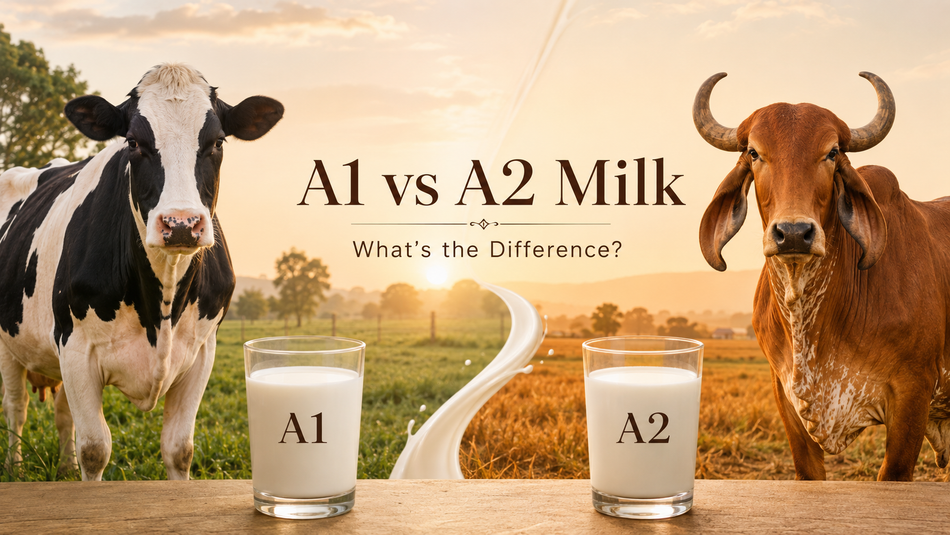
A1 and A2 milk differ mainly in the type of beta-casein protein they contain. A1 beta-casein and A2 beta-casein differ at one position in the protein chain. During digestion, A1 beta-casein can release a peptide called beta-casomorphin-7 (BCM-7), while A2 beta-casein does not release BCM-7 in the same way.
If you have searched for A1 vs A2 milk, you have probably seen very different answers. Some articles describe A2 milk as easier to digest, while others question whether the difference matters at all.
The reality is more nuanced. Research suggests that some people may experience fewer digestive symptoms with A2-only milk than with conventional A1/A2 milk. But the evidence does not establish that A2 milk is universally healthier, nor does it show that A1 milk causes major diseases in humans.
Main Difference
Beta-casein variant
A1 and A2 refer to a milk protein variant, not the entire nutrition profile.
Lactose
Both contain lactose
A2 milk is not lactose-free unless separately processed to reduce lactose.
Best Claim
Possible digestion difference
The stronger evidence is digestive comfort for some people, not broad disease prevention.
A1 vs A2 Milk: At a Glance
The most important thing to understand is that A1 and A2 describe a specific milk protein variant. They do not describe the entire nutritional profile of the milk.
What Is A1 Milk?
A1 milk is milk that contains the A1 variant of beta-casein, a protein found in cow's milk. Cow's milk contains several proteins, and caseins make up a large part of the milk protein. Beta-casein is one of those casein proteins.
A1 and A2 are naturally occurring variants of beta-casein. The difference between them is very small at the molecular level: they differ by one amino acid at position 67. A1 has histidine at that position, while A2 has proline.
What Is A2 Milk?
A2 milk is milk containing A2 beta-casein without A1 beta-casein. In other words, A2 refers to the type of beta-casein present in the milk. It does not mean that the milk is lactose-free, low-fat, higher in calcium or automatically more nutritious.
A2 milk is still ordinary milk in many other respects: it contains water, fat, lactose, protein, minerals and other milk components. The main difference being discussed is the beta-casein variant.
What Is BCM-7?
BCM-7 is a peptide that can be released during the digestion of A1 beta-casein. Researchers have studied BCM-7 because laboratory and animal studies have suggested that it can interact with biological systems, including the gastrointestinal tract.
But there is an important distinction: a biochemical mechanism is not the same thing as a proven health outcome in humans. Human research is therefore much more important when deciding what we can actually say about A1 and A2 milk.
Is A2 Milk Easier to Digest?
There is some evidence that it may be easier for certain people to tolerate, but the evidence is not strong enough to say that A2 milk is universally easier to digest.
Several controlled human studies have reported differences in digestive symptoms between A2-only milk and milk containing both A1 and A2 beta-casein. Some studies found lower abdominal pain or fewer digestive symptoms with A2-only milk in certain groups.
But the story is not completely one-sided. A randomized trial published in 2024 found mixed results, including more bloating and loose stools after A2 milk on some measures, while other symptom measures were lower. That is why we should be careful with universal claims such as A2 milk is easier to digest for everyone.
Does A2 Milk Have Less Lactose?
No. This is one of the most common misunderstandings about A2 milk.
A2 refers to beta-casein, which is a milk protein. Lactose is the natural sugar in milk. They are different components.
Important: A2 milk is not the same as lactose-free milk. Someone who has lactose intolerance should not assume that switching to A2 milk will solve the problem.
A2 Milk vs Lactose-Free Milk
Does A2 Milk Have More Nutrition Than A1 Milk?
There is no simple answer of A2 milk has more nutrients. The A1/A2 distinction primarily concerns one variant of beta-casein. It does not automatically mean that A2 milk has more calcium, vitamins, protein, fat or other nutrients.
The nutritional composition of milk can vary for many other reasons, including breed, feed, lactation stage and processing. So if you are comparing two milk products, do not judge their entire nutritional profile simply from the words A1 and A2.
Is A2 Milk Healthier Than A1 Milk?
The most responsible answer is: we cannot currently say that A2 milk is universally healthier than A1 milk.
A 2019 systematic review found stronger evidence for digestive effects than for broader health outcomes. Evidence for other health outcomes was rated low to very low certainty. So claims that A2 milk definitely prevents heart disease, diabetes, inflammation or other chronic diseases go beyond what the current human evidence can confidently establish.
What Does FSSAI Say About A1 and A2 Milk?
For Indian consumers, it is important to remember that A2 is not, by itself, an FSSAI health certification. FSSAI milk standards classify milk by categories such as cow milk, buffalo milk and toned milk rather than treating A1/A2 as a separate standardized milk category.
This does not mean A1/A2 biology does not exist. It means the label should be read carefully, and any health claim should be supported by evidence rather than marketing language alone.
Are Gir Cows A2?
Gir cows are an indigenous Indian cattle breed, and Gaurya Farms produces its flagship product using milk from indigenous Gir cows.
The important scientific distinction is between breed information and individual animal genotype. A breed can have characteristic genetic patterns, but the claim that a particular cow produces only A2 beta-casein is ultimately a genetic question.
Gaurya Farms positions its flagship product as A2 Gir Cow Bilona Ghee, made from milk from its Gir cows and through its traditional Bilona process. For any specific statement about genetic testing of individual cows, the farm should provide the underlying documentation before that claim is made.
What Does A1 vs A2 Mean for Ghee?
This is an important distinction that is often missed. A1 and A2 refer to beta-casein, a milk protein. Ghee, on the other hand, is predominantly milk fat.
So it would be misleading to take every proposed health effect of A2 milk and automatically apply it to finished ghee. A2 milk and A2-labelled ghee are not scientifically interchangeable concepts.
Gaurya Farms' product is positioned as A2 Gir Cow Bilona Ghee because its starting milk is from Gir cows and the product follows the traditional Bilona process. This is why A2 terminology should be used precisely.
A1 vs A2 Milk: What Do We Actually Know?
What is established?
- A1 and A2 are variants of beta-casein.
- They differ at one amino-acid position.
- A1 beta-casein can release BCM-7 during digestion.
- A2 beta-casein does not release BCM-7 in the same way.
What research suggests
- Some people may experience different digestive symptoms with A2-only milk.
- The effect may be more relevant to people who feel discomfort after conventional milk.
- The human evidence is still not perfectly consistent.
What remains uncertain
- Universal health superiority.
- Disease prevention claims.
- Use for everyone with lactose intolerance.
- Applying A2 milk claims directly to ghee.
Common A1 and A2 Milk Myths
So, Which Is Better: A1 or A2 Milk?
There is not one answer for everyone. If you drink conventional milk without any problems, there is currently no strong evidence that you need to switch to A2 milk simply because it is marketed as healthier.
If you regularly experience digestive discomfort after drinking ordinary milk, A2-only milk may be worth discussing or trying, particularly because several controlled human studies have found differences in digestive symptoms. But those symptoms can have many causes, and A2 milk is not a treatment for lactose intolerance or milk allergy.
If someone has a diagnosed milk allergy, changing from A1 to A2 milk does not remove the relevant milk proteins that can trigger an allergic reaction.
A2 Milk and Traditional Dairy: What Should You Look For?
Buyer checklist
- Clear sourcing: Where does the milk come from?
- Clear A2 explanation: Does the brand explain what it means by A2?
- Product-specific evidence: If genetic testing is claimed, is documentation available?
- Food-safety information: Are manufacturer details, licence information and applicable standards clear?
- No exaggerated health promises: Be cautious when A2 is presented as a cure or guaranteed solution.
For a farm such as Gaurya Farms, this creates an opportunity to explain the actual source and process rather than relying on broad health promises. Gaurya Farms is a family-run dairy farm in Chittorgarh, Rajasthan, focused on Gir Cow Bilona Ghee. Its positioning is built around indigenous Gir cows, farm origin, the complete Bilona process and visible purity/testing evidence.
The Bottom Line
A1 and A2 milk are not two completely different kinds of milk. The key difference is one variant of the beta-casein protein. That difference is scientifically real. The health story is more complicated.
Some human studies suggest that A2-only milk may cause fewer digestive symptoms for certain people compared with conventional A1/A2 milk. But the research is not consistent enough to support the broader claim that A2 milk is universally healthier than A1 milk. And A2 milk is not lactose-free.
For Gaurya Farms, that distinction matters. The brand's product story starts with indigenous Gir cows and a traditional Bilona process, but the A1/A2 science should be explained on its own terms rather than turned into a collection of health promises.
Good food information does not need exaggerated claims. It needs a clear source, an honest explanation and evidence that lets the reader make their own decision.
Frequently Asked Questions
What is the main difference between A1 and A2 milk?
The main difference is the variant of beta-casein protein. A1 and A2 beta-casein differ at one amino-acid position, and they are digested differently.
Is A2 milk healthier than A1 milk?
Current research does not establish that A2 milk is universally healthier. There is better evidence for possible differences in digestive symptoms than for broader health benefits.
Is A2 milk easier to digest?
Some controlled human studies have found fewer or different digestive symptoms with A2-only milk, particularly in some people who report discomfort with conventional milk. However, the results are not completely consistent, so it should not be described as universally easier to digest.
Does A2 milk contain lactose?
Yes. A2 milk naturally contains lactose unless it has also been specially processed to reduce lactose.
Is A2 milk good for lactose intolerance?
Not necessarily. A2 milk still contains lactose. Some trials have found fewer digestive symptoms with A2-only milk even among people with lactose maldigestion, but A2 milk should not be treated as lactose-free milk.
Are Gir cows A2?
Gir cows are an indigenous Indian cattle breed, but breed identity alone should not be treated as genetic proof for every individual animal. An individual cow's beta-casein genotype is the stronger evidence for an A2 claim.
Is A2 milk the same as A2 ghee?
No. A2 milk refers to the beta-casein type in milk. Ghee is predominantly milk fat, so the A2-protein discussion should not automatically be transferred to finished ghee.