100% Pure Ghee Made Only From Gir Cow Milk
 Every Batch Independently Lab-Tested for Purity
 Free Shipping Available Across India
 Crafted Using the Traditional Bilona Method
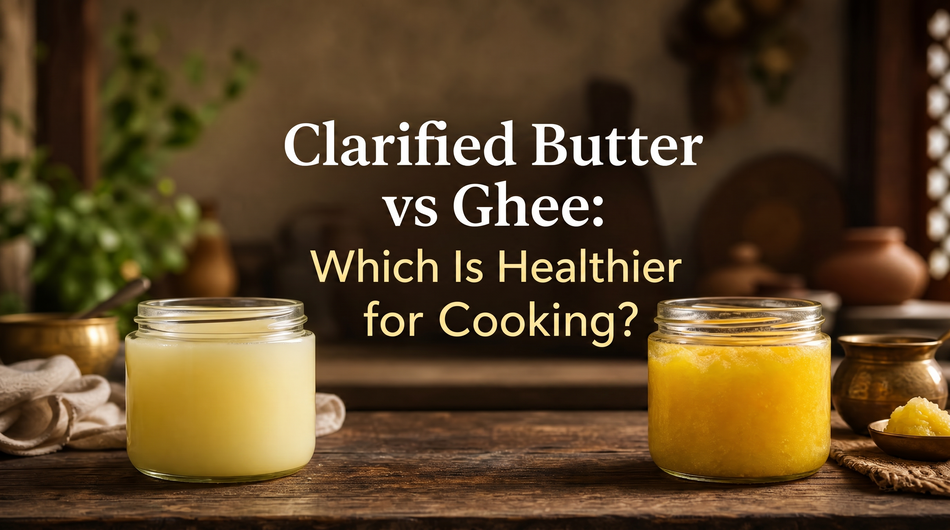
Clarified butter and ghee are closely related, but they are not always the same in practice. Both are made by heating butter or milk fat so that water evaporates and milk solids separate from the fat. The result is a golden cooking fat with a higher smoke point than regular butter. The difference is usually in how far the process is taken — and in the case of traditional Bilona ghee, where in the dairy chain it begins.
| Question | Short answer |
|---|---|
| Is clarified butter the same as ghee? | Not exactly. Ghee is a type of clarified butter, but it is usually cooked longer and develops a deeper nutty aroma. |
| Which is healthier for cooking? | For high-heat Indian cooking, ghee usually performs better. Nutritionally, both are almost pure milk fat, so the difference is modest. |
| Is Bilona ghee different? | Yes. Traditional Bilona ghee starts from cultured curd and churned butter, not simply supermarket butter. This affects flavour, aroma, and production character more than basic macronutrients. |
| Which has less lactose and casein? | Both are very low if properly clarified. Neither is guaranteed safe for people with milk-protein allergy. |
| Which tastes better? | Clarified butter tastes cleaner and milder. Ghee tastes nuttier and more roasted. Bilona ghee often has a more layered cultured aroma. |
The honest health answer: ghee is not automatically “healthier” than clarified butter in a medical sense. Both are calorie-dense dairy fats high in saturated fat. But for cooking performance, flavour impact, shelf life, and traditional Indian preparations, ghee — especially well-made Bilona ghee — often has the advantage.
What Is Clarified Butter?
Clarified butter is butter that has been gently heated until it separates into three parts: foam on top (mostly water vapour, air bubbles, and light milk solids), clear yellow butterfat in the middle, and milk solids at the bottom. The cook skims the foam, pours off the clear fat, and leaves the milk solids behind.
Regular butter is not ideal for high heat because it contains water and milk solids that brown and then burn. Clarified butter removes most of them, giving a more stable fat for higher temperatures. That is why it appears in French and Western kitchens for sautéing fish, cooking eggs, making hollandaise-style sauces, brushing pastry, and pan-frying cutlets — situations where a mild butter flavour matters but the milk solids would cause premature burning.
USDA FoodData Central lists ghee/clarified butter as essentially 100% fat by calories, with about 876 kcal and 99.5 g fat per 100 g. Per tablespoon, USDA-derived data list about 112 kcal, 12.7 g fat, 7.9 g saturated fat, and 32.8 mg cholesterol.
What Is Traditional Ghee?
Ghee is a traditional clarified milk fat used across India and South Asia, made by heating butter, cream, or cultured butter until the water is driven off and the milk solids brown enough to create ghee’s characteristic aroma. Food-science literature describes ghee as clarified butterfat with very low moisture, typically less than 0.5%, which is one reason it is shelf-stable when properly made and stored.
What makes ghee different from ordinary clarified butter?
Ghee is usually heated longer. That extra heating removes more moisture, browns the milk solids, and develops volatile flavour compounds. Research on ghee processing identifies compounds such as free fatty acids, lactones, ketones, carbonyls, and furans as contributors to ghee aroma — and processing method affects volatile flavour more clearly than it affects the broad fatty-acid profile.
What the heating process actually looks like
When butter is first heated, it sounds wet: active bubbling as water escapes. As moisture reduces, the bubbling changes — the foam becomes finer, the sound softens, and the aroma shifts from creamy butter to a warmer nutty smell. Toward the end, the milk solids at the bottom turn golden brown. Stop too early and the ghee may retain moisture. Go too far and the solids scorch, giving bitterness. That small window is where experience matters.
How Bilona Ghee Differs from Standard Ghee and Clarified Butter
Bilona ghee is not just “butter melted for longer.” It begins earlier in the dairy chain. Traditional Bilona ghee is made from curd, not directly from regular butter: milk is boiled, cultured into curd, churned to separate cultured butter, and then that butter is slowly heated into ghee.
| Feature | Clarified butter | Standard ghee | Traditional Bilona ghee |
|---|---|---|---|
| Starting point | Butter | Butter, cream, or milk fat | Cultured curd churned into butter |
| Fermentation step | Usually no | Sometimes no | Yes, curd is central to the method |
| Heating intensity | Gentle, shorter | Longer than clarified butter | Slow heating after cultured butter separation |
| Flavour | Clean, mild, buttery | Nutty, roasted | Nutty, cultured, deeper, often more layered |
| Moisture | Low if done well | Very low if done well | Very low if done well |
| Milk solids | Removed | Removed after browning | Removed after browning |
| Main advantage | Mild butter flavour for delicate dishes | Heat stability and aroma | Traditional process, cultured aroma, source transparency |
What Bilona can influence: aroma complexity, cultured flavour notes, grainy texture, colour development, and traditional authenticity. What Bilona does not do: turn ghee into medicine. The finished product is still concentrated milk fat. Claims about curing disease, burning fat, or detoxing are not appropriate. For Gaurya Farms, the strongest honest position is this: A2 Gir Cow Bilona Ghee is a traditionally made, high-quality cooking fat with distinctive flavour and source integrity. It should be used thoughtfully, not treated as a miracle food.
Flavour and Aroma: Why They Taste Different
The biggest everyday difference between clarified butter and ghee is not nutrition, it is flavour.
Clarified butter
Clarified butter is clean, smooth, and buttery. Because the milk solids are separated before deep browning, it has less roasted aroma. This makes it the right choice when you want butter flavour without dominating the dish: sole or delicate fish, French omelets, hollandaise, light sautéed vegetables, and butter-based sauces.
Standard ghee
Ghee is richer and more aromatic because milk solids are heated longer. The aroma comes from heat-driven reactions involving milk sugars, proteins, fat breakdown products, and volatile compounds — lactones, carbonyls, ketones, free fatty acids, and furans, many of which are influenced by heating and fermentation history. This makes ghee the natural choice for dal tadka, khichdi, roti, halwa, biryani, and any dish where the fat itself should add presence.
Bilona ghee
Bilona ghee often has a more layered profile because it begins from cultured curd. The cultured butter stage can contribute a gentle tangy, dairy-rich background before the nutty ghee aroma develops during heating. This is why Bilona ghee can taste more complete in simple foods — a spoon over hot dal or rice carries the aroma without needing spices to hide behind.
Nutrition Comparison
For nutrition, the comparison is less dramatic than many articles suggest. If both products are properly clarified, clarified butter and ghee are both nearly pure milk fat. The numbers from USDA-derived data for ghee/clarified butter: about 112 kcal, 12.7 g total fat, 7.9 g saturated fat, and 32.8 mg cholesterol per tablespoon.
Vitamins
| Vitamin | Present? | What to know |
|---|---|---|
| Vitamin A | Yes | USDA-derived data list about 107.5 mcg RAE per tablespoon. Amount varies with milk source and feed. |
| Vitamin D | Variable | Do not assume ghee is a reliable vitamin D source unless batch-tested. |
| Vitamin E | Small amount | Present, but not high compared with nuts, seeds, and many vegetable oils. |
| Vitamin K | Small amount | K2 may vary; most labels do not provide detailed K2 testing. |
Fatty acids
Milk fat contains saturated, monounsaturated, and small amounts of polyunsaturated fatty acids. Bovine milk fat is chemically complex and contains many fatty acids influenced by cow diet, breed, rumen metabolism, season, and lactation stage. A fuller breakdown is in What’s Inside A2 Cow Ghee? A Complete Nutrition Guide.
| Fat type | Clarified butter and ghee relevance |
|---|---|
| Saturated fat | Main nutrition concern; contributes most of the fat profile |
| Monounsaturated fat | Present in meaningful amounts, especially oleic acid |
| Polyunsaturated fat | Present in small amounts |
| Short-chain fatty acids (butyric acid) | Naturally present in milk fat; biologically interesting but not a gut cure in food amounts |
| CLA | Naturally present in ruminant dairy fat; amounts vary with cow diet; not a weight-loss tool |
| Ruminant trans fats | Naturally occurring small amounts may be present; different from industrial partially hydrogenated trans fats |
Cholesterol and saturated fat
Both clarified butter and ghee contain cholesterol because both are animal fats. USDA-derived data list about 32.8 mg cholesterol per tablespoon. For most people, the bigger practical issue is that both are high in saturated fat. The American Heart Association recommends limiting saturated fat, especially for people managing LDL cholesterol. WHO also recommends keeping saturated fat below 10% of energy intake.
Lactose and casein
| Person | Practical guidance |
|---|---|
| Lactose intolerant | Many tolerate well-clarified ghee or clarified butter, but individual tolerance varies |
| Milk-protein allergic | Avoid unless advised by a qualified clinician |
| Vegan or strict dairy-free | Neither is suitable |
Cooking Performance
| Use | Best choice | Why |
|---|---|---|
| Tadka | Ghee or Bilona ghee | Carries spice aroma beautifully; Bilona adds cultured depth with cumin, hing, curry leaves, garlic, and mustard seeds |
| Shallow frying (parathas, cutlets, makhana) | Ghee | High heat stability; water and milk solids already removed |
| Repeated deep frying | Neutral oil | Ghee is expensive and aromatic — repeated frying wastes both |
| Roasting (makhana, vegetables, millet) | Ghee | Adds aroma while roasting |
| Western sauces (hollandaise) | Clarified butter | Clean butterfat profile; ghee can taste too assertive |
| Baking | Depends on recipe | Ghee works well in Indian sweets and cookies; note that ghee has almost no water, so it does not behave exactly like whole butter — adjust moisture if substituting |
| Finishing (dal, rice, roti, khichdi) | Bilona ghee | A small spoon delivers a lot of aroma; often the best use of premium ghee |
Smoke Point
Smoke point is the temperature at which a fat begins to visibly smoke. It is useful, but it is not the whole story.
| Fat | Approximate smoke point | Cooking meaning |
|---|---|---|
| Whole butter | Around 150–175°C / 302–347°F | Burns faster due to milk solids |
| Clarified butter | Often around 230–250°C / 446–482°F | Better for higher heat |
| Ghee | Often around 230–250°C / 446–482°F | High-heat friendly, stronger flavour |
Exact smoke point varies with moisture, free fatty acids, filtration quality, age, and whether the fat has been reheated. Smoke point is not a licence for careless frying — a fat can be below its smoke point and still oxidise over long or repeated heating. Use ghee for short, high-heat cooking and aroma. Avoid repeatedly heating the same batch for deep frying.
Shelf Life and Storage
Ghee lasts longer than butter mainly because it contains very little moisture. Low moisture discourages microbial growth and slows spoilage. A review on ghee shelf-life describes ghee as microbiologically stable due to moisture typically below 0.5%.
Clarified butter lasts longer than whole butter, but its shelf life depends on how completely the water and milk solids were removed. Homemade clarified butter that still contains moisture should be refrigerated and used sooner. Well-made ghee can be stored at room temperature in Indian kitchens, though storage conditions always matter.
| Storage practice | Why it matters |
|---|---|
| Use a clean, dry spoon | Water droplets can reduce quality |
| Keep lid closed | Limits oxygen and aroma loss |
| Store away from sunlight | Light accelerates oxidation |
| Avoid steam exposure | Steam introduces moisture |
| Do not mix old and new ghee | Prevents quality carryover |
Signs ghee may be losing quality: a paint-like or stale odour, bitter aftertaste, visible mould, or excessive sourness.
Why Traditional Bilona Ghee Costs More
Bilona ghee costs more because the process is more resource-intensive at every stage: it requires large quantities of milk (since only the fat becomes ghee), time for curd setting, labour for churning, slow heating, smaller batch sizes, closer monitoring, and traceability and testing costs. Clarified butter can be made quickly from commercial butter and skips the curd-setting and churning stages entirely.
Bilona ghee makes economic sense when the ghee itself is part of the experience: dal, khichdi, roti, sweets, prasadam, and festive finishing. It may not be worth using for large-volume deep frying where the fine aroma will be lost in the process.
Common Myths vs Facts
| Myth | Fact |
|---|---|
| Clarified butter and ghee are exactly the same | Ghee is usually cooked longer and develops deeper flavour; Bilona ghee has a different starting point entirely |
| Ghee is always healthier than clarified butter | Nutritionally, they are very similar when both are fully clarified |
| Bilona ghee has no saturated fat | It is still milk fat and is high in saturated fat |
| Ghee is lactose-free for everyone | It is very low in lactose, but trace residues and individual sensitivity matter |
| People with milk allergy can safely eat ghee | Not necessarily. Milk-protein allergy requires medical caution |
| Darker ghee is always better | Colour can reflect heating, feed, season, and processing — darker is not automatically healthier |
| Smoke point means ghee can be reused endlessly | Repeated heating still degrades fats |
| CLA in ghee causes weight loss | CLA exists in dairy fat, but food-level ghee should not be promoted as a weight-loss tool |
| Bilona method dramatically changes all nutrients | It mainly affects process, flavour, aroma, and texture; major fat composition remains milk-fat based |
| Ghee is bad because it contains cholesterol | Too simplistic. It contains cholesterol and saturated fat, so amount and overall diet matter |
Decision Guide: Which to Choose
| Your priority | Clarified butter | Standard ghee | Bilona ghee |
|---|---|---|---|
| Mild butter flavour | Best | Good but stronger | Stronger, more traditional |
| Indian tadka | Works | Better | Best |
| French sauces | Best | Sometimes too nutty | Usually too aromatic |
| High-heat cooking | Good | Good | Good |
| Long shelf life | Good if well clarified | Better | Better if well made |
| Traditional Indian flavour | Moderate | Strong | Strongest |
| Budget cooking | Usually better | Moderate | Premium |
| Finishing dal, rice, roti | Good | Better | Best |
| A2 Gir cow source | Usually no | Depends | Yes, if verified |
Conclusion
Clarified butter and ghee are both concentrated dairy fats — nearly identical in calories, saturated fat, and basic nutrition when both are fully clarified. The meaningful differences are in process, flavour, aroma, and purpose. Clarified butter is clean and mild, suited to delicate dishes and Western cooking. Standard ghee is nuttier and more aromatic, suited to high-heat Indian cooking. Traditional Bilona ghee begins from cultured curd and carries more depth — it is the better choice for finishing, tadka, and traditional Indian preparations where the fat itself is part of the flavour.
Neither is a health food in a therapeutic sense. Both are best used in measured portions as part of a varied diet. The choice between them should be made on the basis of what you are cooking, what flavour you want, and how the sourcing was done — not on exaggerated claims about which one is more ancient or more healing.
To see how purity and adulteration testing apply to any ghee you buy, including clarified butter sold as ghee, the lab report parameters are the most reliable guide.