100% Pure Ghee Made Only From Gir Cow Milk
 Every Batch Independently Lab-Tested for Purity
 Free Shipping Available Across India
 Crafted Using the Traditional Bilona Method
A2 cow ghee is often described in emotional language: pure, ancient, healing, golden, sattvic. Some of that language belongs to culture and tradition. But if you are buying ghee for your family, cooking with it daily, or comparing it with butter and oils, the more useful question is simpler: what is actually inside A2 cow ghee?
The short answer: A2 cow ghee is almost entirely milk fat. It contains saturated, monounsaturated, and small amounts of polyunsaturated fats; natural cholesterol; small amounts of fat-soluble vitamins; short-chain fatty acids such as butyric acid; and minor compounds that contribute to aroma, colour, and cooking behaviour.
The longer answer is more interesting. The nutrition of ghee is not fixed like a chemical formula. It can vary with the cow’s diet, breed, stage of lactation, season, processing temperature, storage, and moisture removal. This is why two jars of traditional A2 Gir cow Bilona ghee may differ slightly in colour, aroma, graininess, and lab-test values while still being genuine ghee.
This guide explains what is inside A2 Bilona ghee without exaggeration. It separates measured nutrition from traditional belief, and explains what current research can and cannot say.
Ghee Nutrition at a Glance
The numbers people search for most: calories, protein, saturated fat, and cholesterol, at the serving sizes people actually use. Figures below are scaled from the same USDA-derived per-tablespoon data cited throughout this guide, so treat them as approximate — a brand's own batch lab report is the best source for a specific jar.
| Serving | Calories | Protein | Saturated Fat | Cholesterol |
|---|---|---|---|---|
| 1 teaspoon (~4.3 g) | ~37 kcal | ~0.01 g | ~2.6 g | ~11 mg |
| 1 tablespoon (~13 g) | ~112 kcal | ~0.04 g | ~7.9 g | ~32.8 mg |
| 100 g | ~862 kcal | ~0.3 g | ~61 g | ~252 mg |
What Is Inside A2 Bilona Ghee?
A2 Bilona ghee is clarified butterfat made from milk of cows that produce the A2 beta-casein type in milk. In Gaurya Farms’ case, the source is traditional A2 Gir cow milk, and the ghee is made using the Bilona process.
At a food-science level, finished ghee contains:
| Component | What it means |
|---|---|
| Milk fat | The main component, usually around 99% or more in well-clarified ghee |
| Water/moisture | Very low after heating and clarification |
| Milk solids | Mostly removed during clarification |
| Lactose | Typically very low because lactose stays with the water/milk-solid fraction |
| Casein/whey proteins | Mostly removed with milk solids; not suitable for people with confirmed milk-protein allergy unless advised by a clinician |
| Cholesterol | Naturally present because ghee is an animal fat |
| Fat-soluble vitamins | Mainly vitamin A, with smaller vitamin E and K; vitamin D varies |
| Fatty acids | Saturated, monounsaturated, polyunsaturated, short-chain, medium-chain, and long-chain fatty acids |
| Aroma compounds | Lactones, carbonyls, free fatty acids, and browned milk-solid-derived compounds formed during heating |
Reliable nutrition databases list ghee/anhydrous butter oil as almost completely fat. USDA-derived data report about 112 kcal, 12.7 g fat, 7.9 g saturated fat, and 32.8 mg cholesterol per 13 g tablespoon of ghee. Values vary by database and product, so a brand’s own lab report and label are the best source for that jar.
Important A2 clarification: A2 refers to the beta-casein protein type in the original milk. Since ghee is clarified fat and contains only trace protein, the “A2” identity matters most as a source and farming marker, not because the finished ghee is a meaningful source of A2 protein.
Complete Nutrition Profile
A practical nutrition profile for ghee is best shown per tablespoon because that is how people use it in dal, roti, rice, tadka, or cooking.
Typical nutrition per 1 tablespoon, about 13 g, from USDA-derived ghee data:
| Nutrient | Typical amount | Practical meaning |
|---|---|---|
| Calories | ~112 kcal | Energy-dense; portion size matters |
| Total fat | ~12.7 g | Nearly all calories come from fat |
| Saturated fat | ~7.9 g | Main nutrition tradeoff; should be counted within daily saturated-fat intake |
| Monounsaturated fat | ~3.7 g | Mostly oleic acid and related fats |
| Polyunsaturated fat | ~0.47 g | Small amount compared with seed oils |
| Carbohydrate | 0 g | Ghee is not a carb source |
| Sugar | 0 g | Lactose is negligible in well-clarified ghee |
| Protein | ~0.04 g | Not a protein source |
| Cholesterol | ~32.8 mg | Naturally present in milk fat |
| Sodium | ~0.26 mg | Essentially sodium-free if unsalted |
| Vitamin A | ~107.5 mcg RAE | Meaningful but not a substitute for a varied diet |
| Vitamin E | ~0.36 mg | Small amount |
| Vitamin K | ~1.1 mcg | Small amount; K2 varies and is often not listed |
| Vitamin D | 0 mcg in the referenced USDA item | Can vary; do not assume ghee is a reliable vitamin D source |
How to read this: ghee is not a multivitamin, protein food, or mineral source. It is a concentrated cooking fat with some naturally occurring fat-soluble nutrients.
Fat Composition Explained
Ghee’s main nutritional story is its fat composition. Milk fat is unusually complex. Research describes bovine milk fat as containing hundreds of fatty acids, influenced by rumen fermentation, cow metabolism, feed, breed, and season. One review notes that milk fatty acids come from both feed and microbial activity in the cow’s rumen.
Saturated Fat
Saturated fats are fatty acids without double bonds, more chemically stable under heat than many polyunsaturated fats. Cow milk fat naturally contains saturated fats because ruminant animals synthesise many milk fatty acids during digestion and milk production — about 7.9 g per 13 g tablespoon in USDA-derived ghee data.
Saturated fat provides energy and contributes to cell membrane structure, but humans do not need large amounts from the diet. WHO recommends that saturated fat provide no more than 10% of total energy intake, and the American Heart Association recommends a stricter limit of less than 6% for heart-health-focused dietary patterns.
A common misconception is that traditional ghee means saturated fat does not count. It still counts. Traditional foods can be high quality and still need portion awareness. One tablespoon of ghee can provide a large share of a day’s saturated-fat limit, especially for people also eating full-fat dairy, paneer, sweets, fried foods, coconut, or meat.
Monounsaturated Fat
Monounsaturated fats contain one double bond — oleic acid is the best-known example. Milk fat naturally contains oleic acid and other monounsaturated fats, about 3.7 g per tablespoon in USDA-derived ghee data.
Monounsaturated fats provide energy and are generally considered more favourable than saturated fats when replacing them in the diet. Public-health guidance generally encourages replacing saturated fats with unsaturated fats, especially from plant sources such as olive oil, nuts, seeds, and some vegetable oils. Ghee is mostly saturated, but it also contains monounsaturated fat — it can be one fat in the kitchen, but it should not be the only fat if dietary diversity is the goal.
Polyunsaturated Fat
Polyunsaturated fats include omega-3 and omega-6 fatty acids. Small amounts come through milk fat, influenced partly by feed — about 0.47 g per tablespoon in USDA-derived data. Essential fatty acids such as linoleic acid and alpha-linolenic acid must come from food, and ghee is not a major source of essential fatty acids compared with walnuts, flaxseed, fish, mustard oil, canola oil, or soybean oil.
A2 ghee may contain small amounts of omega-3, especially when cows eat green forage, but it should not be treated as an omega-3 supplement. Use ghee for flavour and cooking function; get essential fats from a broader diet.
Vitamins in Ghee
Ghee contains fat-soluble vitamins because those vitamins dissolve in milk fat.
Vitamin A
Vitamin A supports normal vision, immune function, reproduction, and cell growth. Cow milk fat carries retinol and carotenoids, and fresh green fodder can increase carotenoid pigments, which may deepen ghee’s golden colour. USDA-derived data list about 107.5 mcg RAE per tablespoon. Vitamin A is genuinely present in ghee, but the amount varies — colour is a clue, not a lab test. The darker the ghee is not necessarily “more medicinal”; golden colour may reflect carotenoids from feed, but it can also be affected by heating, breed, storage, and processing.
Vitamin D
Vitamin D supports calcium absorption and bone health. Milk fat can contain vitamin D, but levels depend on animal sun exposure, feed, fortification practices, and testing. The referenced USDA ghee item lists 0 mcg vitamin D, so it should not be assumed that all cow ghee is rich in vitamin D unless a batch-specific lab report shows it. People with low vitamin D should follow medical advice, sunlight guidance, fortified foods, or supplements where appropriate.
Vitamin E
Vitamin E is a fat-soluble antioxidant nutrient that occurs naturally in milk fat in small amounts and can vary with feed — about 0.36 mg per tablespoon in USDA-derived data. It is present, but not high compared with nuts, seeds, and many vegetable oils, and is useful as part of a mixed diet rather than the main antioxidant source.
Vitamin K
Vitamin K is involved in normal blood clotting; vitamin K2 forms are discussed in relation to bone and calcium metabolism. Dairy fat may contain vitamin K forms, especially K2, but food labels often do not provide detailed K2 data. USDA-derived data list about 1.1 mcg vitamin K per tablespoon, without full K2 detail. K2 in dairy varies by animal diet and fermentation factors, so claims about high K2 in every ghee batch should be backed by testing rather than assumed from the Bilona method alone. If K2 is a selling point, batch-level lab testing is more meaningful than generic claims.
Butyric Acid Explained
Butyric acid is one of the most interesting compounds in ghee because milk fat is one of the few common dietary fats that naturally contains it. Butyric acid, or butyrate in its salt form, is a short-chain fatty acid with four carbon atoms, present because ruminant milk fat naturally contains short-chain fatty acids produced through the cow’s digestion and milk-fat synthesis.
USDA-derived ghee data list about 0.413 g butyric acid per tablespoon. A review of bovine milk fat notes that short-chain fatty acids make up a notable fraction of milk fat, with butyric acid forming a large share of that short-chain group.
In humans, butyrate is also produced in the colon when gut bacteria ferment dietary fibre, and it is studied for its role as an energy source for colon cells and as a signalling molecule. Butyrate biology is real, but eating ghee is not the same as producing butyrate from a high-fibre diet in the colon — the amount, delivery route, and overall dietary pattern differ. The claim that ghee “heals the gut” because it contains butyrate is too strong; gut health depends heavily on fibre intake, microbiome diversity, medical conditions, and overall diet. Ghee can add short-chain dairy fat to the diet, but it does not replace dal, vegetables, fruits, whole grains, or fermented foods.
CLA Explained
CLA stands for conjugated linoleic acid — a group of linoleic acid isomers found naturally in ruminant milk and meat. CLA forms through rumen metabolism and mammary gland processes in cows, and milk fat from pasture-fed cows can contain more CLA than milk fat from cows on grain-heavy diets.
Amounts vary widely. A review on dairy as a CLA source reported milk-fat CLA values in the range of about 2.3 to 6.9 mg per gram of milk fat in some feeding studies, with large variation between cows and diets. CLA has been studied for body composition and lipid metabolism, but human evidence does not justify claims that ghee causes weight loss, burns fat, or treats disease — effects from supplements are mixed and not directly equivalent to normal food amounts in ghee.
The idea that A2 ghee “melts belly fat” because of CLA is not supported. Ghee is calorie-dense, and any weight outcome depends on total calorie intake, activity, protein, sleep, and overall dietary pattern. Pasture-based feeding may improve CLA content, but ghee should still be used in measured portions.
Cholesterol Explained
Cholesterol is a waxy lipid found in animal foods and produced by the human body. Because ghee comes from milk fat, cholesterol is naturally present — USDA-derived data list about 32.8 mg cholesterol per tablespoon of ghee.
Cholesterol is used to make cell membranes, bile acids, vitamin D, and steroid hormones. Blood cholesterol is affected by genetics, body weight, diet quality, saturated fat intake, fibre, activity, and medical conditions. Dietary cholesterol is no longer viewed as the only driver of blood cholesterol, but saturated fat can raise LDL cholesterol in many people, and ghee contains both cholesterol and substantial saturated fat. Natural does not automatically mean unlimited. People with high LDL cholesterol, diabetes, cardiovascular disease, familial hypercholesterolemia, or medical advice to limit saturated fat should be especially portion-aware.
Smoke Point & Cooking Stability
Ghee is valued in Indian cooking because it tolerates heat better than butter. Butter contains water and milk solids that brown and burn, while ghee has most water and milk solids removed, leaving mostly fat.
Ghee is commonly reported with a smoke point around 250°C / 482°F, though exact values vary with moisture, free fatty acids, filtration, and age. Smoke point is the temperature where visible smoke begins, but it is not the only measure of cooking safety — oxidation, repeated heating, frying time, food particles, and storage all matter.
Tempering spices often needs short bursts of high heat, and ghee’s low moisture and lack of milk solids make it less likely to spatter or burn quickly than butter. Ghee is suitable for tadka, sautéing, roasting, and finishing. Avoid repeatedly reheating the same ghee for deep frying, because repeated heating can increase oxidation products.
Does the Bilona Method Affect Nutrition?
The Bilona method affects the starting material and process, but it should be discussed honestly. Traditional Bilona ghee is usually made by boiling milk, setting curd, churning curd to separate cultured butter, slowly heating the butter to remove moisture and milk solids, and filtering the finished ghee.
| What Bilona clearly affects | Likely effect |
|---|---|
| Flavour | More developed, cultured, nutty notes |
| Aroma compounds | Can differ because curd fermentation and slow heating influence volatile compounds |
| Texture | Granular structure may differ with cooling and fat crystallisation |
| Moisture removal | Proper slow heating can improve shelf stability |
| Milk-solid browning | Influences aroma and colour |
| Claims that should not be exaggerated | Careful interpretation |
|---|---|
| “Bilona preserves all nutrients” | Heat-sensitive compounds can still change during heating |
| “Bilona has more butyric acid” | Possible differences need batch testing; butyric acid is naturally in milk fat regardless of method |
| “Bilona is automatically healthier than all other ghee” | Traditional method improves craft quality and sensory character, but nutrition depends on milk quality, cow diet, processing control, and lab values |
A recent processing study found that ghee processing methods can alter volatile flavour compounds without necessarily causing large changes in fatty acid composition. That means Bilona may matter more for flavour, authenticity, and traditional preparation than for dramatically changing basic macros.
Does Gir Cow Breed Influence Composition?
Gir cows are an indigenous Indian dairy breed associated with A2 milk production. Breed can influence milk composition, including fat percentage, beta-casein genetics, and pigment handling, but breed is only one part of the story.
| Factor | How it may affect ghee |
|---|---|
| Breed genetics | Milk fat traits, A2 beta-casein status in milk, carotenoid handling |
| Feed | CLA, omega-3, carotenoids, vitamin content |
| Season | Fresh green fodder vs dry fodder changes fat colour and fatty-acid profile |
| Lactation stage | Milk fat percentage and composition can shift |
| Animal health | Affects milk quality |
| Processing | Moisture, flavour, oxidation, granulation |
The honest conclusion: Gir cow milk is valuable as a traditional A2 milk source, but the finished ghee’s nutrition should be judged through source transparency plus periodic lab testing, not breed claims alone.
Can Nutrition Vary Between Batches?
Yes. Genuine farm-made ghee can vary slightly between batches. This is not automatically a defect — batch variation is expected in minimally standardised farm foods.
| Variation | Possible reason |
|---|---|
| Deeper yellow colour | More green fodder or carotenoids; sometimes longer heating |
| Paler yellow colour | Dry fodder season, less carotene, breed differences |
| Stronger aroma | More cultured butter notes or higher heating intensity |
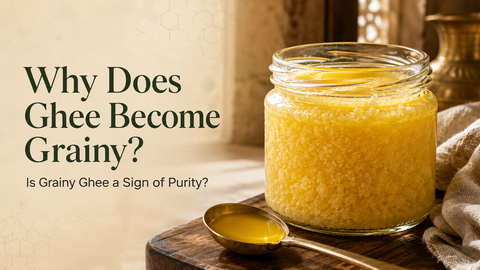
| Grainy texture | Cooling pattern and fat crystallisation |
| Softer texture | Fatty-acid profile, temperature, season |
| Different lab values | Feed, season, moisture, free fatty acids, processing time |
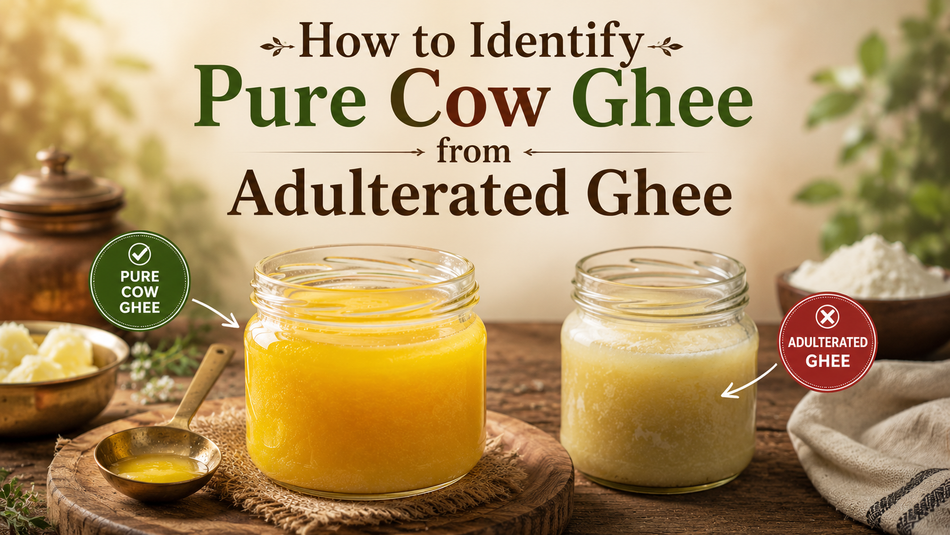
Lab-test parameters consumers may see, and what they indicate, are explained in detail in How to Identify Pure Cow Ghee from Adulterated Ghee. A good ghee brand should be able to explain lab parameters in plain language instead of only showing certificates — our own batch reports are kept publicly available on the lab reports page.
A2 Bilona Ghee vs Regular Ghee vs Butter
| Feature | A2 Bilona Ghee | Regular Ghee | Butter |
|---|---|---|---|
| Source | A2 cow milk, traditionally cultured and churned | Cow/buffalo milk fat; method varies | Cream churned into butter |
| Fat concentration | Very high, around 99% | Very high, around 99% | Around 80–82% fat |
| Water | Very low | Very low | Higher |
| Milk solids | Mostly removed | Mostly removed | Present |
| Lactose | Very low | Very low | Small amount |
| Protein | Trace | Trace | Small amount |
| Smoke point | High | High | Lower |
| Flavour | Cultured, nutty, rich | Depends on method | Creamy, sweet |
| A2 relevance | Source identity; little protein remains | Usually not specified | Depends on milk source |
| Best use | Tadka, dal, roti, rice, sautéing, finishing | Similar | Baking, spreading, low-medium heat |
Per Tablespoon: Ghee vs Common Oils
| Food | Calories | Total fat | Saturated fat | Cholesterol |
|---|---|---|---|---|
| Ghee | ~112 kcal per 13 g | ~12.7 g | ~7.9 g | ~32.8 mg |
| Butter, unsalted | ~102 kcal per 14 g | ~11.5 g | ~7.3 g | ~30 mg |
| Olive oil | ~119 kcal per 14 g | ~14 g | ~1.9 g | 0 mg |
| Coconut oil | ~121 kcal per 14 g | ~13.5 g | ~11.2 g | 0 mg |
| Canola oil | ~124 kcal per tbsp | ~14 g | ~1 g | 0 mg |
Extra virgin olive oil and canola oil are low in saturated fat and contain no cholesterol, while coconut oil is plant-based but still very high in saturated fat. Ghee and butter sit closer together, with ghee offering a higher smoke point because its milk solids and water have already been removed.
Common Myths vs Facts
| Myth | Fact |
|---|---|
| A2 ghee contains lots of A2 protein | Finished ghee contains only trace protein; A2 refers mainly to the milk source |
| Ghee is lactose-free for everyone | It is very low in lactose, but people with severe dairy allergy should be cautious |
| Ghee burns fat | No food burns fat by itself; ghee is calorie-dense |
| Dark yellow always means better nutrition | Colour can reflect carotenoids, but also season and heating |
| Bilona ghee never varies | Traditional farm ghee naturally varies between batches |
| Ghee has no cholesterol | Ghee naturally contains cholesterol |
| Ghee is bad because it has saturated fat | Too simplistic — it is high in saturated fat, so amount and overall diet matter |
| Ghee is healthier than all oils | Not automatically. Olive, mustard, groundnut, sesame, and other oils have different strengths |
| Smoke point means unlimited frying | Repeated heating still degrades fats |
| Lab-tested means all nutrients are high | Lab testing confirms parameters; it does not turn ghee into a cure-all |
How Much Ghee Can You Consume?
There is no single correct amount for everyone. A practical range for many healthy adults is 1–2 teaspoons per day, used intentionally in meals. Some people may use more, but it should fit within total calories and saturated-fat limits.
One tablespoon of ghee contains about 7.9 g saturated fat. On a 2,000 kcal diet, WHO’s 10% saturated-fat ceiling equals about 22 g saturated fat per day, while the American Heart Association’s stricter 6% target is about 13 g per day. That means one tablespoon of ghee can be about one-third of a 10% saturated-fat limit, or more than half of a stricter 6% saturated-fat target.
| Use | Approximate amount |
|---|---|
| Brushing on 1–2 rotis | 1 tsp |
| Dal finishing | 1 tsp |
| Tadka for 2 servings | 1–2 tsp |
| Rice/khichdi topping | 1 tsp |
| Heavy festive use | Track consciously |
People should seek personalised advice if they have high LDL cholesterol; heart disease or strong family history; diabetes or metabolic syndrome; fat-malabsorption conditions; gallbladder issues; medical advice to limit saturated fat; or confirmed milk-protein allergy. Ghee can be part of a balanced Indian diet, but it should share space with dals, vegetables, fruits, curd, whole grains, nuts, seeds, and other cooking fats.
How to Read an A2 Ghee Nutrition Label
When comparing jars, look beyond the front label.
| Label item | What to look for |
|---|---|
| Ingredient list | Ideally only cow ghee / milk fat |
| Serving size | Often 5 g, 10 g, or 15 g; compare carefully |
| Calories | All ghee is calorie-dense |
| Total fat | Should be high because ghee is almost pure fat |
| Saturated fat | Key value for portion planning |
| Trans fat | Should be low; ask if values are tested |
| Cholesterol | Expected in ghee |
| Added colour/flavour | Not needed in genuine ghee |
| FSSAI/license details | Basic compliance marker |
| Batch number | Needed for traceability |
| Lab report | Best brands can explain moisture, FFA, peroxide value, RM value, and adulteration tests |
Conclusion
So, what’s inside A2 cow ghee? Mostly concentrated milk fat, with a naturally complex mixture of fatty acids, cholesterol, small amounts of fat-soluble vitamins, butyric acid, CLA, and aroma compounds created or concentrated through traditional preparation.
The real value of A2 Gir cow Bilona ghee is not that it is a miracle food. It is that it is a traditional, flavourful, heat-stable dairy fat whose quality depends on transparent sourcing, careful processing, honest lab testing, and mindful use.
For Gaurya Farms, the strongest claim is also the most credible one: traditional A2 Gir cow Bilona ghee can be a beautiful part of an Indian kitchen when people understand what it contains, how it varies, and how to use it wisely. Explore the A2 Gir Cow Bilona Ghee to see batch-level lab data for yourself.