100% Pure Ghee Made Only From Gir Cow Milk
 Every Batch Independently Lab-Tested for Purity
 Free Shipping Available Across India
 Crafted Using the Traditional Bilona Method
One tablespoon of buffalo ghee carries close to 9 grams of fat and about 80 calories. The same spoon of cow ghee lands a shade lighter, both in weight and in aftertaste. That small gap on a nutrition label turns into a real difference on your dinner plate, in your monthly grocery bill, and in how your body handles the fat over years of daily use. The "which is better" question does have a real answer — but it depends on who is asking, and why.
The Raw Material Decides Everything
Cow milk holds roughly 3.5% to 4.5% fat. Buffalo milk holds nearly double that, at 6% to 8%. This single number explains almost every downstream difference between the two ghees.
| Milk Type | Fat Content | Milk Needed per Kg of Ghee |
|---|---|---|
| Cow Milk | 3.5%–4.5% | 20–25 litres |
| Buffalo Milk | 6%–8% | 15–18 litres |
Because buffalo milk is fattier, a dairy needs less of it to make a kilogram of ghee. That is why buffalo ghee has historically been cheaper to produce at scale, and why large commercial kitchens, sweet shops, and caterers in North India lean on it. Cow ghee, especially from indigenous (desi) breeds like Gir, Sahiwal, or Tharparkar, yields less fat per litre, which pushes up the cost of production before any branding markup gets added.
Neither milk is "better" at the udder stage. The gap opens once the fat is separated, cultured, and simmered into ghee.
Colour: A Question of Biochemistry, Not Marketing
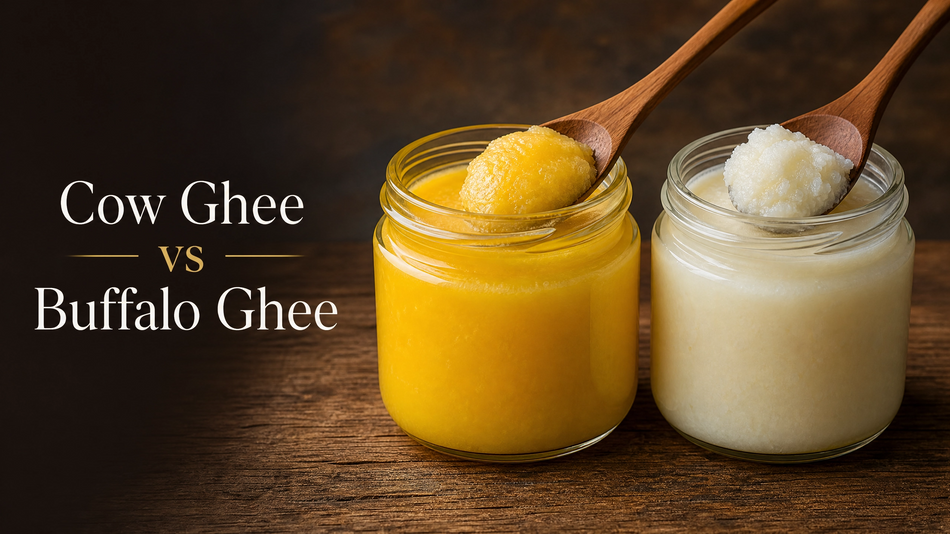
Walk into any Indian kitchen and you can usually tell cow ghee from buffalo ghee just by looking at the jar. Cow ghee runs golden yellow, sometimes deep amber. Buffalo ghee sits pale, almost white or ivory.
This is not dye, and it is not a quality signal either way — it is straight physiology. Cows absorb beta-carotene from grass and fodder and deposit a portion of it, unconverted, directly into their milk fat. That pigment is what paints cow ghee yellow. Buffaloes run a more efficient liver enzyme system that converts nearly all dietary beta-carotene into colourless retinol (active vitamin A) before it reaches the udder. Vitamin A content can be comparable in both ghees; the visible pigment simply is not there in the buffalo version.
So the old idea that white ghee is "less pure" does not hold up. Colour reflects the animal's biology, not adulteration, fat percentage, or nutrient density.
Taste and Texture in the Kitchen
Set both jars on the counter at room temperature — say 25°C to 28°C, typical for most of India outside winter — and the texture split becomes obvious.
| Cow Ghee | Buffalo Ghee | |
|---|---|---|
| Texture | Grainy, crumbly, almost sandy at the edges | Smoother, denser, closer to a solid block |
| Aroma | Light, slightly sweet, faintly caramelised | Heavier, richer, almost waxy |
| Mouthfeel | Softer, breaks down easily | More pronounced, dairy-forward |
| Smoke point | Around 250°C (482°F) | Around 250°C (482°F); holds structure slightly longer under sustained heat |
Traditionalists call cow ghee's granulation a sign of a good "bilona" batch. The difference comes down to triglyceride structure — buffalo milk fat carries a larger share of long-chain saturated fatty acids and bigger fat globules, which pack tighter and melt at a narrower, higher temperature band. Cow milk fat has a wider mix of chain lengths, so it softens gradually and breaks into that classic granular texture.
On smoke point, both sit in a similarly high range — well above sunflower oil (around 225°C) or regular butter (150°C). Buffalo ghee's higher saturated fat share is one reason halwais (sweet-makers) doing repeated deep-frying often prefer it for jalebi and bhatura batches that run for hours.
What the Fat Actually Contains
Strip away tradition and look at the chemistry. Ghee overall — averaged across sources — runs about 99.5% fat, under 0.3% protein, and effectively zero carbohydrate.
| Nutrient (per 100g) | Approximate Value |
|---|---|
| Fat | 99.5% |
| Protein | Under 0.3% |
| Carbohydrate | Close to 0g |
| Saturated fat | Around 62% of total fat |
| Monounsaturated fat | Around 29% |
| Polyunsaturated fat | Around 4% |
| Calories | Around 876 kcal |
| Cholesterol | Around 256 mg |
| Vitamin A | Around 93% of daily value |
| Vitamin E | Around 19% of daily value |
We break these numbers down in more detail, including how ghee compares to other cooking fats, in Ghee Nutrition Facts: Calories, Protein, Fat and Vitamins.
The cow-versus-buffalo split shows up inside that saturated fat number. A fatty-acid profiling study comparing ghee from indigenous cattle breeds (Sahiwal, Tharparkar) against buffalo ghee found some meaningful differences:
| Parameter | Indigenous Cow Ghee | Buffalo Ghee |
|---|---|---|
| Total saturated fatty acids | Lower (around 55 g/100g in Sahiwal) | Higher |
| Oleic acid | Higher (around 35 g/100g) | Lower |
| Conjugated linoleic acid (CLA) | Higher | Lower |
| "Hypercholesterolaemic" fatty acids | Lower | Scored highest among samples tested |
| Atherogenic & thrombogenic indices | Better (lower risk markers) | Higher |
CLA is a fatty acid linked in animal studies to anti-inflammatory and metabolic effects, though human research is still developing. None of this makes buffalo ghee dangerous, and none of it makes cow ghee a health food you can eat without limit — both remain over 55% saturated fat. The World Health Organization, the British Nutrition Foundation, and Canada's Heart and Stroke Foundation all advise capping saturated fat intake generally, ghee included, regardless of the animal source. If you are managing LDL cholesterol or an existing heart condition, portion control matters more than the animal source — a teaspoon or two a day, not a ladle, and always in line with your doctor's guidance.
Where Ghee Quality Actually Fails
The real risk with ghee rarely comes from the cow-versus-buffalo choice. It comes from what happens before the jar reaches your kitchen.
- Adulteration with vanaspati or palm olein. Hydrogenated vegetable fat is cheaper than milk fat and sometimes gets blended into loose "ghee" sold in some markets. The giveaway is a texture that stays uniformly waxy with none of the natural granulation, and a flat smell with no nutty or caramel notes.
- Cholesterol oxidation products (COPs). Repeated deep-frying and reheating of the same ghee batch, common at roadside food stalls, generates oxidised cholesterol compounds that research has linked to arterial damage. Fresh ghee used once or twice, then discarded, avoids this almost entirely.
- Moisture-driven rancidity. Pure ghee holds under 0.5% moisture. Any water contamination invites hydrolytic rancidity, turning the ghee sour and eventually mouldy at the jar's rim.
- Mislabeling on the animal source. FSSAI purity testing uses the Reichert-Meissl (RM) value, which measures short-chain volatile fatty acids. Regulatory minimums differ slightly for cow ghee versus buffalo ghee precisely because their natural fatty acid ranges differ — a batch failing its stated category's RM threshold is the lab's way of flagging a mismatch or dilution.
None of these failure points care whether the ghee came from a cow or a buffalo. They care about how the ghee was made, stored, and reused. We cover how to spot these issues in detail in How to Identify Pure Cow Ghee from Adulterated Ghee.
A Kitchen Test You Can Run Tonight
Buy two small jars — one labelled cow ghee, one buffalo ghee, both from the same reputable brand or the same local dairy. Run this three-step check at home:
- Melt one teaspoon of each in separate pans over low heat. Cow ghee will liquefy faster and clear; buffalo ghee takes a beat longer and looks slightly thicker in its molten state.
- Drizzle each over plain steamed rice or roti. Cow ghee's lighter aroma comes through almost immediately. Buffalo ghee's flavour lands heavier and lingers longer on the palate.
- Use each for tempering (tadka) with cumin and mustard seeds. Watch how fast the seeds crackle — buffalo ghee, holding heat a touch longer due to its fat structure, often gives a slightly sharper pop.
This is not a lab test, but it is the fastest way to build an intuition for the two fats without reading a single ingredient panel.
Bilona, Creamery, and the A2 Question
Two production methods matter more than most shoppers realise. Bilona-method ghee is churned from curdled, cultured milk using a wooden hand-churner, then simmered slowly — a process that preserves more of the natural flavour compounds and typically costs more, sometimes ₹1,200 to ₹2,500 per kilogram for branded desi cow versions. Creamery-method ghee, the industrial default, separates cream directly from raw milk before clarifying it — faster, cheaper, and the standard for most buffalo ghee sold at ₹500 to ₹900 per kilogram. We have written a full breakdown of the traditional process in What Is Bilona Ghee? Traditional Bilona Method Explained.
The "A2 ghee" marketing wave adds another layer, referring to milk from cows producing only the A2 beta-casein protein variant rather than A1. Because ghee is nearly pure fat with the casein protein removed during clarification, the A1/A2 distinction has limited relevance to the finished ghee itself — it is a milk-drinking consideration that has been carried over into ghee marketing more by momentum than by biochemistry. Worth knowing before paying a premium for the label alone.
So, Which One for Daily Use?
There is no single winner — only a better fit for your situation.
- Choose cow ghee if you are feeding small children, managing cholesterol, cooking for elderly family members, or you simply prefer a lighter, more digestible fat for daily roti and dal. Ayurvedic tradition has favoured cow ghee for exactly these use cases, and the modern fatty-acid data lines up with that instinct.
- Choose buffalo ghee if you are deep-frying regularly, running a household with heavy physical labour or high calorie needs, or working within a tighter grocery budget. Its higher fat density and marginally sturdier heat tolerance suit high-heat, high-volume cooking.
Most Indian households do not need to pick one and abandon the other. Many keep a smaller jar of cow ghee for finishing dals, rice, and rotis where its lighter flavour shows up best, and a larger tin of buffalo ghee for frying, sweets, and bulk cooking where cost and heat stability matter more.
Your Next Step
Check the ghee jar already in your kitchen. Look at the colour, scoop out a spoonful and feel the texture at room temperature, and check the label for the fat source and production method. If it is unlabelled loose ghee from a local vendor, ask directly which animal's milk it came from and how it was made — a straight answer, with no hedging, is usually the best purity test you will get outside a lab.
If cow ghee is the better fit for your kitchen, Gaurya Farms makes A2 Gir Cow Bilona Ghee at our farm in Chittorgarh, Rajasthan, with every batch lab tested for purity.