100% Pure Ghee Made Only From Gir Cow Milk
 Every Batch Independently Lab-Tested for Purity
 Free Shipping Available Across India
 Crafted Using the Traditional Bilona Method
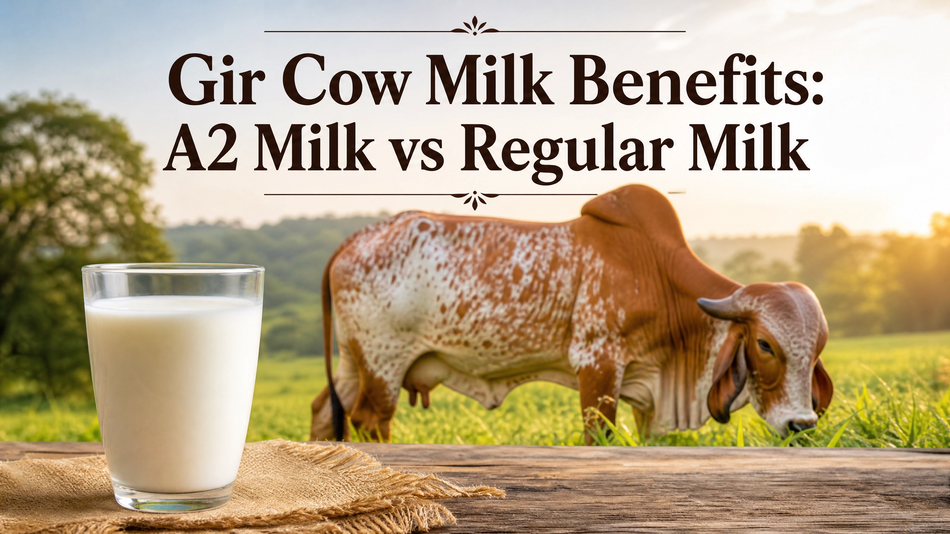
Introduction: Why People Are Interested in Gir Cow Milk
People usually search for gir cow milk benefits because they have heard that Gir cows are connected with A2 milk, they want to understand whether A2 milk benefits are scientifically proven, or they are comparing gir cow milk vs regular milk before buying premium dairy products such as milk, curd, butter, or A2 Gir Cow Bilona Ghee.
The honest answer is this: Gir cow milk can be valuable, but not because it is magical. Its value comes from a combination of breed genetics, milk composition, animal care, feed quality, freshness, processing method, and transparency from the producer.
A2 milk is not medicine. It is not lactose-free. It is not suitable for people with true milk allergy. But for some people who feel digestive discomfort after drinking regular cow milk, early research suggests A2-only milk may be easier to tolerate than milk containing both A1 and A2 beta-casein.
This guide separates what science currently supports, what Indian dairy tradition has valued for generations, and what marketing claims should be questioned before believing.
What Is a Gir Cow?
The Gir cow is an indigenous Indian dairy breed originally associated with the Gir region of Gujarat. It belongs to the Bos indicus, or zebu, cattle group.
Gir cattle are widely respected for heat tolerance, adaptability to Indian climatic conditions, good fertility and longevity under suitable management, and distinct dairy potential among indigenous breeds. They are also known for their domed forehead, long ears, curved horns, and reddish, white, or mottled coat patterns.
According to Indian dairy breed references, Gir is considered one of India’s important milch breeds. The Dairy Knowledge Portal notes average Gir lactation yield around 2,110 kg, with average milk fat around 4.6%, though actual yield varies widely by genetics, feeding, health, and farm management.
What is known: Gir is a recognized Indian dairy breed with good milk potential.
What is uncertain: Milk quality cannot be assumed from breed name alone.
What research suggests: Breed matters, but management strongly affects production and composition.
What consumers should expect: Gir milk may be rich and suitable for ghee-making, but authenticity and farm practices matter as much as breed claims.
History and Characteristics of Gir Cattle
Gir cattle developed in western India, especially Gujarat’s Saurashtra region. Their traditional breeding areas include parts of Junagadh, Amreli, Bhavnagar, and Rajkot. Gir genetics later gained global attention and contributed to dairy development in Brazil, including Gir Leiteiro and Girolando breeding programs.
| Feature | Gir Cow Characteristic |
|---|---|
| Origin | Gujarat, India |
| Cattle type | Bos indicus / zebu |
| Primary use | Dairy |
| Climate suitability | Hot and semi-arid regions |
| Appearance | Convex forehead, long ears, curved horns |
| Milk profile | Often good fat percentage, but varies |
| Temperament | Generally calm when handled well |
Traditional dairy producers value Gir cows not only for milk but also for their ability to perform in Indian environmental conditions. A cow that stays healthy, eats well, calves regularly, and produces consistent milk is more valuable than one that gives high milk only under intensive inputs.
What Is A2 Milk?
A2 milk is cow milk that contains only the A2 type of beta-casein protein. Milk contains several proteins, mainly casein proteins and whey proteins. Beta-casein is one type of casein. Different cows can produce different beta-casein variants, mainly A1, A2, or a mix of both.
So when people say “A2 milk,” they are not referring to the whole milk being completely different. They are referring specifically to the beta-casein protein type.
- A2 milk still contains lactose.
- A2 milk still contains milk proteins.
- A2 milk is not automatically organic.
- A2 milk is not automatically raw, pure, or higher quality.
- A2 milk can come from several breeds, not only Gir cows.
This is one of the biggest misunderstandings in the A2 dairy market.
Understanding A1 vs A2 Beta Casein
The difference between A1 and A2 beta-casein is small at the molecular level but potentially meaningful during digestion. A1 and A2 beta-casein differ by a single amino acid in the protein chain. During digestion, A1 beta-casein may release a peptide called beta-casomorphin-7, often shortened to BCM-7. A2 beta-casein is considered less likely to release BCM-7 under normal digestion.
| Factor | A1 Milk | A2 Milk |
|---|---|---|
| Beta-casein type | Contains A1 beta-casein, often with A2 | Contains A2 beta-casein only |
| BCM-7 release | More likely during digestion | Less likely |
| Lactose content | Present | Present |
| Milk allergy risk | Still possible | Still possible |
| Digestive tolerance | May bother some sensitive people | May be easier for some people |
| Proven disease prevention | Not established | Not established |
What is known: A1 and A2 beta-casein differ structurally. A1 digestion can produce more BCM-7.
What is uncertain: The long-term health significance of BCM-7 in humans remains debated.
What research suggests: A2-only milk may reduce digestive symptoms in some milk-sensitive people.
What consumers should expect: A2 milk may be worth trying for digestive comfort, but it should not be treated as a cure.
How Gir Cow Milk Differs From Regular Milk
“Regular milk” usually means milk from mixed commercial sources. It may come from Holstein, Jersey, crossbred cows, buffaloes, or mixed herds depending on the region and supply chain.
- Beta-casein type: Many Indian indigenous breeds, including Gir, are commonly associated with A2 beta-casein, though individual testing is the reliable method.
- Fat and solids: Gir milk is often valued for fat content, which matters for curd, butter, and ghee.
- Farm system: Smaller traditional farms may handle milk differently from large pooled supply chains.
- Processing: Freshness, boiling, homogenization, pasteurization, fermentation, and ghee-making all influence the final product.
Not every difference comes from the cow breed. Milk composition changes with feed, season, stage of lactation, cow health, water access, stress level, milking hygiene, storage temperature, and processing method.
This is where many A2 articles become misleading. They make it sound as if the breed alone explains everything. In real dairy science, breed is only one part of the story.
Nutrition Profile of Gir Cow Milk
Gir cow milk is nutritionally similar to other cow milk in its basic structure: water, fat, protein, lactose, minerals, and vitamins.
| Nutrient | Role in Diet |
|---|---|
| Protein | Supports body tissue maintenance and growth |
| Fat | Provides energy and carries fat-soluble vitamins |
| Lactose | Natural milk sugar |
| Calcium | Bone and tooth health |
| Phosphorus | Bone structure and metabolism |
| Vitamin B12 | Nerve and blood cell function |
| Riboflavin | Energy metabolism |
| Potassium | Fluid balance and muscle function |
Gir milk may have good fat and solids content, making it suitable for products like curd, butter, and ghee. But exact values vary from farm to farm.
What is known: Gir milk can be a nutrient-dense dairy food.
What is uncertain: A random “Gir milk” label does not guarantee a fixed nutrition profile.
What research suggests: Indigenous breeds may offer useful milk composition traits, but feeding and management matter greatly.
What consumers should expect: Ask for lab-tested fat, SNF, and quality reports if buying premium milk regularly.
Does A2 Milk Have More Benefits? What Science Says
The strongest current discussion around a2 milk benefits is digestive tolerance. Some human studies suggest that A2-only milk may cause fewer gastrointestinal symptoms than regular milk containing A1 beta-casein in certain people who report milk sensitivity. Reported differences may include less bloating, abdominal discomfort, or stool changes.
However, evidence is not strong enough to claim that A2 milk prevents or treats disease. The European Food Safety Authority reviewed beta-casomorphins and concluded that a cause-and-effect relationship was not established between BCM-7 intake and non-communicable diseases.
| Claim | Evidence Status |
|---|---|
| A2 milk contains a different beta-casein profile | Strong |
| A1 beta-casein can release more BCM-7 during digestion | Supported |
| A2 milk may be easier to digest for some people | Promising but still developing |
| A2 milk cures lactose intolerance | False |
| A2 milk prevents diabetes, autism, heart disease, or other diseases | Not established |
| A2 milk is automatically healthier than all regular milk | Too broad |
Practical takeaway: If regular milk causes mild digestive discomfort but you are not allergic to milk, A2 milk may be worth a careful personal trial. If you have diagnosed lactose intolerance, milk allergy, IBS, or another medical condition, speak with a qualified health professional.
Myths vs Facts About A2 Milk
| Myth | Fact |
|---|---|
| All Gir cow milk is automatically verified A2 | Breed tendency is not the same as individual testing |
| A2 milk is lactose-free | A2 milk contains lactose |
| A2 milk cures milk allergy | It still contains milk proteins |
| A2 milk is always organic | A2 refers to protein type, not farming method |
| A2 milk is always raw or traditional | A2 milk can be pasteurized, homogenized, or processed |
| Gir milk benefits come only from A2 protein | Fat, feed, freshness, and handling also matter |
| Regular milk is harmful for everyone | Many people tolerate regular milk well |
| More expensive means more authentic | Verification and transparency matter more than price |
This is where consumers should be cautious. Premium dairy deserves premium transparency.
Why Cow Breed Is Only One Part of Milk Quality
A Gir cow can produce poor-quality milk if the farm has poor feeding, poor hygiene, stress, disease, or careless storage. Likewise, a non-Gir dairy cow can produce clean, nutritious milk under excellent management.
Breed influences genetic potential. Management decides how much of that potential becomes real milk quality. Important quality factors include clean housing, balanced feed, clean water, low-stress handling, udder health, timely milking, rapid chilling or safe boiling, no adulteration, regular testing, and ethical calf and cow care.
A knowledgeable dairy producer does not judge milk by breed alone. They look at the animal, the feed, the milking routine, the smell of the shed, the cleanliness of vessels, and the time between milking and processing. That is the difference between a label and a dairy system.
How Farming Practices Influence Milk Quality
Milk begins before milking. It begins in the soil, fodder, water, and cow care.
Feed
Green fodder, dry fodder, mineral mixture, oil cakes, grains, and pasture access all influence milk yield and composition. Fat percentage can change depending on roughage quality and energy balance.
Stress
Heat stress, overcrowding, rough handling, and poor resting space can affect milk output and animal health.
Udder health
Mastitis and udder infections can reduce milk quality. Responsible farms monitor udder health and avoid selling compromised milk.
Hygiene
Even excellent milk can be spoiled by dirty hands, vessels, water, or storage containers.
Time and temperature
Milk is highly perishable. The gap between milking and boiling, chilling, curd-setting, butter-making, or ghee-making matters.
When buying premium A2 Gir dairy, ask not only “Is it Gir cow milk?” but also how the cows are fed, whether the herd is tested for A2 genetics, whether milk is tested for fat and SNF, whether adulteration tests are done, how quickly milk is processed, and whether the ghee is made from curd-butter or cream-butter.
At Gaurya Farms, customers can also review lab reports to better understand product purity and testing transparency.
From Gir Cow Milk to Traditional Bilona Ghee
For Gaurya Farms, the connection between Gir cow milk and Bilona ghee is especially important. Traditional Bilona ghee is usually made by collecting milk, boiling it, setting curd with a starter culture, churning the curd to separate butter, and slowly heating the butter to make ghee.
This differs from industrial cream-based ghee, where cream is separated directly from milk and converted into ghee. The traditional curd-butter route may influence aroma, texture, and flavor because fermentation develops compounds that are not present in the same way in direct cream processing.
| Method | Process | Likely Difference |
|---|---|---|
| Cream ghee | Milk to cream to butter/ghee | Efficient, common in industry |
| Bilona ghee | Milk to curd to churned butter to ghee | Traditional, fermented flavor profile |
| A2 Gir Bilona ghee | A2 Gir milk to curd-butter ghee | Combines breed selection with traditional processing |
Scientific clarity: Ghee is almost entirely fat, so it contains very little protein. That means the A1/A2 beta-casein distinction is most relevant to milk and curd, not ghee in the same way.
Traditional value: Bilona ghee is valued for its slow process, cultured aroma, and artisanal character. You can read more in our guide to the traditional Bilona method.
Marketing caution: A2 Bilona ghee should not be promoted as a cure for disease. Its real value is ingredient traceability, traditional preparation, sensory quality, and responsible sourcing.
How Consumers Can Identify Authentic A2 Milk
Authentic A2 milk is not proven by a cow photo, a premium jar, or the word “desi.” Look for practical transparency.
| What to Ask | Why It Matters |
|---|---|
| Is the herd beta-casein tested? | Confirms A2 status more reliably than breed claims |
| Are cows pure Gir or crossbred? | Helps understand the breed claim |
| Is milk pooled with other farms? | Mixed milk may dilute traceability |
| Are fat and SNF tested? | Indicates basic milk composition |
| Are adulteration tests done? | Builds safety trust |
| How is milk handled after milking? | Freshness and hygiene matter |
| How is ghee made? | Bilona and cream ghee are different processes |
| Can the farm explain its process clearly? | Honest producers can explain limits, not just benefits |
Red flags include miracle disease claims, promises that A2 milk has no lactose, claims that it is safe for milk allergy, and premium pricing without testing or process transparency.
Final Decision Guide
Use this simple guide before buying Gir cow milk or A2 Bilona ghee.
| Your Priority | What to Look For |
|---|---|
| Digestive comfort | Try verified A2 milk cautiously; do not use if allergic |
| Traditional dairy | Look for curd-churned Bilona process |
| Authentic Gir sourcing | Ask about breed records and herd testing |
| Nutrition | Check fat, SNF, freshness, and handling |
| Trust | Prefer transparency over big claims |
| Ghee quality | Ask whether it is made from curd-butter or cream |
| Medical concerns | Consult a health professional |
Gir cow milk can be a valuable traditional dairy choice, especially when it is genuinely A2, cleanly produced, and transparently processed. But its benefits should be understood realistically. The cow breed matters, the A2 protein matters, and the farm system matters just as much.
For Gaurya Farms, the strongest educational position is not “A2 is a miracle.” It is this: good ghee begins with good milk, good animals, good feed, careful fermentation, honest processing, and transparency at every step. To see the product made from this philosophy, visit our A2 Gir Cow Bilona Ghee.