100% Pure Ghee Made Only From Gir Cow Milk
 Every Batch Independently Lab-Tested for Purity
 Free Shipping Available Across India
 Crafted Using the Traditional Bilona Method
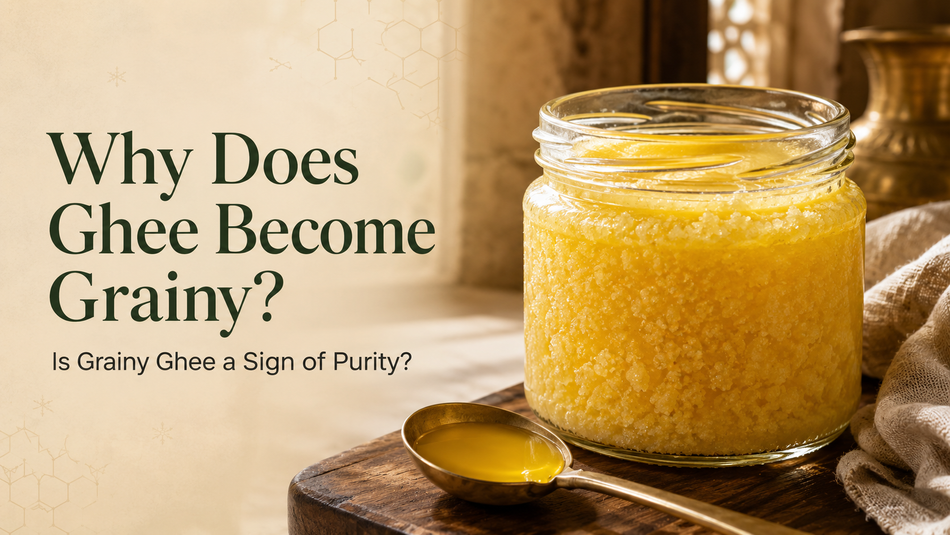
You open a jar of ghee and find tiny grains instead of the smooth texture you expected. Or the ghee that was liquid last week has become semi-solid. Has it spoiled? Is it pure? Should you melt it before using it?
Quick answer
Ghee usually becomes grainy because parts of its milk fat crystallise as it cools. Temperature, cooling rate, fat composition, production method and storage history can all affect the size and appearance of those crystals. Graininess is normally a texture change, not proof of spoilage. It is also not a conclusive purity test: both grainy and smooth ghee can be genuine, so purity should be assessed through sourcing, lab testing and label information rather than texture alone.
What does “grainy” or “danedar” ghee mean?
Grainy ghee contains small, visible or detectable fat crystals. Depending on the jar and room temperature, the texture may look:
- softly granular, like very fine semolina;
- creamy with a thin liquid layer;
- firm with small pale grains; or
- partly solid and partly liquid.
In many Indian households, this texture is called danedar ghee. It is widely associated with traditional ghee, but the grains themselves are not a separate ingredient. They are structures formed by crystallised milk fat.
Milk fat is not a single compound with one exact melting point. It contains a complex mixture of triacylglycerols, fat molecules with different melting and crystallisation behaviour. As warm liquid ghee cools, some fractions begin to form crystals while others remain liquid. Those crystals and the network they form determine whether the ghee feels grainy, creamy, waxy or smooth.
Why does ghee become grainy?
1. Milk fat crystallises while cooling
This is the main reason. During cooling, higher-melting fat fractions start to solidify. Small clusters form first; these act as starting points from which crystals grow. If some crystals grow large enough, the tongue and eye detect a granular texture.
This physical change does not mean that a new substance has appeared in the jar. When the ghee is warmed sufficiently, the crystals melt and the ghee becomes liquid again.
2. Cooling rate changes the size of the crystals
Cooling history matters, not simply whether the ghee became cold.
Milk-fat research shows that different cooling rates produce different crystal sizes and structures. Faster cooling generally creates more, smaller crystals; slower or staged cooling can allow larger crystal structures to develop. This is why two jars from the same type of ghee can look different if one cools gradually and the other is placed in a refrigerator soon after melting.
The simple rule “slow cooling always makes ghee grainy” is still too absolute. The result also depends on the temperature at which the ghee rests, its composition, movement during cooling and how long it is allowed to crystallise.
3. Room temperature changes through the year
Ghee can be liquid in a hot Rajasthan summer, semi-solid during milder weather and firm in winter. These are different physical states of the same fat.
Milk fat melts over a range rather than at one sharp temperature. Research on ghee and milk fat reports several crystal forms and melting transitions across ordinary storage-temperature ranges. That is why one part of a jar may be solid while another remains soft or liquid.
Repeated warming and cooling can also rearrange the crystals. A jar that melted during transport may set with a different texture after reaching your home. The change alone does not show that the product was adulterated.
4. Fat composition varies
The proportion of individual fatty acids and triacylglycerols influences how milk fat melts and crystallises. A study comparing commercial and laboratory ghee found substantial variation in grain size and quantity, along with differences in fatty-acid composition and crystallisation behaviour.
Composition can be influenced by several factors before and during production, including the source milk and processing conditions. This means natural ghee is not guaranteed to look identical in every batch.
5. Processing and handling affect texture
Clarification temperature, cooling conditions, stirring, packing temperature and later storage can all influence the crystal network. A curd-based Bilona process describes how the butter used for ghee is obtained; it does not guarantee one fixed grain size.
A Bilona ghee may therefore be grainy, creamy or liquid depending on temperature and handling. Likewise, a smooth jar is not automatically industrial or fake.
Is grainy ghee a sign of purity?
Graininess can occur naturally in genuine ghee, but it cannot prove purity by itself.
The distinction matters because texture is easy to overinterpret:
| Observation | What it can tell you | What it cannot prove |
|---|---|---|
| Ghee has visible grains | Milk fat has crystallised under its particular cooling and storage conditions | That no other fat has been added |
| Ghee is smooth | Crystals may be very small, recently melted, stirred or formed under different conditions | That the ghee is fake |
| Ghee is liquid in summer | The surrounding temperature is high enough to melt much of its fat | That the ghee is pure or impure |
| Ghee is solid in winter | More of the milk fat has crystallised at the lower temperature | Its production method or A1/A2 origin |
| A layer has formed | The jar may have undergone partial melting and re-setting | Adulteration without further testing |
India's food standard defines ghee by its source and composition, not by a requirement that every jar must be visibly grainy. Under the FSSAI standard, ghee is a milk-fat product derived exclusively from milk or milk products through processes that result in the near-total removal of water and milk solids-not-fat; the standard then specifies compositional and quality parameters.
Reliable verification may require tests of those parameters and, where adulteration is suspected, appropriate laboratory methods. A home observation such as colour, aroma, melting behaviour or graininess may help you notice a change, but it cannot replace compositional analysis.
Can adulterated ghee also look grainy?
Potentially, yes. A mixture containing other fats can also crystallise. Its appearance will depend on what was mixed, in what proportion and how the product was cooled. It is therefore unsafe to reason backwards from “I see grains” to “this must be pure milk fat.”
Can pure ghee be completely smooth?
Yes. Genuine ghee may appear smooth when it is warm, freshly melted, rapidly cooled, stirred while setting or composed of very small crystals. Smoothness is a texture, not a laboratory result.
Grainy, solid and separated ghee: what is the difference?
These descriptions overlap, but they do not mean exactly the same thing.
| Texture | What you may see | Likely explanation |
|---|---|---|
| Grainy | Small crystals throughout a soft or firm base | Crystal growth during cooling |
| Solid | Most of the jar is firm | A higher proportion of milk fat is solid at the current temperature |
| Semi-solid | Soft ghee with some liquid and some crystals | The room temperature lies within ghee's broad melting range |
| Layered | A liquid portion above a firmer portion | Partial melting, temperature fluctuation or uneven re-setting |
| Smooth | Uniform liquid, cream or paste | Warm temperature, small crystals, stirring or cooling history |
None of these states, on its own, is a purity certificate.
Why does ghee turn solid in winter and liquid in summer?
Lower temperatures allow more of the milk-fat molecules to arrange into solid crystals. Higher temperatures melt those structures, so the ghee softens and eventually becomes liquid.
Because different fractions melt at different temperatures, the transition is gradual. You may notice a clear liquid around pale solid grains, a soft centre with firmer edges or different textures on different days. A cupboard near a hob, a sunny delivery vehicle and an air-conditioned room can expose a jar to very different temperature histories.
If only the texture has changed and the ghee still has its normal aroma and taste, seasonal melting or crystallisation is usually the more plausible explanation than spoilage.
Why are the grains sometimes white?
Fat crystals can scatter light and look paler or white even when the melted ghee is golden. Fine white or cream-coloured granules distributed through otherwise normal ghee are often crystallised fat.
Do not assume that every white mark is harmless, however. Crystals are usually embedded in the fat and have a clean, granular or waxy appearance. Fuzzy surface growth, damp patches or an unusual odour are different warning signs. If you see suspected mould or the ghee smells rancid, sour or otherwise abnormal, do not taste it to investigate; discard it.
Does graininess mean ghee has spoiled?
No. Graininess alone is not a usual sign of spoilage.
Ghee contains very little moisture, which makes microbial growth less likely than in butter. Its more important quality risk during normal storage is oxidation: exposure to oxygen, heat and light can gradually produce stale or rancid flavours. Moisture or food introduced by a wet or used spoon can also compromise the jar.
Look beyond texture. Stop using the ghee if you notice:
- a distinctly rancid, paint-like, stale or unpleasant smell;
- a bitter or clearly abnormal taste already noticed during normal use;
- visible fuzzy growth or mould;
- water, food particles or other contamination in the jar; or
- damaged packaging or a failed seal when first opened.
When uncertain, follow the label's storage directions and best-before date, and contact the manufacturer with the batch number and photographs.
Is it safe to eat grainy ghee?
If the graininess is simply crystallised fat, the ghee has been stored as directed and there are no signs of spoilage or contamination, it can generally be used normally. The grains melt during cooking and do not need to be removed.
Texture does not make ghee lower in calories or substantially change its nutrition. A spoonful of grainy ghee and the same amount after melting are the same ghee in different physical states. Measure portions consistently: scooping a heaped spoon from firm ghee and comparing it with a level spoon of liquid ghee can create an unintended difference.
Should you melt grainy ghee?
You do not need to melt grainy ghee for safety or everyday cooking. It can go directly into a pan, onto a hot roti or into dal.
If you prefer a more uniform appearance, warm only the amount you plan to use. Repeatedly heating the entire jar is unnecessary and increases exposure to heat and air.
For a jar that has partially melted and reset unevenly:
- Keep the lid closed and place the jar in a bowl of comfortably hot - not violently boiling water.
- Let the ghee melt gradually. Keep water away from the lid and inside of the jar.
- Remove the jar, dry the outside and leave it undisturbed to cool.
- Expect the final texture to depend on the new cooling conditions; it may not reproduce the original grains.
Do not microwave a metal-lidded container or heat a cold glass jar abruptly, as thermal shock can crack glass. Never add water to ghee to change its texture.
How to store ghee without confusing normal texture with damage
Good storage is mainly about protecting the ghee from moisture, contamination, excess heat, light and air, not forcing it to remain grainy.
- Keep the lid tightly closed.
- Use a clean, completely dry spoon.
- Store the jar away from the hob, oven, steam and direct sunlight.
- Do not return a used spoon to the jar.
- Follow the manufacturer's storage instruction and best-before date.
- If the label recommends refrigeration after opening, follow it. Refrigeration will make the ghee firmer and can change its crystal texture.
The goal is stable quality. A natural change from liquid to semi-solid or grainy as the weather changes is not, by itself, a storage failure.
Does Bilona ghee become more grainy than regular ghee?
There is no universal rule that all Bilona ghee must be grainy or that non-Bilona ghee must be smooth.
“Bilona” refers to a preparation route in which curd is churned to obtain butter, which is then heated to make ghee. Graininess is the outcome of fat composition plus thermal and handling history. The production route may influence the finished product, but cooling rate, setting temperature, agitation and storage still matter.
At Gaurya Farms in Chittorgarh, Gir cow milk is taken through a curd-based Bilona process: milk → curd → Bilona-churned butter → slow-cooked ghee. Grainy texture is one of the sensory characteristics checked during batch evaluation, alongside colour and natural aroma. But Gaurya Farms does not use graininess as the sole proof of purity. Sourcing, process records and batch-specific external laboratory testing provide more meaningful evidence than a visual test alone.
Does A2 ghee have a special grainy texture?
No distinctive grain pattern proves that ghee is A2.
A1 and A2 describe variants of beta-casein, a milk protein. Ghee is predominantly milk fat, while graininess is created by fat crystallisation. A jar's grains therefore cannot establish the beta-casein genotype of the source animal, nor can they show that an “A2” claim is genuine.
This is also why claims that A2 ghee must be yellower, grainier or more aromatic should be treated cautiously. Breed, feed, production and storage can affect product characteristics, but no single sensory cue verifies an A2 claim.
How can you assess ghee quality more reliably?
Instead of relying on one home test, use several forms of evidence:
Check the label
Look for the product name, ingredient declaration, net quantity, manufacturer or marketer details, FSSAI licence information, batch or lot number, packing or manufacturing information, best-before date and storage directions.
Ask where the milk comes from
Traceable sourcing does not prove composition on its own, but a clear answer is more useful than vague terms such as “farm fresh” without an identifiable source.
Understand the process claim
If a product is described as Bilona ghee, the brand should be able to explain whether curd was churned into butter before clarification. The word should describe a process, not serve as a substitute for evidence.
Look for batch-relevant testing
An external lab report is most useful when it identifies the product or batch tested, the date, the laboratory and the parameters measured. A report supports only what was actually tested; it does not guarantee every future batch or prove claims outside its scope.
Use your senses for quality changes, not definitive authentication
An unfamiliar odour, contamination or damaged seal can tell you to stop and investigate. Colour, aroma, melting and graininess alone cannot conclusively authenticate ghee.
Common claims about grainy ghee: fact check
| Claim | Verdict | Why |
|---|---|---|
| “Grainy ghee is always pure.” | Not established | Genuine ghee can crystallise, but other fat mixtures can crystallise too. |
| “Smooth ghee is fake.” | False | Warmth, rapid cooling, stirring and small crystals can produce a smooth texture. |
| “Only Bilona ghee becomes grainy.” | False | Granulation is a property of milk-fat crystallisation, not exclusive proof of one process. |
| “Ghee has spoiled if it becomes solid.” | Usually false | Solidification is normally a temperature-related physical change. Check smell, contamination and storage history. |
| “White grains are chemicals.” | Usually unsupported | Pale grains distributed through normal-smelling ghee are often fat crystals. Fuzzy growth or odour needs caution. |
| “Grainy ghee has more nutrients.” | Unsupported | Crystal size changes texture, not the basic nutrient content of the same ghee. |
| “A2 ghee can be identified by its grains.” | False | A2 refers to a milk-protein variant; graininess concerns fat crystallisation. |
The bottom line
Grainy ghee is usually the visible result of milk-fat crystallisation. It may become firmer in winter, liquid in summer or develop a different texture after transport because temperature and cooling history reshape the fat crystals.
What the texture tells you is limited: the ghee has crystallised in a particular way. It does not independently prove that the ghee is pure, Bilona-made or A2.
For a sensible quality check, combine the label, source transparency, process information, storage history and batch-relevant testing. If the aroma remains normal and there is no contamination or mould, a shift between smooth, grainy, solid and liquid is generally a normal physical change, not a reason to throw away the jar.