100% Pure Ghee Made Only From Gir Cow Milk
 Every Batch Independently Lab-Tested for Purity
 Free Shipping Available Across India
 Crafted Using the Traditional Bilona Method
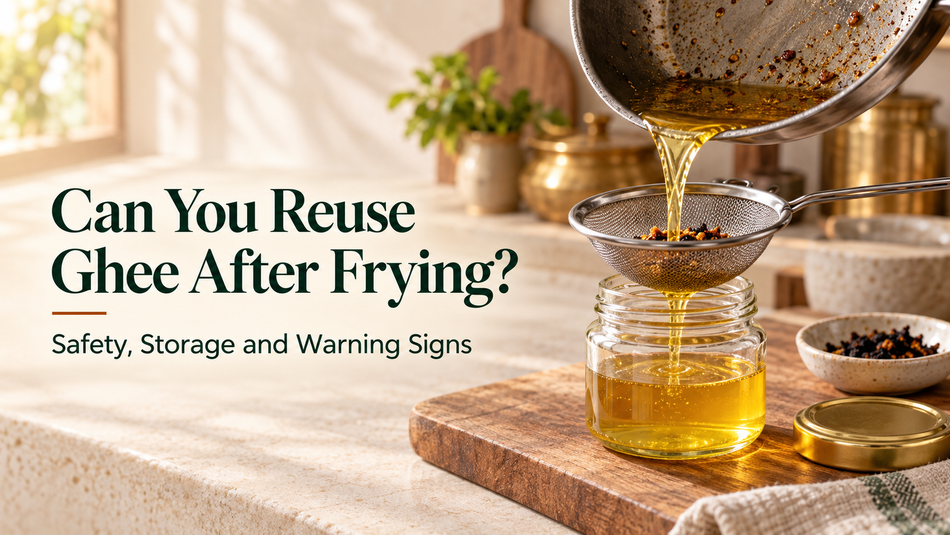
You have finished frying puris, pakoras or a festive sweet, and a noticeable amount of ghee remains in the kadai. It still looks usable. Throwing it away feels wasteful, especially when you bought good-quality ghee.
So, can you reuse ghee after frying?
Practical household rule
Strain once, use promptly for ordinary cooking, and do not fry in it again.
Quick answer
Short answer
Ghee left after one controlled frying session may be strained and used promptly in a curry, dal or another non-frying preparation if it did not smoke, burn, foam unusually or become contaminated.
Reusing the same ghee for another round of deep-frying is best avoided. Repeated heating accelerates oxidation and other forms of deterioration, and appearance alone cannot establish that used ghee is safe.
Important
This article provides general food-safety information, not a laboratory assessment of a particular batch of used ghee. If you are uncertain about how hot or how long the ghee was heated, discarding it is the safer choice.
The answer depends on what happened during frying
“Used once” does not describe the ghee well enough. A spoonful warmed briefly for a tadka has not experienced the same conditions as a kadai of ghee kept near smoking temperature through several batches of pakoras.
Before deciding what to do, consider:
- Temperature: Did the ghee smoke or smell sharply burnt?
- Heating time: Was it heated for a few minutes or kept hot for a long session?
- Number of batches: Was one small batch fried, or was food added repeatedly?
- Food residue: Are crumbs, flour, masala or burnt particles suspended in it?
- Moisture: Did wet food cause prolonged spluttering or leave moisture behind?
- Storage: Was the ghee strained and covered promptly, or left exposed for hours?
- Sensory change: Has it become unusually dark, murky, thick, sticky, foamy, acrid or rancid-smelling?
These factors are more useful than a rule such as “ghee can be reused three times.” No universal reuse count can account for different foods, temperatures, cooking times and kitchen handling.
What happens to ghee when it is heated?
Ghee is mainly milk fat. During frying, heat, oxygen, moisture and food particles begin changing that fat.
Three processes are particularly relevant:
Oxidation
Oxygen reacts with fat during heating. Oxidation can produce primary and secondary breakdown products, and the rate generally increases with higher temperature, longer exposure and repeated heating.
Hydrolysis
Water released by food can split some triglycerides and contribute to an increase in free fatty acids. This is one reason wet ingredients and repeated frying can shorten the useful life of a frying fat.
Polymerisation and accumulation of polar compounds
At frying temperatures, some breakdown products combine into larger compounds. Food-safety systems use total polar compounds (TPC) as one measure of deterioration in used frying oils and fats.
FSSAI states that TPCs develop through hydrolysis, oxidation and polymerisation during frying. It sets a maximum limit of 25% TPC for used oil or fat; beyond that level, the frying medium should not remain in the food chain. A household cannot reliably measure TPC without suitable testing equipment, so visual and smell checks are only warning signs—not proof of chemical safety.
But isn’t ghee stable at high heat?
Ghee contains a relatively high proportion of saturated fatty acids, which are generally less susceptible to oxidation than highly polyunsaturated oils. That relative stability does not make ghee unaffected by heat or suitable for unlimited reuse.
Ghee also contains cholesterol, and laboratory research has found that intermittent heating and frying can form cholesterol oxidation products. Another study of desi ghee found increasing molecular deterioration as temperature rose, particularly at higher temperatures. That experiment used buffalo-milk ghee heated for five minutes at set temperatures, so it should not be converted into a universal “safe temperature” for every household ghee or frying session.
The honest conclusion is simple: ghee may tolerate cooking heat reasonably well, but repeated or excessive heating still damages it.
What do Indian food-safety guidelines recommend?
The 2024 Dietary Guidelines for Indians from ICMR–National Institute of Nutrition advise households not to use the same frying oil for frying again. They say oil from one frying session may be filtered and used for a curry, then consumed within a day or two rather than stored for a long period. The guideline discusses vegetable oils and cooking fats broadly; it does not establish a separate number of safe frying cycles specifically for cow ghee.
FSSAI’s household guidance follows a similar approach:
- Filter frying oil before any permitted secondary use.
- Use it for a non-frying preparation rather than another frying cycle.
- Consume it within a day or two.
- Discard it if it smokes blue-grey, develops persistent foam, becomes dark and murky, or changes consistency.
- Do not pour discarded oil or fat into a drain.
Although official documents often use the word “oil,” FSSAI’s quality limit and discussion of TPC also refer to used oil/fat. The conservative approach is therefore not to treat dairy ghee as exempt from used-frying-fat precautions.
Keep it or discard it? A practical decision table
| What happened during frying? | Recommended decision | Why |
|---|---|---|
| Ghee was used for one short frying session, stayed below smoking, and contains only light residue | Strain and use promptly in a non-frying dish | This follows the conservative household approach for once-used frying fat |
| Ghee was used for several batches over a long period | Discard after cooling | Long heat exposure and repeated food additions increase deterioration |
| Ghee produced blue-grey smoke or a sharp burnt smell | Discard | Smoking indicates excessive heating and visible quality breakdown |
| Ghee is persistently foamy, dark, murky, thick or sticky after cooling | Discard | These are recognised warning signs of deteriorated frying fat |
| Ghee contains many burnt crumbs or black particles | Discard rather than trying to rescue it | Burnt residue continues to affect flavour and quality |
| The heating history is unknown | Discard | Appearance cannot reconstruct time and temperature exposure |
| Used ghee was left uncovered for hours or contacted water, dirty utensils or food waste | Discard | Contamination and moisture add a separate food-safety concern |
| Used ghee smells stale, paint-like, bitter, sour or otherwise rancid | Discard | An abnormal odour suggests deterioration; reheating will not restore it |
The “keep” option above does not mean the ghee is unchanged. It means a limited, prompt, non-frying use is the less wasteful option described in household guidance when no warning signs are present.
Can ghee used for puri, pakoras or sweets be reused?
Puris
Ghee used for one batch of puris can sometimes be strained and added in a small amount to a savoury preparation within a day or two, provided it never smoked and has no burnt smell, persistent foam or heavy residue.
Do not use it to fry another batch later. Puri dough can leave flour particles in the ghee, and those particles continue browning if reheated. Fine filtration removes crumbs but cannot remove chemical changes already caused by heat.
Pakoras
Pakora batter often sheds more crumbs than puri dough, and masala or vegetable moisture can enter the frying medium. If the remaining ghee is dark, strongly flavoured, crowded with residue or has been hot through several batches, discard it.
If the frying session was brief and the ghee remains free of deterioration signs, strain it carefully and use it promptly in a compatible savoury dish. Do not reuse it for deep-frying.
Sweets
The same decision rule applies, but flavour transfer matters. Ghee used for a mild, crumb-free sweet may still carry sugar, flour or dairy solids. Ghee used for boondi, balushahi or other batch-fried sweets may have been held hot for a long time and can contain considerable residue.
Do not assume that sweet-smelling ghee is chemically fresh. Sugar and aromatic ingredients can mask early off-notes. If the ghee was overheated, used for multiple batches or contains caramelised particles, discard it.
How to strain and handle used ghee safely
If the ghee passes the checks above and you intend to use it in a non-frying dish, handle it promptly.
Straining removes food particles. It does not remove oxidised compounds, reverse overheating or make old frying ghee fresh again.
For how to look after unused fresh ghee (not leftover frying fat), see how to store fresh desi ghee.
Should used frying ghee be refrigerated?
Official Indian household guidance emphasises prompt use within a day or two and avoiding long storage. Refrigeration can slow some changes, but it cannot undo heat damage. It can also make ghee solid, which may hide suspended particles until the ghee melts again.
If you cannot use once-used ghee promptly, do not keep it for a future frying occasion. Discarding a small amount is safer than stretching its life because it was expensive. Note also that normal texture changes in fresh ghee (graininess when cooled) are different from deterioration signs in used frying fat.
Can used ghee be mixed with fresh ghee?
No. Keep used frying ghee separate from fresh ghee.
Mixing does not “refresh” damaged fat. It makes the heating history of the entire container unclear, transfers food particles and odours, and may shorten the quality life of the fresh ghee. FSSAI’s used-oil guidance advises against refilling a fresh-oil container with used oil; the same separation principle is sensible for household ghee.
Can you add fresh ghee to an old frying batch?
Adding fresh ghee increases the volume, but it does not remove deterioration products already present in the used portion. The mixture is still partly used frying fat.
For a new frying session, start with a clean vessel and fresh frying medium rather than topping up old ghee.
Warning signs that used ghee should be discarded
Discard the ghee if you notice any of the following:
Smoke
Blue-grey smoke during frying
Smell
Sharp, burnt, acrid or rancid odour
Foam
Persistent or tough foam that will not settle
Appearance
Unusual darkening or a murky look
Texture
Thick, sticky or altered consistency after cooling
Residue
Many burnt crumbs or black particles
Taste
Bitter or unpleasant flavour
Contamination
Water, dirt, insects or dirty utensils
Unknown history
Unclear storage time or heating exposure
Smell, colour and texture are useful rejection signals. Their absence is not a laboratory guarantee, because TPC and oxidation products cannot be assessed accurately by looking at the ghee.
Why did my ghee become dark or foamy after frying?
Darkening
Some colour change can come from the food. Flour, spices, sugar, milk solids and crumbs brown during frying and disperse through the ghee. Heat-induced oxidation and polymerisation can also contribute to darkening.
Darkness alone cannot tell you exactly what changed. However, ghee that has become markedly dark and murky—especially alongside smoke, foam, thickness or a burnt smell, should be discarded.
Foaming
Fresh food releases moisture and steam, so temporary bubbling while frying is normal. Persistent, dense foam after food has been removed is different. FSSAI lists tough foam as a sign that used frying oil should be discarded.
Foam can be influenced by food debris, moisture and accumulated degradation products. Do not try to fix persistently foamy ghee by adding fresh ghee.
Burnt or rancid smell on reheating
A burnt smell usually indicates excessive temperature or scorched food particles. A stale, paint-like or unpleasant rancid odour can develop as fat oxidises during heating and storage. Research on heated desi ghee has detected increasing oxidation-related changes at high temperatures, including aldehydes and ketones at severe heating conditions. A smell cannot identify individual compounds, but an off-odour is enough reason not to consume the ghee.
Does filtering make used ghee safe again?
Filtering is useful, but its role is limited.
It can remove: flour crumbs, burnt fragments, spices and other visible particles.
It cannot remove: all dissolved breakdown products, oxidised compounds already present in the fat, changes caused by excessive time or temperature, or off-flavours absorbed from the fried food.
Think of filtering as good handling, not purification.
How should used ghee be disposed of?
Never pour hot or cooled ghee down the sink, toilet or drain. Fat can solidify, block plumbing and add to sewer problems.
For a small household quantity:
- Let the ghee cool completely.
- Place it in a sealable waste container, or absorb it into paper towel or another suitable absorbent material.
- Put the sealed or absorbed waste in the appropriate household rubbish according to local waste rules.
Larger quantities from food businesses should enter an authorised used-cooking-oil collection system rather than the food chain. FSSAI’s RUCO initiative is designed for this purpose.
Does the quality of fresh ghee change the reuse rule?
Starting with fresh, properly made ghee matters for flavour, traceability and initial quality. It does not make the ghee immune to heat.
Gaurya Farms makes Gir Cow Bilona Ghee from its own-farm milk through a curd-based Bilona process: milk is set into curd, the curd is Bilona-churned to obtain cultured butter, and the butter is cooked into ghee. Once that ghee is used for frying, however, its future use should still be decided by the same time, temperature, contamination and deterioration factors described above.
Premium ghee should be handled carefully—not repeatedly overheated because it cost more. If you are also checking whether a jar is authentic before you cook with it, see how to evaluate ghee purity.
Fresh frying starts with fresh ghee
For a new frying session, begin with a clean vessel and fresh Bilona ghee—not topped-up leftovers.
Shop Gir Cow Bilona GheeCommon beliefs about reusing ghee
| Common belief | More accurate explanation |
|---|---|
| “Ghee is saturated, so it never oxidises.” | Ghee may be relatively heat-stable, but high or repeated heating still causes chemical changes. |
| “If it looks clear after filtering, it is fresh again.” | Filtering removes particles, not dissolved oxidation or polymerisation products. |
| “Ghee can always be reused three times.” | No fixed household count accounts for temperature, duration, food and storage. |
| “Adding fresh ghee repairs old ghee.” | Dilution does not reverse deterioration and makes the whole batch’s history unclear. |
| “If it does not smell bad, it is definitely safe.” | Off-smell is a discard signal, but the absence of smell cannot measure TPC or all oxidation products. |
| “Expensive Bilona ghee can withstand unlimited frying.” | Production quality does not prevent deterioration during excessive or repeated heating. |
A simple household checklist
Before keeping leftover frying ghee, ask:
Decision shortcut
If every answer is yes, strain and keep it separately for prompt non-frying use. If any answer is no—or you do not know the answer—discard it.
Frequently asked questions
How many times can ghee be reused for frying?
Can I reuse ghee after frying puris?
Can I reuse ghee after frying pakoras?
Can I use leftover frying ghee in dal or sabzi?
Can I use strained ghee for another round of frying?
Can used ghee be stored for a week?
Should I refrigerate used ghee?
Why has my used ghee turned dark?
Why does used ghee smell different?
Can I mix used ghee with fresh ghee?
Is reused ghee harmful?
Does ghee’s smoke point prove that it is safe for repeated frying?
Can filtering remove harmful compounds from used ghee?
How can I test used ghee at home?
How should I discard used ghee?
Final takeaway
Ghee left after frying does not have to be judged by guesswork or a made-up “three-use rule.” Look at the complete heating history.
If the ghee went through one short, controlled frying session and shows no sign of smoking, burning, persistent foam, heavy darkening, stickiness or contamination, strain it and use it promptly in a non-frying dish. Do not return it to the fresh jar, do not mix it with fresh ghee, and do not save it for another frying session.
If its history is uncertain or any warning sign appears, discard it. Starting with good ghee matters, but careful use matters just as much.