100% Pure Ghee
Made Only From Gir Cow Milk
100% Pure Ghee
Made Only From Gir Cow Milk Every Batch
Independently Lab-Tested for Purity
Every Batch
Independently Lab-Tested for Purity Free
Shipping Available Across India
Free
Shipping Available Across India Crafted Using the
Traditional Bilona Method
Crafted Using the
Traditional Bilona Method
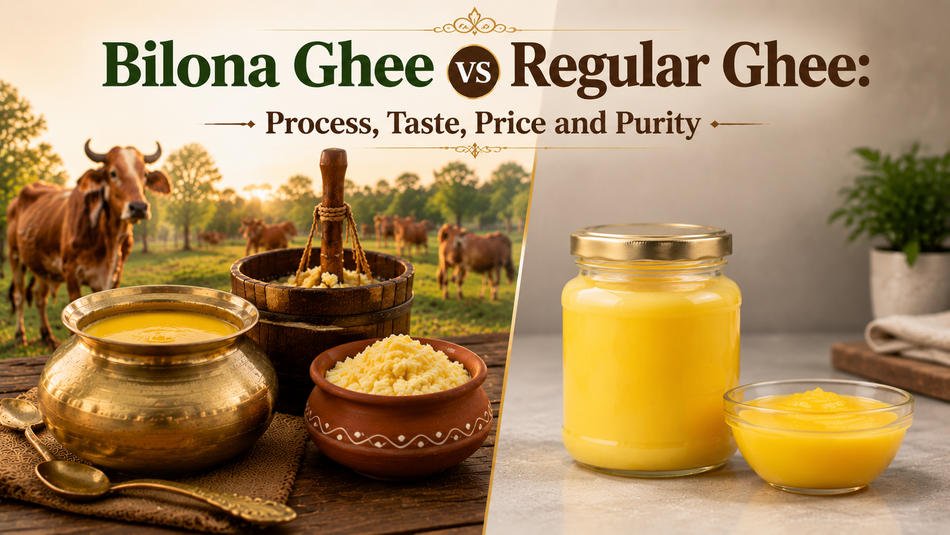
Two jars of ghee can sit on the same shelf with similar labels. One is made using the traditional Bilona method — from curd, cultured butter, and slow cooking. The other may be made from cream in a faster process. Both are legally ghee. But they are not the same thing.
The difference lies in how each is made, where the milk comes from, how long the process takes, how the taste develops, and whether the brand behind it can show you proof.
If you are buying ghee for your family and you want to understand what you are actually choosing, this comparison will help. Not with miracle claims. Not with confusing jargon. Just an honest explanation of Bilona Ghee vs regular ghee — by process, taste, price, and purity.
Gaurya Farms, based in Chittorgarh, Rajasthan, makes Bilona A2 Gir Cow Ghee using the traditional Bilona process — ethically cared-for Gir cows, small-batch preparation, slow cooking, and batch-level lab testing. This article is written from that lived experience, not from marketing copy.
What Is Bilona Ghee?
Bilona Ghee is ghee made using the traditional curd-churning process. Milk is first set into curd, the curd is churned to obtain cultured butter (makhan), and the butter is then slow-cooked until ghee separates.
The basic flow is:
Milk → Curd → Cultured Butter → Slow-Cooked Ghee
This is the traditional Indian household method. The word "Bilona" refers to the churning process. Today, the exact equipment may vary, but the principle remains: ghee is made from cultured butter obtained from curd, not directly from cream.
We have covered the full process step by step in: What Is Bilona Ghee? Traditional Bilona Method Explained.
How Regular Ghee Is Made
Not all regular ghee is bad, and not all Bilona Ghee is automatically good. The real difference comes from source, process, honesty, and quality control.
Most regular commercial ghee is made from cream or butter. In large-scale production, the focus is often on efficiency, consistency, and volume.
A typical regular ghee production flow:
- Milk is collected from different sources
- Cream is separated from milk
- Cream or butter is heated
- Moisture evaporates
- Milk solids separate
- Ghee is filtered and packed
This process can be clean and safe when done properly. But it is different from the traditional Bilona method.
Mass Production and Scale
Regular ghee production is often designed for scale. Large batches can be produced faster. This helps reduce cost and makes the product widely available.
But scale can also mean less connection to the source of milk, mixed milk sources, less transparency about preparation, faster processing, and less batch-specific traceability unless the brand provides it. This does not mean every regular ghee is impure. It means the buyer should not assume purity only because the label says "ghee."
Additives and Preservatives
Pure ghee generally does not need preservatives because it has low moisture when properly prepared. A good ghee should have a simple ingredient profile. If the ingredient list is confusing or includes unnecessary additives, that is a reason to pause.
The safest rule: buy ghee from a brand that clearly explains source, process, ingredients, testing, and storage.
Taste Comparison
Taste is one of the biggest differences customers notice.
Bilona Ghee Taste
Bilona Ghee usually has a richer aroma, more traditional flavor, slightly deeper cooked notes, smooth mouthfeel, and a stronger presence in simple foods.
It works beautifully with dal, khichdi, roti, bajra roti, rice, halwa, laddoo, panjiri, pulao, and tadka.
In Indian homes, good ghee is often judged by smell first. When hot ghee touches dal or rice, the aroma should feel warm and natural. Bilona Ghee made from curd and slow-cooked butter tends to develop this richness more than cream-processed ghee.
Regular Ghee Taste
Regular ghee taste depends heavily on the brand and process. Some is mild and neutral. Some has a strong aroma. Some may feel flat if the source or process is average. It may be suitable for daily cooking where a lower-cost option is needed.
Texture Difference
Good Bilona Ghee may have a grainy or semi-grainy texture depending on temperature, storage, and natural crystallization. In Rajasthan and other hot regions, ghee may become liquid in summer. In winter, it may become grainy or semi-solid. This is normal.
Texture alone does not prove purity. Lab testing and source transparency are more reliable indicators.
Price Difference Explained
Many buyers ask: why is Bilona Ghee more expensive? It is a fair question. Premium products should explain their price clearly.
1. More Time
The Bilona process takes longer. Milk must be set into curd, curd must be churned, butter must be collected, and ghee must be slow-cooked. This cannot be rushed.
2. More Labor
Churning, monitoring, cooking, filtering, and packing require effort. Small-batch production is more hands-on.
3. More Milk Requirement
Traditional ghee production requires a large quantity of milk for a small quantity of final ghee. This directly affects cost.
4. Gir Cow Milk Source
Ghee made from indigenous Gir cow milk is positioned as premium because of breed value, cow care, and sourcing limitations.
5. Ethical Cow Care
Proper cow care costs money — feed, space, hygiene, veterinary support, and daily routines all matter. If a brand is serious about ethical care, the final product cannot be priced like mass-produced commodity ghee.
6. Small-Batch Preparation
Small batches are harder to scale. Lower volume means higher per-unit cost. But small batches also allow more careful monitoring of aroma, texture, and cooking time — which is why this matters beyond just being a premium label.
7. Purity Assurance
Lab testing, quality checks, and transparent reporting add cost. But they also build trust.
8. Packaging and Delivery
Premium ghee needs proper packaging to protect quality during shipping. This also affects final pricing.
The main point: Bilona Ghee is not expensive only because of the word "Bilona." It is expensive when the source, process, labor, care, and testing behind it are real.
Purity and Lab Testing
Purity is one of the biggest concerns in the ghee market. Many customers worry about adulteration, mixed fats, poor sourcing, or misleading claims. This is why lab testing matters.
What Lab Testing Can Show
A good lab report may help check fat content, moisture level, adulteration indicators, safety parameters, quality consistency, and compliance with relevant standards. Lab testing does not replace good sourcing, but it supports trust.
Why Batch-Level Testing Matters
If a brand says "pure ghee" but shows no testing, the customer has to rely only on trust. If the brand shares lab reports, the customer gets real confidence.
At Gaurya Farms, every batch is lab tested and reports are available for transparency. View our lab testing and purity reports.
How Consumers Can Check Authenticity
Before buying, ask: Is the milk source explained? Is the Bilona process explained clearly? Are lab reports available? Is the ingredient list simple? Are reviews visible? Is the brand reachable? Does the price make sense for the process?
Avoid brands that use big claims but provide little proof.
Practical Buying Tips
1. Do Not Buy Only by the Word "A2"
A2 is important, but it should not be the only reason to buy. Look at cow breed, farm source, Bilona process, lab testing, and reviews together.
2. Check Whether It Is Actually Bilona
A real Bilona Ghee brand should clearly explain: milk to curd, curd churning, butter separation, and slow cooking. If the method is not explained, ask questions.
3. Check the Brand Story
A farm-based brand should show its farm, cows, people, and process. For Gaurya Farms, this is a strength — the brand is built around Gir cows, Chittorgarh farming roots, and transparent preparation.
4. Check Lab Reports
Lab reports are one of the strongest trust signals. They show that the brand is willing to be checked.
5. Choose the Right Pack Size
If you are trying the brand for the first time, start with a smaller pack. Once you like the taste and trust the quality, move to a larger pack.
6. Store Ghee Correctly
- Keep the jar closed
- Use a clean, dry spoon
- Keep away from water
- Store in a cool, dry place
- Avoid direct sunlight
- Do not mix old and new ghee in the same jar
For a full buyer's guide including how to identify pure ghee, see our detailed article on A2 Gir Cow Ghee Benefits: What Makes It Different.
Common Myths About Bilona Ghee
Myth 1: Bilona Ghee Cures Diseases
No. Ghee should not be claimed to cure, prevent, or treat diseases. Bilona Ghee is a traditional cooking fat used in moderation — not medicine.
Myth 2: All Bilona Ghee Is Pure
The word "Bilona" alone does not guarantee purity. You still need to check sourcing, process, testing, and reviews.
Myth 3: A2 Gir Cow Ghee and Bilona Ghee Mean the Same Thing
They are related but not the same. A2 Gir Cow Ghee refers to the milk source. Bilona Ghee refers to the preparation method. A product can be both if it is made from Gir cow milk using the traditional Bilona method — which is exactly what Gaurya Farms produces.
Myth 4: Higher Price Always Means Better Quality
Not always. A higher price should be supported by real proof: farm source, Gir cow care, Bilona method, lab reports, and honest customer reviews.
Conclusion
The difference between Bilona Ghee and regular ghee is not just a matter of price. It is a difference in source, process, time, labor, taste, and transparency.
Regular ghee can be suitable for many households. But if you are looking for traditional Indian ghee made through the curd-churning method, with richer aroma, small-batch care, and better traceability, Bilona Ghee is worth understanding.
For Gaurya Farms, that proof starts at the farm in Chittorgarh — from Gir cows to curd to slow-cooked ghee, with every batch tested and every report available to read.
An informed buyer should not choose ghee only by label claims. Choose by proof.