100% Pure Ghee Made Only From Gir Cow Milk
 Every Batch Independently Lab-Tested for Purity
 Free Shipping Available Across India
 Crafted Using the Traditional Bilona Method
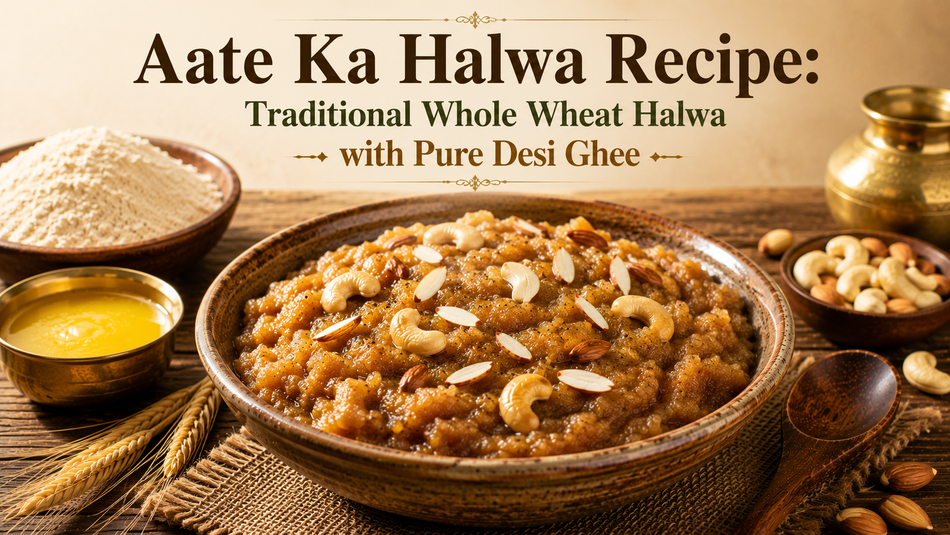
If you have ever walked past a kitchen where aate ka halwa is being made, you already know the moment this recipe is about. It is not when the sugar syrup goes in. It is not when the nuts get added. It is the 15 minutes in the middle — when the whole wheat flour is slowly roasting in a kadai full of desi ghee, turning from pale and raw to deep golden, and releasing a nutty, warm, almost caramel-like aroma that fills the entire house.
That smell is the recipe. Everything else is just following steps.
Aate Ka Halwa is one of the oldest and most honest Indian sweets. Four ingredients: whole wheat flour, pure ghee, a sweetener, and water. No fancy technique. No hard-to-find ingredients. Just patience, a heavy-bottomed pan, and good ghee. Made with care, it produces a halwa that is smooth, rich, and deeply satisfying — equally at home on a festival plate, as a prasad, or as an everyday sweet made because someone in the family asked for it.
At Gaurya Farms, we make our A2 Bilona Gir Cow Ghee in Chittorgarh, Rajasthan — a region with a long tradition of halwa, particularly the jaggery version that many Rajasthani families still prefer over the sugar version. This recipe covers both. But it starts where all good aate ka halwa starts: understanding what slow roasting in real ghee actually means.
Aate Ka Halwa at a Glance
| Detail | Info |
| Preparation Time | 5 minutes |
| Cook Time | 20–25 minutes (the roasting step takes most of this time) |
| Serves | 4 people — scales up easily |
| Occasion | Festivals, prasad, Navratri, everyday sweet, winter comfort |
| Difficulty | Easy — but requires patience and continuous stirring |
| Two Versions | Jaggery version (Rajasthani style) and Sugar version — both covered below |
| Key Ingredient | Pure A2 Bilona Gir Cow Ghee — this is not a recipe where ghee quality is optional |
Why Ghee Is the Real Ingredient in This Recipe
Most halwa recipes list ghee as one ingredient among four. In aate ka halwa, ghee is the recipe.
When wheat flour roasts in ghee, two things happen simultaneously. The heat drives off moisture from the flour, eliminating the raw taste. And the fat in the ghee coats every particle of flour, allowing the natural sugars in the wheat to caramelise slowly and evenly — producing that deep golden colour and complex nutty aroma that is the signature of a well-made halwa.
This is why the quality of ghee you use has a direct, noticeable impact on the final dish — more so than in most Indian recipes. A ghee with a weak aroma or adulteration produces a flat-tasting halwa that never quite reaches that depth of flavour. A pure, traditionally prepared ghee transforms the same four ingredients into something genuinely memorable.
The bilona method of making ghee — where milk is first set into curd, churned to separate cultured butter, and then slow-cooked into ghee — produces a ghee with a natural richness and depth of fragrance. When this ghee heats in a kadai and absorbs the wheat flour, the result is noticeably different from factory-made ghee. Gaurya Farms A2 Bilona Gir Cow Ghee is prepared using this traditional method from the milk of indigenous Gir cows at the farm in Chittorgarh, Rajasthan, and is independently lab-tested for purity before packaging.
The Ghee-to-Flour Ratio: Why You Cannot Cut Corners
Traditional aate ka halwa uses an equal ratio of ghee and flour — 1:1 by weight. Many recipes reduce the ghee to cut calories or cost. The result is a denser, slightly gummy halwa that lacks the smooth texture and glossy finish of the real thing. The ghee is not just flavour — it is structure. Do not reduce it below the ½ cup ghee per 1 cup flour ratio given in this recipe.
Ingredients
Main Ingredients (Serves 4)
- 1 cup whole wheat flour (atta)
- ½ cup Gaurya Farms A2 Bilona Gir Cow Ghee — measured as liquid; if your ghee is solid from cold temperature, measure after gently warming
- ¾ cup grated jaggery OR ¾ cup sugar — see the jaggery vs sugar section below before deciding
- 2½ cups water
For Garnish (Optional but Traditional)
- 1 tablespoon cashews, roughly chopped
- 1 tablespoon raisins
- Grated fresh coconut — traditional in the jaggery version; particularly common in Rajasthan
- A pinch of cardamom powder — adds a subtle fragrance, especially in the sugar version
For a Richer Version
- Add 2 tablespoons of grated coconut directly into the halwa along with the syrup for a denser, more festive preparation
- A few strands of saffron dissolved in 1 tablespoon of warm milk, added just before finishing
Note on ghee temperature: If your Bilona Ghee has been stored in a cool environment and solidified, do not microwave it. Warm the jar gently in a vessel of hot water until it returns to liquid. Measure it in liquid state for accuracy. Cold, solid ghee and liquid ghee measure very differently by volume.
Jaggery or Sugar: Which One Should You Use?
This is the question most aate ka halwa recipes sidestep. The answer depends on what you are making it for and what flavour you prefer.
| Jaggery Version | Sugar Version | |
| Flavour | Deeper, slightly molasses-like, more complex | Clean, straightforward sweetness |
| Colour | Darker golden-brown | Lighter, more uniform gold |
| Texture | Slightly denser, more rustic | Smoother and lighter |
| Traditional region | Rajasthan, Gujarat, rural North India | Punjab, urban North India, Gurudwara prasad |
| Festival suitability | Navratri, winter festivals, daily prasad | Kada Prasad, formal occasions, general festivals |
| Extra tip | Add grated coconut — pairs beautifully with jaggery | Add cardamom for fragrance |
At Gaurya Farms, the jaggery version is what gets made in Chittorgarh. The combination of jaggery, fresh coconut, and Bilona Ghee is a Rajasthani preparation that has been around for generations.
Important for jaggery: Grate the jaggery before dissolving it in water, and strain the liquid through a fine mesh or cloth before using. Raw jaggery often contains impurities that make the halwa gritty. This one step is what separates a smooth jaggery halwa from a rough one.
How to Make Aate Ka Halwa: Step-by-Step
Step 1 — Prepare the Sweetener Liquid First (5 minutes)
Before you even touch the ghee, prepare the liquid. This is important because the liquid must be hot when you add it to the roasted flour. Cold liquid added to hot flour causes lumps and the roasting aroma disappears.
For jaggery: Grate the jaggery and add it to 2½ cups of water in a saucepan. Heat until dissolved, stirring occasionally. Once dissolved, strain through a fine mesh cloth to remove any impurities. Keep it warm on a very low flame.
For sugar: Add sugar to 2½ cups of water in a saucepan. Bring to a boil, stirring until dissolved. Keep warm. You do not need a thread consistency — just a simple syrup.
Step 2 — Roast the Nuts in Ghee (3 minutes)
If you are adding cashews and raisins, roast them first. Add a teaspoon of ghee to the kadai, add the cashews on medium heat, and stir until they turn golden. Add raisins and stir for 30 seconds until they puff slightly. Remove and keep aside. This step is optional but gives you a proper garnish.
Step 3 — The Roasting Step: Where the Recipe Is Won or Lost (12–18 minutes)
This is the step. Everything before and after this is just preparation and finishing.
Add the remaining ghee to the same heavy-bottomed kadai on low-medium heat. Let it warm for a minute. Add all the whole wheat flour at once.
Begin stirring immediately and do not stop.
For the first 5 minutes, the flour will look pale and the ghee will sit on top. Keep stirring. By the 8-minute mark, the flour starts to change colour and a nutty aroma begins to emerge. By the 12-minute mark, the colour should be a warm, even golden. By 15 to 18 minutes, depending on your flame and pan, it should be deep golden-brown with a strong, rounded, nutty fragrance.
The flour is ready when:
- The colour is an even deep golden — not just on the edges, but throughout
- The aroma is distinctly nutty and caramel-like, not raw
- The ghee begins to visibly separate around the edges of the flour in the pan
- The flour looks dry and moves freely — it should not clump
Critical: Keep the flame at low to medium throughout. High heat browns the outside of the flour while leaving it raw inside. Low, patient roasting is the only way to get an even result. This is the step most recipes rush. Do not rush it.
Step 4 — Add the Hot Liquid (3 minutes)
The moment the flour reaches that deep golden colour and the ghee begins to separate, remove the kadai from heat for 20 seconds. Then return to low heat and begin adding the hot sweetener liquid in a slow, steady stream.
This is the most dramatic step. The hot liquid hitting the hot flour-ghee mixture will bubble and sputter aggressively. This is normal. Keep stirring continuously and do not stop.
Add the liquid in three additions rather than all at once — add one-third, stir until mostly absorbed, add the next third, stir, then the final third. This prevents lumps and gives you more control over the final consistency.
Why the liquid temperature matters: The liquid must be hot — close to boiling — when it hits the roasted flour. Cold or room-temperature liquid causes the flour to seize and form lumps that are very difficult to remove. If your liquid has cooled while waiting, bring it back to a near-boil before adding. This is one of the most common reasons halwa turns out lumpy.
Step 5 — Cook Until It Leaves the Sides (3–5 minutes)
Once all the liquid is incorporated, return to medium heat. Stir continuously. The halwa will go through a loose, porridge-like stage before it begins to thicken. Keep stirring.
The halwa is ready when it pulls away cleanly from the sides of the kadai and moves as one mass when you stir. It should look glossy, not dry or dull. If you run a spoon through it, it should hold the line briefly before slowly settling back.
If adding grated coconut, add it now and stir for another 60 seconds.
Step 6 — Finish and Serve
Remove from heat. Transfer to a serving dish. Add the roasted cashews and raisins on top. If using cardamom, stir it in just before serving.
Serve hot. Aate Ka Halwa is best eaten within the first 15 minutes of being made, when the ghee is still liquid and fragrant and the texture is at its smoothest.
A small drizzle of warm Bilona Ghee over each serving just before it reaches the table is the finishing touch most Rajasthani homes would not skip.
Troubleshooting: Why Your Halwa May Not Have Turned Out Right
These are the four most common problems and exactly what causes each one:
| Problem | Most Likely Cause | How to Fix It |
| Lumpy halwa | Liquid was added cold, or added too fast all at once | Always add hot liquid slowly in thirds while stirring continuously |
| Flat, dull flavour | Roasting was rushed or done on high heat; or ghee quality was poor | Roast on low-medium heat for the full 15–18 min; use pure Bilona Ghee |
| Gritty texture | Jaggery was not strained before use; had impurities | Always strain jaggery liquid through a fine mesh cloth before adding |
| Dense and heavy halwa | Too little ghee — ratio was reduced below 1:2 ghee to flour | Use at least ½ cup ghee per 1 cup flour; do not reduce below this |
| Raw flour taste | Under-roasted — removed from heat before golden | Roast until the colour is genuinely deep golden and aroma is nutty |
Aate Ka Halwa and Kada Prasad: What Is the Difference?
This comes up often, so it is worth answering clearly.
Kada Prasad is the sacred offering distributed in Gurudwaras. It is made from the same four base ingredients as aate ka halwa — whole wheat flour, ghee, sugar, and water — but follows a strict 1:1:1:2 ratio (equal parts flour, ghee, and sugar to double the water). It is always made with sugar, never jaggery. No nuts or garnish are added. The devotional context gives it a simplicity and purity that is part of its identity.
Aate Ka Halwa is the home version — more flexible in ratio, open to jaggery or sugar, and often finished with nuts, coconut, or cardamom. Both use the same roasting method and both depend completely on the quality of the ghee.
If you are making this recipe as prasad for a puja or religious occasion at home, use the sugar version with a clean ratio and pure, traditionally made ghee. The bilona method and the indigenous Gir cow source of Gaurya Farms ghee make it particularly suited to a devotional preparation.
When Is Aate Ka Halwa Made? Festival Calendar
This is one of the most versatile traditional sweets in North Indian and Rajasthani cooking. Here are the occasions when it is most commonly made:
- Navratri — one of the most common times aate ka halwa appears in Indian homes, both as prasad and as a sattvic meal
- Janmashtami — halwa is a standard prasad for this festival
- Teej — widely made in Rajasthan during the monsoon festival
- Lohri — the jaggery version is particularly appropriate for this winter harvest festival
- Makar Sankranti — another winter festival where the jaggery and coconut version fits the season
- Havan and puja at home — whenever a family hosts a pooja or prayer ceremony at home, halwa is the most common prasad to make
- Shraadh — aate ka halwa is traditionally prepared as an offering during ancestral rituals in many North Indian families
- Simply when someone asks for it — this is the everyday sweet of Rajasthan and North India
Three Variations Worth Making
1. Jaggery and Coconut Halwa — Rajasthani Style
Replace sugar with grated jaggery dissolved and strained in water. Add 2 tablespoons of fresh or dried grated coconut along with the liquid. This is the version most associated with Rajasthan and is richer, more fragrant, and slightly denser than the plain sugar version. Best served during winter festivals or as a warm dessert on a cold evening.
2. Saffron Halwa — For Festive Occasions
Make the sugar version. Dissolve a generous pinch of saffron in 1 tablespoon of warm milk. Add this to the halwa just before it comes off the heat and stir to combine. The saffron gives the halwa a warm golden colour and a delicate floral aroma. Suitable for Diwali, Dussehra, or any celebration where a slightly elevated version of the recipe is appropriate.
3. Simple Daily Version — No Garnish
Skip the nuts and coconut entirely. Just flour, ghee, jaggery or sugar, and water. Roasted properly and served hot, this is the purer and more honest version — the one that has been made in Indian kitchens for centuries without anything extra. It is also the easiest to make and the one most suitable as prasad when simplicity is the point.
How to Store Aate Ka Halwa
Aate Ka Halwa stores well because of the ghee content — the fat acts as a natural preservative.
- At room temperature: 24 hours in an airtight container
- In the refrigerator: 4 to 5 days; the ghee will solidify as it cools
- To reheat: add 1 to 2 tablespoons of water and warm on very low heat, stirring gently — or microwave in short bursts with a splash of water to restore the texture
- The halwa should not be frozen — freezing changes the texture of the wheat flour
Important: when reheating, add a small teaspoon of fresh Bilona Ghee after warming. This brings back the gloss and fragrance that cooling takes away.
The Recipe That Teaches You to Wait
Aate Ka Halwa is not a difficult recipe. But it is an honest one — it gives back exactly what you put in. Rush the roasting and it shows. Use poor quality ghee and the result is flat. Roast slowly in pure, traditionally made ghee, add hot jaggery liquid at the right moment, stir without interruption, and the result is something genuinely good.
The slow roasting step is where this recipe teaches patience. That 15 minutes of continuous stirring while the kitchen fills with the smell of wheat flour and bilona ghee becoming something golden and aromatic — that is the part of cooking that no shortcut replaces.
Gaurya Farms ghee is made the same way it has always been made: from the milk of Gir cows, through the traditional bilona method, in small batches, with each batch independently lab-tested before it leaves the farm in Chittorgarh. It is a ghee made for exactly this kind of cooking.