100% Pure Ghee Made Only From Gir Cow Milk
 Every Batch Independently Lab-Tested for Purity
 Free Shipping Available Across India
 Crafted Using the Traditional Bilona Method
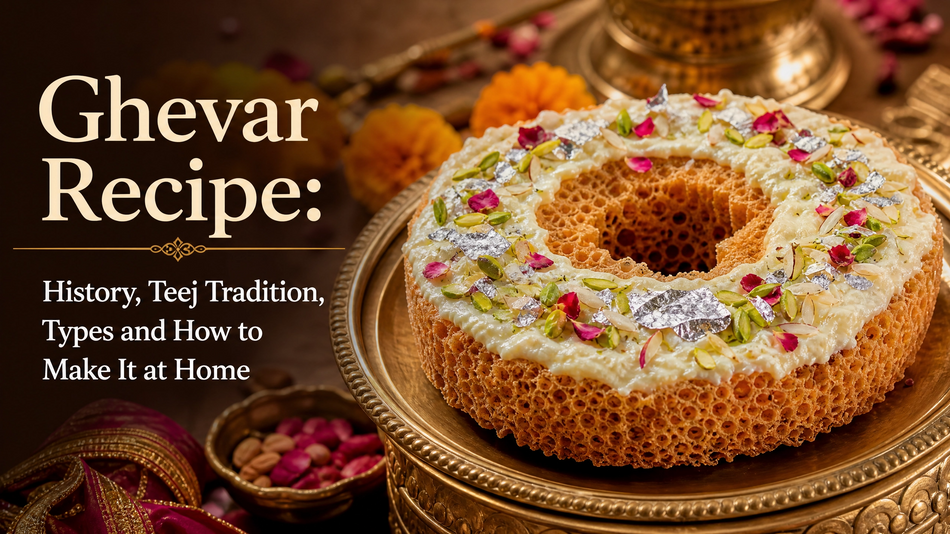
Ghevar (also spelt ghewar) is a disc-shaped Rajasthani sweet with a porous, honeycomb-like interior. It is made from a thin batter of refined flour, ghee and ice-cold water, deep-fried and soaked in sugar syrup, and it belongs to Sawan, Teej and Raksha Bandhan the way jalebi belongs to a winter morning.
This guide covers where ghevar comes from, why it is tied to the monsoon festivals, the four traditional types, and a full step-by-step method with the batter and temperature cues that decide whether you get a honeycomb or a pancake.
Ghevar at a Glance
| Detail | Info |
| Preparation Time | 30 minutes (plus chilling all ingredients) |
| Cooking Time | 60–75 minutes |
| Yield | 4–5 ghevars of 12–14 cm — 8 to 10 servings |
| Season | Sawan (July–August), Hariyali Teej, Sinjara, Raksha Bandhan |
| Difficulty | Advanced — the batter is unforgiving, the technique is not hard |
| Mould needed | No — a deep, narrow, heavy-bottomed vessel does the same job |
| Key ingredient | Fresh, aromatic cow ghee — in the batter it is not optional |
What is Ghevar?
Ghevar is a round, disc-shaped fried sweet, usually 12 to 20 cm across and 3 to 5 cm tall. Cut one open and you see a lattice of fine holes running through it, much like a honeycomb. That structure is the whole point: it makes ghevar crisp, light and able to hold sugar syrup without turning into a dense lump.
The ingredient list is short: maida, ghee, cold water (sometimes a little cold milk) and sugar syrup. Everything else — saffron, cardamom, slivered pistachios, silver leaf, rabri or thickened cream — is topping.
What separates ghevar from other Indian fried sweets is the cooking method. Jalebi is piped, imarti is pressed, and balushahi is shaped by hand. Ghevar is poured. A thin, ice-cold batter is streamed into deep, hot ghee, and the violent sizzle of each pour builds up the porous disc layer by layer. It is fried, never baked, and the frying vessel itself acts as the mould.
Ghevar is traditionally served at room temperature, either plain, lightly soaked in syrup, or topped with malai, mawa or rabri and finished with nuts.
Ghevar History and Origin
Ghevar belongs firmly to Rajasthan. Standard references on Indian food, including regional cookery books and travel guides, list it as a Rajasthani sweet, and it remains a fixture of sweet shops in Jaipur, Jodhpur, Bikaner and smaller towns like Chittorgarh, especially through the monsoon months. From Rajasthan it spread across neighbouring Haryana, Delhi, western Uttar Pradesh, Madhya Pradesh and Gujarat, where it is now equally at home during Teej and Raksha Bandhan.
The name itself carries a clue about its age. “Ghevar” is linked to the Sanskrit term ghritapura, roughly “ghee-filled cake”, which suggests the sweet — or an ancestor of it — predates modern Rajasthan. The sixteenth-century saint-poet Mirabai mentions offering ghevar to Krishna in one of her poems, which places a sweet by this name in the region at least four to five centuries ago. Ghevar is also traditionally counted among the Chhappan Bhog, the fifty-six dishes offered to Krishna.
What about the popular story that ghevar was invented in the royal kitchens of Rajasthan for the Maharajas? Historical accounts vary, and the exact origin is not firmly documented. The royal-kitchen account appears widely in popular writing but is not backed by dated primary sources, so it is best treated as tradition rather than established fact. What is well documented is the sweet’s long association with Rajasthan’s monsoon festivals, its place in the Sinjara gifting custom, and its evolution in famous sweet houses — Jaipur’s Laxmi Misthan Bhandar, for instance, is credited with introducing chhena ghevar in 1961.
Why Ghevar Is Associated with Teej, Sawan and Raksha Bandhan
Ghevar is a monsoon sweet. Its season begins with the Hindu month of Shravana (Sawan, roughly July–August) and runs through Raksha Bandhan, after which most halwais stop making it until the next year.
The seasonal timing has a practical side that halwais often point out: the humid monsoon air makes the thin batter and the frying behave well, and the festivals of this period create the demand. Whether humidity truly improves the batter is hard to verify scientifically, but the festival calendar is beyond doubt.
Teej
Hariyali Teej falls on the third day after the new moon in Shravana. It is celebrated mainly by married women and unmarried girls, especially in Rajasthan, Haryana, Punjab and western UP, to honour the goddess Parvati and welcome the monsoon. Ghevar is the sweet of this festival — prepared at home, bought from halwais, offered in puja and shared among families. Jaipur’s two-day Teej procession is one of the best-known public celebrations, and the city’s sweet shops sell ghevar in enormous quantities through the season.
Sinjara
The day before Teej (and before Gangaur, earlier in the year) is called Sinjara or Sindhara. On this day, a married daughter traditionally receives a gift package from her parents — clothes, bangles, mehndi and ghevar. The word Sindhara is linked by folklorists to the Sanskrit shringar, the adornment of women. In many Rajasthani families, sending ghevar on Sinjara to a newly married daughter is considered essential, and the first Sinjara after a wedding is treated with particular ceremony.
Raksha Bandhan
Rakhi falls on the full moon of the same month, so ghevar season naturally extends to it. In Rajasthan and much of North India, ghevar is a customary Rakhi gift, carried by sisters to brothers’ homes or sent along with rakhis.
These customs are strongest in Rajasthan and its neighbouring states; they are not uniform across all of India, and families differ in how strictly they observe them. But across the region, the association is simple and consistent: Sawan arrives, and so does ghevar.
Types of Ghevar
Four types cover almost everything you will find at a traditional sweet shop.
Plain (sada) ghevar is the base disc soaked lightly in sugar syrup and finished with nothing more than cardamom, saffron and a few nuts. It is the crispest of the four and the best keeper.
Malai ghevar is topped with a thick layer of sweetened, cardamom-scented malai, the clotted cream skimmed from boiled full-cream milk. The contrast of crisp base and cool cream is the reason many people consider it the finest version. It is also the most perishable.
Mawa ghevar carries a layer of lightly sweetened mawa (khoya — milk solids cooked down until fudgy), usually pressed onto the syruped disc and covered with nuts. It sits between plain and malai in both richness and shelf life.
Rabri ghevar is topped with rabri, the slow-reduced sweetened milk with layers of clotted cream. It is the richest and softest of the traditional versions, best eaten the day it is assembled.
| Type | Topping | Texture | Storage | Best served |
| Plain (sada) | Syrup, nuts, cardamom | Crispest of the four | Airtight at room temperature, several days | Any time in season |
| Malai | Sweetened clotted cream | Crisp base, soft creamy top | Refrigerated; within a day of topping | Same day, with a chilled top |
| Mawa | Sweetened khoya layer | Crisp base, dense rich top | Refrigerated, 1–2 days | Within a day or two |
| Rabri | Reduced sweetened milk | Softens fastest | Refrigerated; within a day of topping | The day it is assembled |
Modern variations — chocolate ghevar, paneer or chhena ghevar, mini ghevar, sugar-free ghevar — are shop innovations of recent decades, not traditional preparations. Chhena ghevar dates to at least 1961 in Jaipur; the chocolate versions are newer still. They are enjoyable but belong to a different category from the four classics.
Ingredients for Homemade Ghevar
This recipe makes 4 to 5 ghevars of about 12–14 cm diameter, enough for 8 to 10 servings.
Equipment
- One deep, narrow, heavy-bottomed vessel: a tall kadai, a deep saucepan or a steel patila about 15–18 cm in diameter and at least 12 cm deep (or a traditional ghevar mould if you have one)
- A ladle with a spout, or a small steel glass, for pouring
- A long wooden skewer or the handle of a steel spoon
- A wide bowl set over ice, for the batter
- A slotted spoon and a wire rack
For the batter
- Maida (refined flour): 250 g (2 cups)
- Ghee, solid and cold: 50 g (¼ cup)
- Ice cubes: 3–4 medium
- Cold full-cream milk: 60 ml (¼ cup)
- Ice-cold water: 550–600 ml (about 2¼–2½ cups), added in stages
- Lemon juice: 1 teaspoon (5 ml)
For frying
- Ghee: 750 g to 1 kg, enough for a depth of 7–8 cm in your vessel — a neutral oil, or half oil and half ghee, also works
For the sugar syrup
- Sugar: 200 g (1 cup)
- Water: 100 ml (½ cup)
- Green cardamom: 4 pods, lightly crushed
- Saffron: a small pinch, about 15 strands
For malai or rabri topping (optional)
- Rabri or sweetened thickened malai: 250 g (1 cup), chilled
- Powdered sugar for malai, if making your own: 2 tablespoons (25 g)
For garnish
- Slivered pistachios: 2 tablespoons (15 g)
- Slivered almonds: 2 tablespoons (15 g)
- Dried rose petals: 1 tablespoon (optional)
- Silver leaf (chandi ka varq): 2 sheets (optional)
Which Ghee Is Best for Ghevar?
Ghee does two different jobs in ghevar, and it helps to keep them separate.
In the batter, ghee is not negotiable. Cold solid ghee is rubbed with ice until it turns pale and creamy, and this creamed fat is what the flour and water are built on. The fat coats the flour particles and limits gluten development, which is what keeps the fried disc short and crisp rather than chewy. The batter needs only 50 g, so this is where quality matters most per rupee: a fresh, aromatic ghee flavours the whole sweet from the inside.
As the frying medium, ghee is the traditional choice and gives ghevar its characteristic nutty aroma, but it is not structurally essential. The honeycomb forms because of batter temperature, consistency and frying heat — not because of what fat is in the pan. Plenty of home cooks and commercial makers fry in neutral oil or a ghee-oil blend, and the results are respectable. If you want the full halwai-style flavour and can spare the quantity, fry in ghee; the leftover frying ghee can be strained and stored for everyday cooking.
Whichever ghee you choose, freshness and purity matter more than appearance. Grainy texture and deep yellow colour are often cited as proof of purity, but neither is reliable on its own — graininess depends on how the ghee cooled, and colour varies with the cow’s breed and feed. A cleaner test is aroma: good ghee smells nutty and clean, never flat or soapy, and it should list a single ingredient. There are a few more simple ways to check ghee purity at home if you want to be sure.
Traditionally made ghee suits this recipe particularly well. At Gaurya Farms in Chittorgarh, we make Gir cow ghee the bilona way — milk is set into curd, the curd is hand-churned into butter, and the butter is slow-cooked into ghee. That slow cooking develops the roasted, nutty notes that older Rajasthani households associate with festival sweets. To be clear, bilona ghee will not change the structure of your ghevar or make it a health food; what it changes is aroma and flavour, which in a sweet this simple counts for a lot.
How to Make Ghevar at Home
Total active time is about 90 minutes. Read the batter-consistency and temperature sections below before you start; they are where most first attempts go wrong.
Step 1 — Prepare and chill the ingredients
Measure everything first. Put the water and milk in the refrigerator until properly cold. Set your mixing bowl inside a larger bowl of ice. Keep extra ice on hand. What to look for: the ghee should be solid, not melted or even soft-pooled. What can go wrong: warm ingredients are the single most common cause of failure — the batter splits and the honeycomb never forms. Move on only when everything is cold to the touch.
Step 2 — Cream the ghee
Put the cold solid ghee in the chilled bowl with one ice cube. Rub the ghee against the ice with your fingertips or a whisk in fast circular strokes for 4 to 6 minutes. What to look for: the ghee turns from yellowish and greasy to pale, white and fluffy, like soft whipped butter. Discard what remains of the ice cube. What can go wrong: if the ghee melts instead of whipping, your kitchen or hands are too warm — chill the bowl again and use a whisk rather than fingers. Move on when the ghee holds soft peaks and looks matte white.
Step 3 — Prepare the batter
Add the cold milk to the creamed ghee and whisk. Add the maida in two or three additions, alternating with about half the cold water, whisking constantly. Then thin the batter with the remaining water, a little at a time, and finish with the lemon juice. What to look for: a completely smooth, lump-free, thin batter. What can go wrong: adding all the water at once creates lumps that never dissolve; whisking too slowly lets the mixture warm up. Move on when the batter is smooth and noticeably colder than room temperature.
Step 4 — Check the consistency
Lift a ladleful and pour it back from about 30 cm above the bowl. What to look for: a thin, continuous stream, like a slightly thickened milk. What can go wrong: batter that falls in ribbons or blobs is too thick and will fry into a dense cake with no holes. Thin it with cold water, one tablespoon at a time. Keep the bowl sitting over ice throughout frying.
Step 5 — Heat the frying medium
Fill your tall vessel with ghee or oil to a depth of 7–8 cm — never more than half the vessel’s height — and heat on medium-high. What to look for: drop a few drops of batter in; they should sink briefly, then rush to the surface within a second or two, sizzling hard. On a thermometer this corresponds to roughly 170–180 °C. What can go wrong: impatience. Ghee that is not hot enough gives you the most disheartening failure of all — the batter sinks, sulks and soaks. Test again after every adjustment.
Step 6 — Pour the batter gradually
Fill your small glass or spouted ladle with about 50–60 ml of batter. Pour it into the centre of the hot ghee in one thin, steady stream from a height of 20–25 cm. The ghee will froth up dramatically — this is normal and necessary. What to look for: the batter should scatter into lacy strands and rise, and the froth should subside within 15–20 seconds. Wait for it to settle completely, then pour the next glassful in the same spot. Repeat 4 to 6 times, waiting each time. What can go wrong: pouring the next round before the froth settles collapses the layers into a solid mass; pouring from too low makes a pancake instead of a web. Move on when the disc has visible layered structure and reaches 3–4 cm height.
Step 7 — Form the central opening
After the second or third pour, push a wooden skewer gently into the centre of the disc and rotate it to open a hole about 2 cm wide. Pour the remaining rounds of batter around, not into, this hole. What to look for: a clear open centre; hot ghee bubbling up through it cooks the middle evenly. What can go wrong: skip this and the centre stays raw and greasy while the edges brown.
Step 8 — Cook until crisp
Lower the heat slightly and let the ghevar fry undisturbed. Spoon hot ghee over the top a few times if the upper surface looks pale. What to look for: the sizzling quietens, bubbles become small and lazy, and the ghevar turns an even light golden — the colour of well-baked biscuit, not deep brown. This takes 5 to 8 minutes per ghevar. What can go wrong: pulling it out while still pale gives a ghevar that turns soft within the hour; dark brown means bitter. Move on when the edges look set and golden and the sizzle has almost stopped.
Step 9 — Remove and drain
Slide the skewer through the central hole, lift the ghevar out and hold it over the vessel for 20–30 seconds so ghee drains back through the honeycomb. Rest it on a wire rack, never on paper pressed flat against it. What to look for: it should feel rigid and surprisingly light. What can go wrong: lifting it by the edge breaks it; draining on flat paper steams the base soft. Bring the ghee back to temperature before starting the next one.
Step 10 — Prepare the sugar syrup
Combine sugar and water in a pan, bring to a boil, add cardamom and saffron, and simmer 4 to 6 minutes. What to look for: one-string consistency — a drop pressed between thumb and forefinger and pulled apart forms a single unbroken thread. What can go wrong: thin syrup soaks in and turns the ghevar soggy; overcooked syrup crystallises into a crust. Take it off the heat as soon as the single thread forms, and let it cool until warm, not hot.
Step 11 — Add syrup and toppings
Place each ghevar on a plate with a slight rim and spoon 2 to 3 tablespoons of warm syrup evenly over the top — do not dunk it. Let it stand 10 minutes. Garnish plain ghevar with nuts and rose petals. For malai, mawa or rabri versions, add the topping only just before serving. What to look for: the syrup should disappear into the top layer, leaving a slight sheen. What can go wrong: drowning the ghevar in syrup undoes an hour of careful frying in thirty seconds.
Correct Ghevar Batter Consistency
The batter is thinner than most people expect — closer to thin buttermilk or slightly thickened milk than to dosa or pakora batter. Poured from a ladle held 30 cm up, it should fall in a fine, unbroken stream and land without mounding. Dip a spoon in: the batter should coat it in a translucent film through which you can still see the metal.
Cold is as important as thin. The whole system is a fragile emulsion of whipped ghee, flour and water. Kept cold, the emulsion holds; allowed to warm, the ghee melts out and floats in greasy streaks — a split batter that fries into flat, oily fragments. This is also why the sharp shock of ice-cold batter meeting hot ghee matters: the water in the batter flashes into steam almost instantly, blasting the strands apart and setting the honeycomb.
Practical rules that follow from this:
- Keep the batter bowl sitting over ice for the entire frying session, and stir before every pour.
- If the batter thickens as it stands, because the flour keeps absorbing water, thin it with a tablespoon of ice-cold water. Never add more flour to a batter that seems too thin at the start — check the stream test first.
- If greasy streaks appear on the surface, whisk in an ice cube vigorously until the batter looks uniform again. The lemon juice in the recipe helps the emulsion hold, but ice is the real fix.
How to Make Ghevar Without a Mould
The traditional ghevar mould is simply a tall metal ring that keeps the batter from spreading. Any vessel with the right proportions does the same job.
Good options, in order of preference:
- A deep, narrow kadai of 15–18 cm diameter. The sloping sides release the ghevar easily.
- A deep saucepan or steel patila, heavy-bottomed, at least 12 cm deep. The ghevar takes the diameter of the vessel, so narrower means taller, neater discs.
- A tall steel dabba-style vessel works if it is genuinely heavy-gauge. Thin-walled vessels create hot spots and scorch the base layer.
Depth matters more than width: you need 7–8 cm of frying fat with at least an equal height of empty vessel above it, because the froth on each pour rises fast and high.
Safety is not optional here. Never fill the vessel more than half with fat. Pour the batter in a thin stream from a height — never tip in a cupful, which makes hot ghee surge. Keep children out of the kitchen, keep the vessel’s handle turned inward, keep a lid nearby to smother any flare-up, and never leave hot ghee unattended even for a minute. If a vessel feels unstable on your burner, do not improvise with it; use a stabler one even if the shape is less ideal.
Correct Temperature for Frying Ghevar
If you own a kitchen thermometer, use it: hold the fat around 170–180 °C, the standard deep-frying range, and expect the temperature to drop with each pour of cold batter. Between pours, let it climb back.
Without a thermometer, read the ghee:
| Reading | What you see | What to do |
| Too cool | Test drops sink and rise slowly with a weak sizzle; batter soaks and comes up greasy and limp | Wait, then test again before pouring |
| Right | Test drops dive briefly and shoot back up within a second or two, sizzling loudly; each pour erupts into froth and knits onto the disc | Pour and carry on |
| Too hot | The ghee shimmers hard or smokes, and test drops brown within seconds; colour sets before structure does | Take the vessel off the heat for a minute |
Every pour of cold batter cools the fat, so the rhythm of ghevar frying is pour, wait for the froth to settle, let the heat recover, pour again. Nudge the flame up just after each pour and down once the disc is built. Most collapsed or greasy ghevars trace back to ignoring this recovery time rather than to any fault in the batter.
Common Ghevar Problems and Fixes
| Problem | Most likely cause | How to fix it |
| No holes forming | Batter too thick, or too warm | Thin with ice-cold water a tablespoon at a time and whisk over ice; do the stream test before the next session |
| Batter sinks and stays down | Fat not hot enough | Wait and re-test with drops; test before every session and after every heat change |
| Ghevar breaks on removal | Underfried, or lifted by the edge | Fry until the sizzling nearly stops, then lift only by a skewer through the centre hole |
| Centre closes up | Hole made too late or too small | Reopen with the skewer immediately; next time open a 2 cm hole after the second or third pour |
| Too much oil absorbed | Fat too cool, or drained flat on paper | Drain over the vessel 30 seconds then on a rack; let the fat recover heat between pours |
| Too dark | Fat too hot, or ghee darkened from long use | Pull off the heat for a minute and strain out browned bits; moderate the flame and use fresh fat |
| Raw, doughy centre | No central hole, or disc too wide for the vessel | Spoon hot fat into the centre hole repeatedly; use a narrower vessel and always form the hole |
| Soft within hours | Underfried, too much syrup, or humid storage | Re-crisp plain ghevar 2–3 minutes in hot fat; fry to full golden, drizzle syrup rather than soak, store airtight |
| Uneven, lopsided shape | Batter poured off-centre or from too low | Pour into the centre from 20–25 cm using a spouted ladle in a steady thin stream |
| Batter separating into ghee streaks | The batter warmed up | Whisk in an ice cube until uniform; keep everything cold from step one and work in a cool spot |
| Syrup making it soggy | Syrup too thin, or too much of it | Serve as is with rabri, or re-crisp before syruping again; cook syrup to one-string and use 2–3 tbsp per ghevar |
| Sticking to the vessel | Thin-walled vessel; base layer scorched | Loosen gently with a skewer around the edge; use a heavy-bottomed vessel and keep the first pour smaller |
How to Make Malai, Mawa and Rabri Ghevar
The base recipe does not change. All three are the same plain ghevar, syruped lightly, with the topping added at the end — and the timing of that topping is the entire trick.
Malai ghevar: simmer 1 litre full-cream milk and repeatedly collect the clotted layers, or thicken 250 ml cream over low heat; sweeten with 2 tablespoons powdered sugar and a pinch of cardamom, and chill. Spread a 1 cm layer over the syruped ghevar just before serving and finish with pistachios.
Mawa ghevar: crumble 200 g mawa, warm it gently with 2 tablespoons sugar until it loosens, cool to room temperature, then press a thin, even layer onto the syruped disc. Top with nuts and, if you like, silver leaf.
Rabri ghevar: spoon 3 to 4 tablespoons of chilled rabri over each syruped ghevar at the table. Rabri is wetter than malai or mawa, so this version softens fastest — assemble it last, serve it first.
In every case, top only what you will eat that sitting. A topped ghevar cannot be stored crisp.
How to Keep Ghevar Crispy
Crispness is won during frying and lost through moisture. Everything below is about controlling moisture.
Fry fully — a properly golden, fully cooked ghevar stays crisp for days, while a pale one softens the same evening. Drain thoroughly over the vessel and cool completely on a wire rack; trapped steam under a warm ghevar softens the base. Use one-string syrup and use it sparingly, drizzled rather than poured. Store plain ghevar in an airtight container at room temperature with a sheet of paper below it, away from the humid corners of a monsoon kitchen. Add malai, mawa or rabri only at serving time; cream toppings release moisture into the honeycomb continuously, which is why malai ghevar from even the best shop is soft by the next morning. If plain ghevar has gone slightly soft, 2 to 3 minutes back in hot ghee restores most of its crunch.
How to Store Ghevar
Storage time depends on moisture, topping and temperature, so treat the figures below as conservative guidance for a home kitchen, not guarantees.
| Type | Where | How long | Notes |
| Plain dry ghevar (no syrup) | Airtight container, room temperature | Up to about a week | Keeps best of all; syrup it when needed |
| Syruped ghevar | Airtight container, cool dry spot | 2–3 days | Softens gradually; humid weather shortens this |
| Malai ghevar | Refrigerated, covered | Within 24 hours of topping | Base will be soft; the flavour is still worth it |
| Mawa ghevar | Refrigerated, covered | 1–2 days | Mawa spoils fast in Sawan humidity if left out |
| Rabri ghevar | Refrigerated, covered | Within 24 hours of topping | Assemble fresh whenever possible |
Refrigeration keeps dairy toppings safe but costs texture: the cold, humid air of a refrigerator softens the fried lattice, and chilled ghee firms up and dulls the aroma. Let refrigerated ghevar stand 15 to 20 minutes at room temperature before serving. For make-ahead planning, the answer is simple — fry plain ghevars up to several days ahead, store them airtight and dry, and add syrup and toppings on the day you serve.
Ghevar Calories and Nutrition
A single honest number does not exist for ghevar, because the three biggest calorie contributors all vary from piece to piece: the ghee absorbed during frying, the amount of syrup added, and the topping.
Calculated from this recipe, one medium plain ghevar — roughly 50 g flour, an estimated 20–30 g absorbed ghee and 25–30 g syrup sugar — works out to approximately 350 to 500 kcal. A malai, mawa or rabri topping adds roughly 150 to 250 kcal more. These are estimates from ingredient arithmetic, not laboratory analysis, and a larger shop-made ghevar can exceed them comfortably.
On dietary questions: ghevar made this way contains gluten (maida) and dairy (ghee, milk, and any malai, mawa or rabri). The batter can be made with water alone and fried in oil, which removes milk from the base, but ghee-fried or cream-topped versions are unsuitable for anyone with a milk allergy. Ghee is very low in lactose, so some lactose-intolerant people tolerate plain ghee-made ghevar, but tolerance varies — the cream-topped versions are clearly unsuitable. Nut garnishes are optional but assume cross-contact at any sweet shop. Ghevar is a festival sweet; enjoy it as one, and ignore anyone marketing it as anything else.
Is Ghevar Made with Ghee or Oil?
Both, depending on who is making it. The batter always contains ghee — that is not in dispute anywhere. The frying medium is where practice divides. The old halwai standard, and the version most Rajasthani families consider definitive, is fried entirely in ghee, which gives the deepest aroma. Many modern shops and most home cooks fry in refined oil or a ghee-oil blend, mainly for cost, since the vessel needs close to a kilo of fat. An oil-fried ghevar with a proper ghee batter is still a perfectly legitimate ghevar — crisper-tasting to some palates, plainer to others. If you fry in ghee, strain and reuse it for everyday cooking so nothing is wasted.
What Decides a Good Ghevar
Ghevar is honest about difficulty: it asks for one fragile batter, one hot vessel and no shortcuts. Three things decide success. Keep everything cold — the creamed ghee, the water, the batter bowl over ice — because the honeycomb is born from the collision of cold batter and hot fat. Keep the batter thin enough to fall in an unbroken stream. And respect the fat’s temperature, letting it recover after every pour.
It is worth the trouble because ghevar is not just a sweet but a calendar. When Sawan clouds gather over Rajasthan, ghevar appears — in halwai windows, in Sinjara baskets travelling to married daughters, on Rakhi trays. A sweet with four ingredients hides nothing, which is why the flour should be fresh, the technique patient, and the ghee the best you can get. That last conviction is more or less the reason our family at Gaurya Farms still churns its A2 Gir Cow Bilona Ghee by hand in Chittorgarh.