100% Pure Ghee Made Only From Gir Cow Milk
 Every Batch Independently Lab-Tested for Purity
 Free Shipping Available Across India
 Crafted Using the Traditional Bilona Method
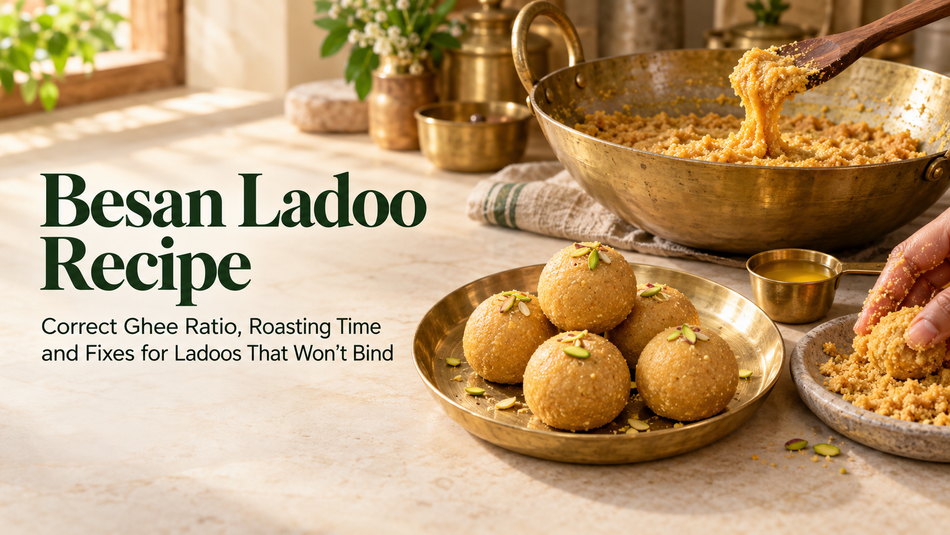
Besan ladoo needs only a few ingredients, but the result depends on three decisions: how much ghee to use, how far to roast the besan and when to add the sugar.
This guide gives you a dependable starting ratio, clear visual cues and practical fixes for mixtures that are dry, loose, sticky, raw-tasting or difficult to shape.
Starting ratio
200 g besan : 100 g ghee : 160 g boora/powdered sugar — a 2:1 besan-to-ghee ratio by weight. Roast slowly, cool to warm, then add sugar.
Quick answer
Short answer
For a dependable home batch, start with 200 g besan, 100 g ghee and 160 g boora or finely powdered sugar. That is a 2:1 besan-to-ghee ratio by weight. Roast the besan slowly until the raw smell has disappeared, the colour has deepened slightly and the mixture looks looser and smells nutty. Cool it until warm—not hot—before mixing in sugar and shaping.
What is besan ladoo?
Besan ladoo is an Indian sweet made by roasting gram flour in ghee, then mixing it with sugar and usually cardamom. The mixture is shaped into round portions after it has cooled enough to handle.
Besan is flour milled from Bengal gram or chana dal. It is not the same as flour made from whole kabuli chickpeas, although both may be labelled “chickpea flour” outside India. For the familiar ladoo flavour and texture, use fresh Indian besan.
The sweet is made across India for festivals, puja, family occasions and gifting. Recipes vary by household: some use fine besan, others use coarser ladoo besan; some add nuts or a little semolina; sweetness and ghee levels also differ. There is no single ratio that covers every flour, pan and preferred texture.
The besan, ghee and sugar ratio
The following ratio is a practical starting point for beginners:
| Ingredient | Weight | Approximate volume | Ratio to besan |
|---|---|---|---|
| Besan | 200 g | About 2 level cups | 1 |
| Ghee | 100 g | About 7 tbsp; slightly under 1/2 cup | 0.5 |
| Boora or finely powdered sugar | 160 g | About 1 heaped cup, depending on grind | 0.8 |
Weigh when you can
Use the gram measurements when possible. Besan settles in a cup, powdered sugar varies greatly by grind, and a small measuring difference can change whether the mixture binds.
Is 2:1 always the correct besan-to-ghee ratio?
No ratio is universal. Published recipes from established Indian recipe writers commonly use around 200–220 g besan with 100–125 g ghee. The useful conclusion is a range, not a magic number.
Start near 2 parts besan to 1 part ghee by weight. Keep another 10–15 g melted ghee aside for correction, but do not add it automatically. Fine besan, coarse besan, roasting loss, room temperature and the brand of flour can all change how the warm mixture behaves.
Which besan and ghee work best?
Which besan is best for ladoo?
Both fine besan and coarse ladoo besan work, but they produce different results.
| Besan type | Finished texture | What to watch |
|---|---|---|
| Fine besan | Smooth and close-textured | Can feel pasty if excess ghee is used; under-roasted flour may stick to the teeth |
| Coarse ladoo besan | Slightly grainy, traditional-style bite | Needs patient roasting so the larger particles cook evenly |
| Fine besan with a little semolina | Deliberately grainier | This is a variation, not necessary for the base recipe |
Choose besan that smells fresh and neutral before cooking. A stale, musty or rancid smell will not disappear through roasting.
Which ghee is suitable for besan ladoo?
Ghee does four practical jobs in besan ladoo:
- It transfers heat through the flour during roasting.
- It carries the roasted aroma and cardamom flavour.
- It coats the flour particles and shapes the mouthfeel.
- It firms as the ladoos cool, helping them hold their shape.
Use fresh ghee with an aroma you enjoy. Bilona ghee is one traditional option, but the word “Bilona” does not make a ladoo healthier or guarantee that the recipe will bind. The quantity, freshness and roasting technique matter more to the structure.
Gaurya Farms produces Gir Cow Bilona Ghee in Chittorgarh through a traditional Bilona ghee process—milk is set into curd, the curd is Bilona-churned to obtain butter, and the butter is slow-cooked into ghee. If you use it for this recipe, use the same measured quantity as any other ghee and adjust only after observing the mixture.
Colour and graininess alone do not prove ghee purity. If you are evaluating a jar, look for traceable sourcing, clear labelling, freshness and relevant testing rather than relying on a home trick or one visual sign.
Fresh ghee for roasting
A clean aroma in the jar becomes the aroma of the ladoo. Measure carefully, do not overpour because the ghee is premium.
Shop Gir Cow Bilona GheeIngredients
For 14–16 medium ladoos
- 200 g besan (about 2 level cups)
- 100 g ghee (about 7 tablespoons), plus up to 15 g extra only if correction is needed
- 160 g boora, tagar or finely powdered sugar (about 1 heaped cup; weigh for consistency)
- 1/2 teaspoon green cardamom powder
- 20 g cashews, almonds or pistachios, finely chopped (optional)
- 1 tablespoon raisins (optional)
Equipment
- Digital kitchen scale
- Heavy-bottomed kadai or wide frying pan, preferably 24–26 cm
- Sturdy spatula
- Sieve
- Wide plate or mixing bowl
- Measuring spoons
How to make besan ladoo
How to know when besan is roasted properly
No single cue is enough. Look for several signs together:
Stage 1
Thick and floury
The spatula leaves firm tracks and the aroma is still raw.
Stage 2
Smoother and looser
The besan becomes easier to stir as the ghee distributes and the flour cooks.
Stage 3
Aromatic and flowing
The mixture looks glossy, falls more readily from the spatula and smells distinctly roasted and nutty.
- The raw, grassy flour smell has disappeared.
- A clear roasted, nutty aroma has developed.
- The mixture is smoother and looser than it was at the start.
- The colour has deepened slightly and evenly.
- The spatula moves without revealing dry flour pockets.
- A tiny cooled taste does not feel raw or floury.
The mixture does not have to release a pool of ghee. Visible separation depends on the flour and ghee ratio. Waiting for dramatic ghee release can over-roast a leaner batch. Stop if you see dark specks, smell bitterness or notice smoke.
Common besan ladoo problems and fixes
| Problem | Likely reason | What to do now | Prevent it next time |
|---|---|---|---|
| Ladoos will not bind | Mixture is too cool, slightly short of ghee, or not compressed firmly | Warm one portion in your hands and press firmly. If the whole batch still crumbles, add warm ghee 1 teaspoon at a time | Weigh ingredients; wait before correcting; press before rolling |
| Mixture is runny or oily | It is still warm or contains too much ghee | Let it cool at room temperature. If necessary, chill briefly until shapeable | Do not judge the mixture while hot; reserve correction ghee instead of adding it upfront |
| Ladoos flatten after shaping | Mixture was shaped too warm or has excess ghee | Reshape after it firms; brief chilling can help | Let the mixture cool further before rolling |
| Besan tastes raw | Heat was too high and the outside coloured before the flour cooked, or roasting stopped too soon | If sugar has not been added, return it to low heat and continue roasting. After sugar is mixed in, the batch cannot be reliably re-roasted | Use a wide heavy pan and rely on aroma, flow and a cooled taste—not colour alone |
| Ladoos taste bitter | Besan scorched or the ghee/flour was stale | A burnt or rancid batch cannot be repaired | Stir continuously, transfer out of the hot pan promptly and check ingredients before starting |
| Mixture becomes sticky after sugar | Sugar was added while the besan was too hot, or moisture entered | Let it cool fully; it may firm. If it remains sticky, press into a lined tray and serve as pieces rather than adding raw besan | Add sugar only when the mixture is comfortably warm; keep utensils dry |
| Ladoos feel hard | Too little ghee, excess sugar, or mixture compressed after it became cold and rigid | Let one ladoo return to room temperature before judging. For a crumbly batch, work in a little warm ghee | Weigh sugar and ghee; shape while mixture is warm and pliable |
| Texture sticks to the teeth | Fine besan may be under-roasted, or sugar may have melted into the mixture | Cooling may help if sugar is the cause; under-roasting cannot be properly fixed after sugar is added | Roast completely; use fresh ladoo besan for a coarser bite; cool before sugar |
| Mixture is grainy | Coarse besan or boora naturally creates texture | No fix is needed if the flavour is clean and the ladoos bind | Choose fine besan and finely powdered sugar for a smoother result |
| Sugar can be felt as crystals | Sugar was not ground finely enough | The finished batch cannot be made fully smooth without remaking it | Use boora/tagar or grind and sieve sugar before mixing |
| Nuts fall out while shaping | Pieces are too large or mixture is too dry | Chop smaller; press the mixture firmly; add minimal correction ghee if needed | Use finely chopped, dry nuts and do not overload the mixture |
Most important repair rule
Do not add raw besan to a finished loose mixture. Raw flour will bring back an uncooked taste. Cooling is the first fix for an oily mixture. Measured warm ghee is the first fix for a genuinely dry mixture.
Why besan ladoo sometimes will not bind
A mixture that looks dry is not always short of ghee. Test these causes in order:
If the mixture bound when warm but crumbles after several hours, the ambient temperature may be low. Let a portion return to room temperature before assuming the ratio failed.
Why sugar should not be added to very hot besan
Very hot roasted besan can melt finely powdered sugar. The mixture may then turn sticky, glossy or loose instead of remaining sandy and shapeable.
Cooling to warm gives you better control. It also protects the powdered texture of boora or sugar. This is a technique choice rather than a food-safety rule: some established recipes use a hotter mixing method successfully, but that method is less forgiving for a first attempt.
Jaggery, oil and milk substitutions
Can jaggery replace sugar?
Jaggery is not always a direct one-for-one replacement. Different jaggery products contain different amounts of moisture, and warm jaggery can make the mixture softer or stickier. It also changes the flavour and colour.
Use a separately tested jaggery ladoo formula rather than replacing the 160 g sugar in this recipe blindly. Calling jaggery “healthier” would also oversimplify the choice; both are concentrated sweeteners.
Can you make besan ladoo without ghee?
The classic sweet depends on ghee for aroma, roasting behaviour and the way the mixture sets. A neutral oil may roast the flour, but it remains liquid at typical room temperatures and produces a different texture. A vegan version needs a formula tested with a suitable plant fat; it is not a simple substitution in this recipe.
Can milk be added if the mixture is dry?
Some home recipes use a small amount of milk, but milk changes both texture and storage needs. For a longer-keeping dry ladoo, correct the mixture with measured warm ghee rather than milk. If milk is added, refrigerate the ladoos and treat them as a short-life dairy sweet.
How to scale the recipe
| Batch | Besan | Ghee | Sugar | Expected yield |
|---|---|---|---|---|
| Half | 100 g | 50 g | 80 g | 7–8 ladoos |
| Base | 200 g | 100 g | 160 g | 14–16 ladoos |
| Double | 400 g | 200 g | 320 g | 28–32 ladoos |
For a double batch, use a much wider kadai or roast in two batches. Doubling the ingredient weight does not mean doubling a fixed roasting time.
Storage and gifting
Let the ladoos cool completely before packing. Store them in a clean, dry, airtight container away from heat, sunlight and moisture. Use dry hands or utensils to remove them. The same dry-storage habits that protect how ghee is stored after opening also help finished ladoos keep their aroma.
Published home-recipe guidance varies considerably—from about a week to several weeks at room temperature—because climate, hygiene, added nuts, residual moisture and packaging differ. For a cautious home-quality recommendation:
- Make a modest batch and aim to use it within 7–10 days at cool room temperature.
- Refrigerate if the kitchen is hot or humid or if you need to keep the batch longer.
- Expect refrigerated ladoos to become firmer; let them sit briefly at room temperature before serving. (Firmness here is different from the natural graininess you may see when unused ghee cools—see why ghee can look grainy.)
- Discard ladoos that develop mould, moisture droplets, a fermented smell or a rancid odour.
- If milk, khoya or another moist ingredient is added, this room-temperature guidance no longer applies.
For gifting, pack only fully cooled ladoos. Separate layers with food-safe paper and avoid leaving the box in a hot vehicle.
Estimated calories and allergens
Using 200 g besan, 100 g ghee, 160 g sugar and 20 g nuts, this batch is estimated to provide roughly 165–190 kcal per ladoo when divided into 14–16 pieces. This is a calculation, not a laboratory result. The actual value changes with ingredient brands, ladoo size and optional garnishes.
Allergens: Ghee is a milk-derived ingredient. Optional cashews, almonds and pistachios are tree nuts. Besan does not naturally contain gluten, but cross-contact can occur during milling or packing; people who need strict gluten avoidance should use appropriately certified ingredients. Ghee should not be assumed safe for a person with a milk allergy simply because it contains little milk solid.
Recipe card
Recipe card
Besan Ladoo
Gram flour roasted slowly in ghee, mixed with powdered sugar and cardamom, then shaped into ladoos. Uses a 2:1 besan-to-ghee starting ratio with measured correction guidance.
Prep
15 min
Cook
25–35 min
Shape
25–35 min
Yield
14–16 ladoos
Course
Sweet
Cuisine
Indian
Ingredients
- 200 g besan (about 2 level cups)
- 100 g ghee (about 7 tbsp), plus up to 15 g extra only if needed
- 160 g boora, tagar or finely powdered sugar
- 1/2 tsp green cardamom powder
- 20 g finely chopped nuts (optional)
- 1 tbsp raisins (optional)
Instructions
- Weigh and sieve the besan. Keep the sugar finely powdered and completely dry.
- Melt 100 g ghee gently in a heavy-bottomed wide pan over low heat.
- Add the besan and stir until no dry pockets remain.
- Roast over low to medium-low heat, stirring and scraping continuously, until the raw smell disappears, a nutty aroma develops, the colour deepens slightly and the mixture becomes smoother and looser. This commonly takes 25–35 minutes for the stated pan and batch, but use the sensory cues to decide.
- Transfer immediately to a wide plate or bowl. Mix in cardamom and optional nuts.
- Cool until comfortably warm, not hot.
- Mix in the powdered sugar in two additions.
- Rest 5–10 minutes. Press a test portion firmly. If the full batch still crumbles, add warm melted ghee 1 teaspoon at a time. If it is loose, cool it longer.
- Divide into 14–16 portions. Compress each portion, then roll it between the palms.
- Cool completely in a single layer before storing.
Notes
- Gram measurements are authoritative; cup measures are approximate.
- Do not add correction ghee until a rested test portion has been firmly pressed.
- Do not add raw besan to repair an oily mixture.
- Do not re-roast after sugar has been added.
- A double batch needs a larger pan or two separate roasting batches.
Storage
Store fully cooled ladoos in a dry airtight container. For conservative home-quality guidance, use within 7–10 days at cool room temperature or refrigerate in hot or humid conditions. Discard if moisture, mould, fermentation or rancidity appears. Any addition of milk or khoya shortens the storage window and requires separate guidance.
Allergen information
Contains milk. Contains tree nuts if optional nuts are used. For strict gluten avoidance, use certified gluten-free besan and check every packaged ingredient for cross-contact statements.
Estimated nutrition
Approximately 165–190 kcal per ladoo when the batch is divided into 14–16 pieces. This estimate is calculated from standard ingredient values and is not a laboratory analysis.
Frequently asked questions
What is the correct ghee ratio for besan ladoo?
How long should besan be roasted for ladoo?
Why are my besan ladoos not binding?
Why did my besan ladoos become flat?
Why does my besan ladoo taste raw?
Can under-roasted besan ladoo be fixed?
Why is my ladoo mixture sticky?
Should I use boora or powdered sugar?
Can I refrigerate besan ladoo mixture before shaping?
Can I use coarse besan?
Can I use whole-wheat flour instead of besan?
Can I reduce the sugar?
Why did my besan burn before it smelled roasted?
Is Bilona ghee necessary for besan ladoo?
How can I make ladoos of equal size?
How should besan ladoo be stored?
Final takeaway
Successful besan ladoo is less about following one exact roasting minute and more about controlling the mixture at each stage. Remember these three points:
Ratio
Start near a 2:1 besan-to-ghee ratio by weight.
Roast
Go slowly until smell, colour and flow all show the raw flour has cooked.
Sugar timing
Add sugar only after the mixture has cooled from hot to comfortably warm.
If the mixture looks wrong, diagnose temperature before changing the ingredient ratio. Cooling fixes many loose batches; firm hand pressure and a teaspoon of warm ghee fix many dry ones.
Keep reading
Related
What Is Bilona Ghee?
The curd → butter → ghee route behind traditional Bilona ghee.
Related
How to Store Desi Ghee
Keep opened ghee dry, covered and away from stove heat.
Related
Vanaspati vs Desi Ghee
Why dairy ghee and vanaspati are not interchangeable in sweets.
Related
How to Identify Pure Cow Ghee
Label, sourcing and testing cues that matter more than colour.