100% Pure Ghee Made Only From Gir Cow Milk
 Every Batch Independently Lab-Tested for Purity
 Free Shipping Available Across India
 Crafted Using the Traditional Bilona Method
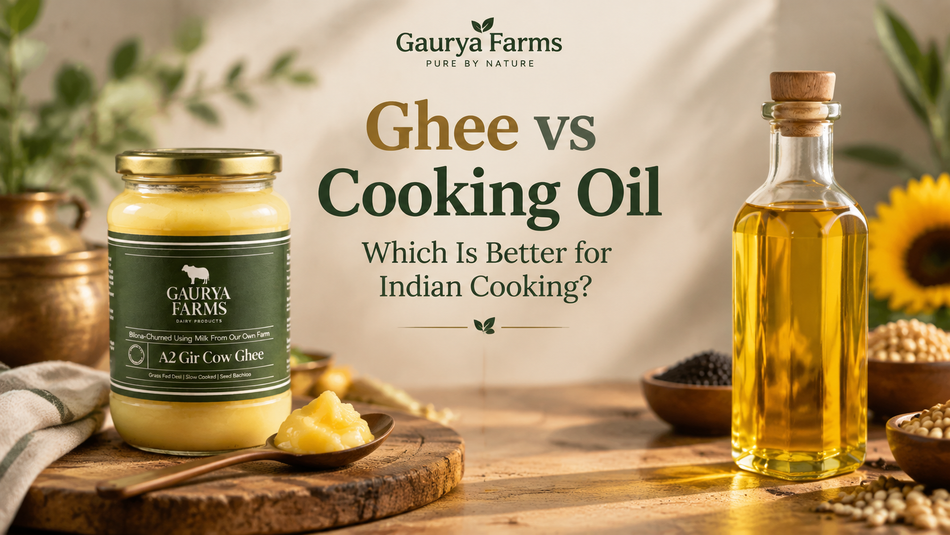
Neither ghee nor cooking oil is universally better. They are both fats. They both add about 9 calories per gram. The useful difference is not “healthy versus unhealthy.” It is source, flavour, heat behaviour, cost and the dish in front of you.
Short answer
Use ghee where aroma matters: tadka, dal, roti, paratha, khichdi, sweets and finishing. Use a suitable oil where volume, neutrality or regional flavour matters: deep frying, large sauté batches, pickles and many everyday curries.
Count both towards the same daily fat limit. The honest question is not “Should I cook only in ghee?” It is “Which fat does this recipe need, and how much of it do I actually need?”
Why people compare ghee and oil
This is not a new debate. Indian homes have always used more than one fat.
A Rajasthani kitchen may keep ghee for dal baati, aate ka halwa and finishing roti, and mustard or groundnut oil for everyday sabzi. A Tamil or Kerala kitchen may keep coconut or sesame oil for regional dishes and still use ghee in payasam, pongal or a spoon on rice. A sweet shop may fry in oil or vanaspati for cost, then finish a premium batch with ghee for aroma.
Search results often flatten this into a slogan: “ghee is traditional and better” or “oil is lighter and healthier.” Both slogans skip the kitchen.
People are usually asking one of these questions:
- Which fat should I use for tadka?
- Can I deep-fry in ghee?
- Is ghee healthier than sunflower or mustard oil?
- Why does ghee cost so much more?
- Should I switch my whole kitchen to ghee?
- How much ghee is reasonable in a day?
This article answers those questions as cooking decisions, not as a contest between two miracle foods.
What is ghee?
Ghee is clarified milk fat. Butter or makkhan is heated until water evaporates and milk solids separate. The remaining golden fat is strained and stored.
Traditional Bilona ghee follows a longer route: milk is set into curd, the curd is churned into cultured butter, and that butter is slow-cooked into ghee. Commercial ghee is often made from cream-separated butter. Both can legally be ghee if they are milk fat. They are not the same product in flavour, process or cost. The process difference is explained in Bilona ghee vs regular ghee.
Because most water and milk solids are removed, well-made ghee:
- is almost entirely fat
- has very little lactose and protein
- keeps longer than butter at room temperature when stored clean and dry
- browns spices quickly and carries aroma into dal, rice and sweets
Ghee is not vegetable fat. If a product is made from refined oils, it is not ghee. That distinction belongs to vanaspati vs desi ghee.
What is cooking oil?
Cooking oil is fat extracted from seeds, nuts or fruit. In Indian kitchens the common ones are:
| Oil | Typical kitchen role |
|---|---|
| Mustard | Pungent North and East Indian cooking, pickles, some frying |
| Groundnut | Neutral-to-nutty everyday cooking and frying |
| Sesame / gingelly | South Indian tadka, chutneys, some sweets |
| Coconut | Kerala, coastal and many South Indian dishes |
| Sunflower, soybean, rice bran | Neutral refined oils used for volume cooking and frying |
| Olive | Low-to-medium heat, salads, some modern home cooking |
The same crop can be sold as cold-pressed or refined. That changes flavour and heat tolerance more than the label “oil” suggests. Cold-pressed groundnut oil is not interchangeable with refined groundnut oil for a long deep-fry.
Oil is not automatically “lighter” than ghee. A tablespoon of oil and a tablespoon of ghee are both concentrated fat. Oil is often used in larger amounts because it is cheaper and because frying needs volume.
Ghee vs cooking oil at a glance
| Factor | Ghee | Cooking oil |
|---|---|---|
| Source | Milk fat from cow, buffalo or mixed milk | Plant seeds, nuts or fruit |
| Flavour | Dairy, nutty, cooked-butter aroma | Ranges from pungent (mustard) to almost neutral (refined sunflower) |
| Texture at room temperature | Soft, grainy or liquid depending on weather | Usually liquid; coconut oil can be solid in cooler rooms |
| Typical calories | About 876 kcal per 100 g; about 112 kcal per 13 g tablespoon | About 880–900 kcal per 100 g; similar calories per spoon |
| Saturated fat | High | Varies: coconut high; mustard, groundnut and olive lower; sunflower often high in omega-6 PUFA |
| Essential fatty acids | Not a meaningful source of linoleic or alpha-linolenic acid | Some oils supply PUFA the body cannot make |
| Smoke point | Often around 230–250°C, depending on moisture and filtration | Wide range: cold-pressed oils can be much lower than refined versions |
| Best everyday use | Tadka, finishing, roti, sweets, flavour-led sauté | Volume cooking, deep frying, regional flavour, budget meals |
| Cost per spoon | Higher | Usually much lower |
| Cultural and ritual use | Common in puja, panchamrit and traditional sweets | Rarely used as a ritual dairy fat |
| Shelf life | Long when dry, clean and protected from heat and light | Varies; opened refined oils oxidise; do not keep used frying oil for long |
The table is a starting point. The next section is the one most generic articles skip.
Which fat for which Indian dish?
Use the dish, not the slogan.
| Dish or task | Better everyday choice | Why | Typical amount |
|---|---|---|---|
| Dal tadka | Ghee, or ghee plus a little oil | Aroma is the point of tadka. One teaspoon of ghee is usually enough | 1 teaspoon ghee |
| Jeera or mustard-seed tadka | Ghee, mustard oil or sesame oil | Match the regional flavour. Ghee is the more neutral dairy option | 1 teaspoon |
| Roti, phulka, bajra roti | Ghee | A thin smear changes flavour more than the same amount of oil | 1/2 teaspoon |
| Paratha, thepla, stuffed paratha | Ghee if flavour matters; oil if you are cooking a stack | Ghee browns the layers and adds aroma; oil is cheaper for many pieces | 1–2 teaspoons per paratha |
| Khichdi, pongal, ghee rice | Ghee | The fat is part of the dish, not only a cooking medium | 1 teaspoon to 1 tablespoon |
| Everyday sabzi | Oil, with optional ghee finish | Volume sauté does not need premium milk fat | 1–2 teaspoons oil, optional 1/2 teaspoon ghee at the end |
| Dosa, uttapam | Oil or ghee on the tawa | Ghee gives a richer crust; oil is the usual everyday choice | 1/2–1 teaspoon |
| Deep-fried puri, pakora, samosa, vada | Suitable high-heat oil | You need volume. Ghee works thermally but is expensive and easy to overheat across batches | 200–400 ml oil for a household batch |
| Shallow-fried cutlet or tawa fry | Oil, or a mix | A mix can add flavour without using a full kadai of ghee | 2–3 tablespoons |
| Besan ladoo, aate ka halwa, mohanthal | Ghee | These recipes depend on ghee aroma and roasted-flour flavour | Recipe-dependent; often 50–100 g+ |
| Commercial bakery or bulk sweets | Oil or vanaspati in many kitchens | Cost and consistency, not tradition | Large volume |
| Pickles | Mustard, sesame or other specified oil | Ghee is not the usual pickle medium | As the recipe requires |
| Baking cakes or cookies | Oil or butter, sometimes ghee | Ghee works in some bakes but changes flavour and texture | Recipe-dependent |
| Salad or finishing drizzle | Extra virgin olive oil, or a small spoon of ghee on hot food | Cold extra virgin olive oil is not a tadka fat. Ghee is not a salad oil | 1 teaspoon |
| Puja, panchamrit, havan | Ghee | The requirement is dairy ghee, not a plant oil | Small measured amount |
Household rule
If the fat is the flavour, choose ghee. If the fat is only the heat-transfer medium, choose a suitable oil. That is why a spoon of ghee on dal is a different decision from a kadai of fat for twenty pakoras.
Ghee smoke point: can you use ghee for frying?
Yes, you can cook with ghee at high heat. That does not mean every frying job should be done in ghee.
Smoke point is the temperature at which a fat begins to produce visible smoke and break down. Published figures for ghee are commonly around 230–250°C. Butter is much lower, often around 150–175°C, because it still contains water and milk solids.
Typical Indian cooking temperatures sit below those ghee figures:
- tadka: roughly 150–180°C
- tawa sauté and shallow fry: roughly 150–180°C
- deep frying: roughly 170–190°C
So ghee can handle tadka, sautéing and a controlled fry. The limits are different:
- Smoke point is a range, not a guarantee. Moisture, free fatty acids, filtration, age and previous heating all change it. Homemade ghee with leftover moisture can smoke earlier than a well-clarified batch.
- A high smoke point is not a licence for repeated frying. Heat, oxygen, moisture and food crumbs still oxidise the fat. ICMR–NIN advises against repeatedly heating cooking oils. The same caution applies to ghee used as a frying medium.
- Cold-pressed oils can smoke earlier than their refined versions. Refined groundnut or sunflower oil is a more realistic deep-fry medium than cold-pressed groundnut oil.
- Cost and flavour transfer matter. Ghee used for pakoras will pick up masala and crumbs. You will not want that fat back in the original jar.
If you do fry in ghee, keep the batch small, keep the temperature below smoking, strain food particles, and do not treat the leftover fat as fresh ghee. For the keep-or-discard decision, use Can you reuse ghee after frying?.
Ghee vs mustard, groundnut, sunflower, coconut and olive oil
These are the comparisons people actually type after “ghee vs oil.”
Ghee vs mustard oil
Mustard oil is a cooking fat with its own flavour, not a ghee substitute. It is a common choice in Bengal, Bihar, Jharkhand, parts of Punjab and many pickle recipes. It generally tolerates high heat well.
Use mustard oil when the dish should taste of mustard. Use ghee when you want dairy aroma without pungency. Many kitchens keep both.
Ghee vs groundnut oil
Refined groundnut oil is one of the more practical Indian frying oils: relatively high heat tolerance, mild nutty taste, lower cost. Cold-pressed groundnut oil is better for medium-heat cooking than for a long deep-fry.
Ghee wins on aroma in tadka and sweets. Groundnut oil wins when you need a kadai of fat.
Ghee vs sunflower, soybean or rice bran oil
These refined oils are usually chosen for neutrality and price. They can be reasonable for high-volume frying. They are not equivalent to ghee in flavour.
Sunflower oil is often high in omega-6 polyunsaturated fat. That is one reason ICMR–NIN recommends using a variety of fat sources and moderating high n-6 oils, rather than making one refined oil the only fat in the house.
Rice bran oil is frequently marketed for frying. Treat the marketing as a heat-performance claim, not a health certificate.
Ghee vs coconut oil
Both are relatively high in saturated fat. Coconut oil is a plant fat with a distinct aroma used in many South Indian and coastal dishes. Ghee is dairy fat with a different flavour. Coconut oil can be solid in a cooler kitchen, just as ghee can be grainy or firm. Texture is not proof of purity in either case.
Ghee vs olive oil
Extra virgin olive oil is a poor substitute for Indian tadka. Its flavour is not the flavour of dal tadka, and many extra virgin oils are better below high Indian frying temperatures.
Refined or light olive oil can tolerate more heat, but it still will not give ghee’s cooked-butter aroma. Olive oil belongs in salads, low-to-medium sautéing and some modern recipes. It does not replace ghee in ladoo or halwa.
Calories, saturated fat and daily amount
This is where many articles over-claim.
Calories are similar
USDA data for anhydrous butter oil, the standard reference entry used for ghee, list about 876 calories and 99.5 g fat per 100 g. A 13 g tablespoon is about 112 calories and 7.9 g saturated fat.
Cooking oils are also almost pure fat. Switching from oil to ghee, or ghee to oil, does not automatically reduce calories. The spoon size does.
| Amount | Approx calories from ghee | Kitchen meaning |
|---|---|---|
| 1/2 teaspoon, about 2.5 g | About 22 | Thin smear on one roti |
| 1 teaspoon, about 5 g | About 44 | One dal tadka or a finishing spoon |
| 1 tablespoon, about 13 g | About 112 | Generous cooking portion or a rich rice dish |
| 100 g | About 876 | A ladoo or halwa recipe can use this much or more |
If weight is the concern, the comparison is not ghee versus oil. It is measured fat versus “and then some more.” That is covered in is ghee good for weight loss.
Fat quality is different
Ghee is high in saturated fat. WHO recommends that adults and children keep saturated fat to 10% of total energy or less, and notes that ghee, butter, lard, palm oil and coconut oil are saturated-fat-rich hard fats.
ICMR–NIN’s 2024 Dietary Guidelines for Indians say:
- use oils and fats in moderation
- restrict cooking oils to about 25–30 g per day in the context of a balanced adult diet, with about 27 g fats and oils shown in a 2,000 kcal example
- limit high-saturated-fat fats such as ghee and butter
- avoid vanaspati and other partially hydrogenated fats
- do not reheat and reuse leftover heated oils
- get essential fatty acids from a variety of nuts, oilseeds, legumes and whole grains, not from one cooking fat alone
Ghee can supply fat-soluble vitamins in small amounts and a characteristic flavour. It is not a meaningful source of the essential polyunsaturated fats the guidelines want in the wider diet.
Balanced conclusion
Ghee is a traditional cooking fat to use in measured amounts. It is not a health upgrade that cancels the need for vegetables, pulses, nuts and variety in oils. People with high LDL cholesterol, heart disease, diabetes or medical advice to limit saturated fat should treat ghee as a flavour fat, not a default frying medium, and should take personalised advice from a qualified clinician or dietitian.
How much ghee or oil should you use in a day?
There is no single medical dose of ghee. A practical pattern for a healthy adult cooking Indian food:
- Keep total visible fat — ghee plus oil plus butter — near the guideline range unless a clinician has given different advice.
- Use 1 teaspoon of ghee where it changes the dish.
- Use oil for the volume work.
- Do not add a tablespoon of ghee on top of an already oily curry and call it “only one spoon.”
- Festival sweets are an exception day, not a daily template.
Example of a measured day that still tastes like an Indian kitchen:
- morning: 1/2 teaspoon ghee on roti or in upma
- lunch: 1 teaspoon oil in sabzi + 1 teaspoon ghee tadka on dal
- dinner: 1 teaspoon oil for cooking + optional 1/2 teaspoon ghee on khichdi
That is roughly 4 teaspoons of visible fat, about 20 g, before any fried snack. A pakora evening or a ladoo batch changes the arithmetic immediately. Homemade ghee from collected malai is still the same calorie-dense fat. The method is different from Bilona, and the yield is not a health advantage. See how to make ghee from malai.
Why ghee costs more than cooking oil
This is a kitchen-economics question, not a purity slogan.
Ghee starts as milk. A large quantity of milk becomes a small quantity of fat. Traditional Bilona adds curd setting, churning, butter collection and slow cooking. Plant oils are pressed or refined from oilseeds at industrial scale.
A simple cost comparison, using rounded market ranges rather than one brand’s sale price:
| Fat | Illustrative price | Cost of 1 teaspoon (5 g / about 5 ml) | Cost of a 300 ml deep-fry |
|---|---|---|---|
| Premium cow Bilona ghee | ₹2,000–₹3,500 per kg | About ₹10–₹18 | About ₹600–₹1,050 |
| Commodity dairy ghee | ₹500–₹900 per kg | About ₹2.50–₹4.50 | About ₹150–₹270 |
| Refined cooking oil | ₹150–₹250 per litre | About ₹0.75–₹1.25 | About ₹45–₹75 |
The numbers will move with the market. The pattern will not.
A teaspoon of good ghee in tadka is a small extra cost for a large flavour change. A kadai of the same ghee for pakoras is an expensive way to heat potatoes. Price also does not prove purity. Very cheap “Bilona” or “A2” ghee should make you read the label more carefully, not assume a bargain. Use how to identify pure cow ghee for that check.
Can you replace oil completely with ghee?
You can cook many Indian dishes in ghee. Most households should not make ghee the only fat.
Keep oil for
Deep frying, regional mustard/coconut/sesame recipes, essential fatty-acid variety, budget cooking and medical advice to limit saturated fat.
Keep ghee for
Tadka and finishing, traditional sweets, roti and khichdi, ritual use, and flavour a neutral refined oil cannot copy.
Mixing fats
Cook in oil and finish with ghee when that is the point. Do not mix leftover frying oil back into a jar of fresh ghee.
A mixed-fat kitchen is not indecision. It is how Indian cooking actually works.
Storage, leftovers and kitchen hygiene
Fresh ghee and fresh oil keep differently. Used frying fat is a third category.
- Store ghee in a clean, dry jar, away from steam and sunlight, with a dry spoon. Details: how to store desi ghee.
- Grainy or solid ghee in winter is usually crystallised fat, not spoilage.
- Do not pour used frying ghee or oil back into the original bottle.
- Strain once-used fat only if you will use it promptly in a non-frying dish, and discard it if it smoked, turned dark, foamed or smells rancid.
- Do not pour discarded fat down the drain.
How Gaurya Farms fits this decision
Gaurya Farms makes A2 Gir cow Bilona ghee in Chittorgarh, Rajasthan, from milk taken through a curd-based process: milk → curd → churned makkhan → slow-cooked ghee.
That process is the reason to choose this ghee for flavour-led cooking. It is not a reason to deep-fry every snack in it, and it is not a medical claim.
Use Gaurya Farms ghee where a small amount is noticeable:
- dal and tadka
- roti and bajra roti
- khichdi and ghee rice
- besan ladoo, halwa and other ghee-dependent sweets
- finishing a sabzi that was cooked in oil
For a large fry, a suitable cooking oil is the more sensible fat. The farm’s job is to make the ghee traceable and honestly produced. The cook’s job is to decide how much of any fat the meal needs.
Key takeaway
Ghee and cooking oil are not rivals. They are different fats for different jobs.
Ghee is milk fat with a high smoke point and a strong aroma. Oil is plant fat with many regional identities and a lower cost for volume cooking. Calories are similar. Saturated fat is higher in ghee. Essential fatty acids are more available from a varied plant-fat diet than from ghee alone.
Cook with ghee when the fat is part of the taste. Cook with oil when the fat is mostly the medium. Measure both. Do not reheat the same frying fat again and again. Do not treat a premium jar as proof that every other fat in the kitchen is a mistake.
Frequently asked questions
Is ghee better than oil for Indian cooking?
Is ghee healthier than cooking oil?
Can I use ghee for deep frying?
What is the smoke point of ghee?
Ghee or oil: which is better for weight loss?
How much ghee should I eat per day?
Is mustard oil better than ghee?
Is olive oil better than ghee?
Can lactose-intolerant people use ghee instead of oil?
Why is ghee more expensive than oil?
Can I mix ghee and oil in the same recipe?
Does Bilona ghee behave differently from oil than regular ghee does?
Is vanaspati a cooking oil or a ghee?
Which oil is best if I only keep one oil plus ghee?